
E-E-A-T Content Strategy: The Framework That Separates Real Authority From Surface-Level SEO
ⓘ TL;DR
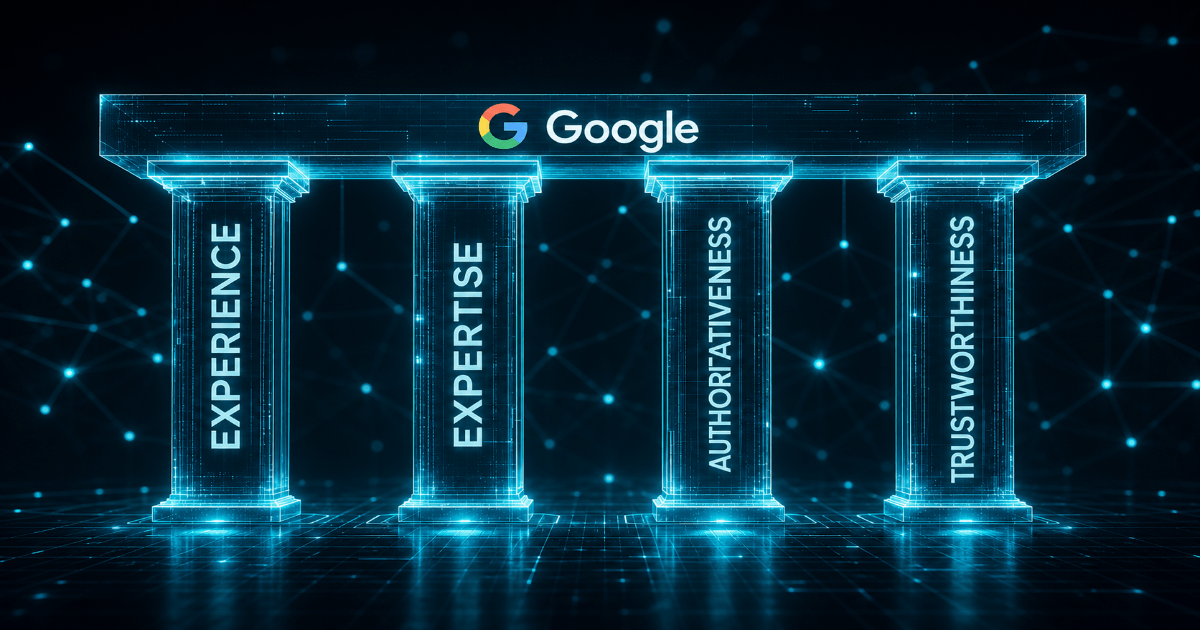
- An E-E-A-T content strategy is not a checklist. It is a system where experience, expertise, authority, and trust create tension with each other. Getting one right while ignoring the others still fails the quality rater test.
- E-E-A-T is not a ranking factor. It trains Google’s automated systems through human rater feedback. Performative fixes like adding author bios without substance move nothing.
- A quality rater spends two minutes per page. A missing author bio drops you from High to Lacking instantly. Build verifiable signals before rankings drop, not after.
- Formal credentials are not required. Specificity is. One paragraph about when a strategy failed and what you learned proves experience better than a certification list.
- Trust is the one component that compounds and the one that collapses fastest. A single inaccurate claim undoes months of credibility building.
A content director stares at a SERP analysis showing their article ranks on page four. The piece has an author bio, cited sources, and a clean URL structure. None of it matters. Most E-E-A-T advice treats the framework as a checklist. This misses the structural reality of how these components interact.
Experience, expertise, authoritativeness, and trust do not stack neatly. They create tension with each other. A personal health blog with firsthand experience lacks formal expertise. A credentialed medical writer without patient stories lacks lived perspective. The real competitive advantage comes from understanding these trade-offs.
This article shows how to build an E-E-A-T content strategy that treats the framework as a strategic system. You will learn where each component conflicts, how quality raters evaluate your pages, and the steps to demonstrate credibility when formal credentials are absent. The goal is to make the right trade-offs for your specific content context.
Why E-E-A-T Content Strategy Is Not a Ranking Factor
E-E-A-T is not a ranking factor. It is a quality framework that Google’s human quality raters use to assess whether content meets a standard worth surfacing. Ranking factors are algorithmic signals like backlinks and keyword usage. E-E-A-T is a set of guidelines for human evaluators that indirectly shapes algorithm updates.
This distinction matters because most content teams treat E-E-A-T as a checklist of signals to optimize. They add author bios, cite sources, and clean up URLs, then wonder why rankings do not move. The framework does not feed directly into any algorithm. It feeds into the Google Search Quality Rater Guidelines, which train raters to flag low-quality content. Google then uses those flagged patterns to train its automated systems.
Treating E-E-A-T as a direct ranking signal leads to performative fixes that produce no measurable ranking change. The real comes from understanding that the framework is a proxy for content quality. Google wants its algorithms to reward the same things raters reward. The goal is not to satisfy raters. The goal is to build content that algorithms learn to trust because it consistently matches what raters call high quality.
A content director staring at page four rankings does not need more author bios. The fix is to audit content against the actual rater criteria, accuracy, transparency, firsthand experience, and close the gaps that make algorithms uncertain.
Compare two approaches. A health site adds author credentials to every page. Another site removes every claim that lacks a primary source and restructures its content around clinical accuracy rather than keyword density. The second approach moves rankings. The first does not.
The Four Components and the Tension Between Them
Most guides treat E-E-A-T as four separate boxes to check. The real work lives in the friction between them.
Experience and expertise do not always align. A blogger with a decade of personal health management shares firsthand accounts. That same blogger lacks formal medical training that signals specialized knowledge through formal qualifications. Google’s framework values both, but the tension surfaces when a reader needs treatment advice, not a personal story.
Experience: The Weight of Firsthand Accounts
Experience means you have done the thing. It is the product review from someone who actually used the software, not the affiliate marketer who read the spec sheet. Experience creates authenticity that expertise alone cannot manufacture.
The tension appears when experience contradicts established knowledge. A founder who scaled a startup on a non-standard growth tactic has real experience. Publishing that tactic as general advice without acknowledging its risks creates a trust gap.
Expertise: The Credential That Cuts Both Ways
Expertise is formal knowledge. Degrees, certifications, published research. It signals that the author has passed someone else’s quality bar. For YMYL topics, expertise is non-negotiable.
But expertise without experience reads as sterile. A financial advisor with a CFP designation who has never managed a client through a recession writes advice that lacks practical weight. The best content bridges both, but most content teams pick one and miss the other.
Authoritativeness: What Others Say About You
Authority is external. It is measured by who links to your content, who cites your work, and whether recognized institutions reference your name. You cannot declare yourself authoritative. Others must grant it.
The tension is that authority takes time. A new site with strong experience and expertise will struggle to rank against an established competitor whose authority is based on old content. The strategy must account for this lag.
Trust: The Component That Holds Everything Together
Trust is the cumulative result of the other three components working correctly. It is built through consistent accuracy, transparent sourcing, and a track record of not misleading readers.
Trust is also the easiest to lose. One inaccurate claim in a high-authority article erodes trust faster than any single signal can rebuild it. This is why E-E-A-T content strategy must prioritize accuracy over speed in every editorial decision.
How Google Quality Raters Evaluate Your Content
The people judging your content are not algorithms. They are trained contractors following a 168-page document called the Search Quality Rater Guidelines.
These raters assess pages against four rating levels: Lowest, Lacking, High, and Very High. A page at Lowest fails to meet the user’s needs entirely. A page at Lacking has some useful information but falls short on demonstrating E-E-A-T signals. High pages serve their purpose well. Very High pages are the gold standard, authoritative, trustworthy, and clearly created by someone with demonstrated experience or expertise.
A rater spends roughly two minutes per page. In that time, they scan for author credentials, source quality, site reputation, and whether the content matches the stated purpose of the page. A missing author bio drops a page from High to Lacking instantly. A cited statistic without a source does the same.
The rating levels create a hierarchy that most content never escapes. A page rated Lacking by enough raters signals to Google’s systems that similar content should rank lower. The fix is not more keywords. It is proving the page deserves a higher rating. This evaluation process is why surface-level fixes fail. Raters are trained to spot the difference between a page that looks authoritative and one that actually is.
Take a medical advice page. A rater sees a byline from a practicing cardiologist with hospital affiliations and a linked author page. That page starts at High before the rater reads a word.. A page on the same topic with no author attribution starts at Lacking.
The gap between these two outcomes has nothing to do with writing quality. It is entirely about signals the rater can verify in seconds. Build those signals before the rater arrives.
The Content Strategy Shift: From Keywords to Credibility
The standard keyword-first approach builds content around search volume and ranking difficulty. It treats every page as a landing pad for a specific query. The E-E-A-T-driven alternative starts with a different question: what does a reader need to trust this information?
Keyword-first strategy works well for informational queries where the searcher wants a quick definition or a list. The content is efficient, scannable, and easy to produce at scale. But it collapses when the topic carries stakes, health advice, financial guidance, legal interpretation, because the reader needs more than the right phrase match.
Credibility-first strategy demands different research entirely. Instead of analyzing keyword gaps, teams study what top-ranking pages do to earn trust: author credentials, cited sources, original data, transparent methodology. The content formats shift too. A keyword-first brief produces a listicle. A credibility-first brief produces a detailed guide with case studies, expert quotes, and process walkthroughs that demonstrate real experience.
The difference shows in the promotion phase as well. Keyword-first content relies on link building and on-page optimization. Credibility-first content earns backlinks naturally because it contains original insights or primary research that other sites want to reference. The WryveAI SERP analysis tool surfaces exactly what top-ranking pages are doing for credibility, not just their keywords, but their author bios, source patterns, and content depth.
The strongest approach combines SEO precision with E-E-A-T principles to create content that connects with real people while performing strongly in search. Keyword research identifies the opportunity. Credibility strategy determines whether the content earns the ranking.
The shift changes how content teams allocate resources too. A team that spends 70% of its time on keyword research and 30% on content depth has the ratio exactly backwards for high-stakes topics. Flipping that split changes the quality of what gets published.
Demonstrating Experience When You Lack Formal Credentials
Formal credentials are not the only path through Google’s quality framework. A blogger who has spent a decade managing a chronic condition can write about it with more practical weight than a doctor who has never lived it.
Case studies and detailed process walkthroughs carry the same weight as a degree when they show real outcomes. A step-by-step account of how you solved a specific problem, complete with what went wrong and how you adjusted, proves experience more effectively than a generic author bio. This is the human editing requirement for E-E-A-T that most automation tools ignore.
WryveAI structures content around these lived details. Its content briefs surface the specific angles and process steps that top-ranking pages use to demonstrate firsthand knowledge.
The gap competitors barely cover is the willingness to be specific about what actually happened. Vague claims about “years of experience” mean nothing to a quality rater. A paragraph describing the exact moment a strategy failed and what you learned from it carries more weight than a list of certifications. The Aspectus Group’s EEAT implementation strategies reinforce this point, real-world application beats academic qualification for topics where lived experience matters most.
This shifts the burden from what you cannot prove to what you can. Every content creator has some form of direct experience worth surfacing. The question is whether the content structure allows it to show.
Consider a travel blogger who spent six months backpacking through Southeast Asia on a tight budget. That writer can describe the exact negotiation tactics for a Bangkok market stall, the specific bus route that saves three hours, and the guesthouse that looks good online but floods during monsoon season. No amount of research can replicate that texture.
Why Most E-E-A-T Advice Misses the Trust Component
Trust holds the other three together, yet receives the least strategic attention. Most guides treat trust as a byproduct of good author bios and a privacy policy page. That misses the operational reality. Trust comes from accuracy, transparency, and consistency across every page. A single inaccurate claim erodes trust faster than any author bio can rebuild it.
Accuracy Requires a Sourcing Standard
Every factual claim needs a verifiable source. Not a link for SEO, a link that lets a reader confirm the claim. Google’s helpful content guidance makes this clear: systems prioritize information created to benefit people.
Build a sourcing policy requiring primary sources for statistics, peer-reviewed studies for health claims, and dated references. Content that cannot be verified within two clicks is content that will eventually lose trust.
Transparency Means Showing the Process
Readers and quality raters need to understand how content was created. An author page should name the writer, their credentials, and their relationship to the topic. A contributor page should explain how subject matter experts were involved. This is where most sites fail. A name without credentials is a signal of nothing.
Consistency Creates the Track Record
A single well-researched article does not build trust. A consistent publishing record over months and years does. Google’s systems evaluate patterns, not individual pages.
Publish on a regular cadence. Update older content. Remove or redirect pages with outdated claims. An archive of abandoned, stale content is the fastest way to signal that your site cannot be trusted.
This is the deeper work that most E-E-A-T content strategy advice ignores. Author bios are table stakes. The real competitive advantage comes from building a site where every page reinforces the credibility of every other page.
Building an E-E-A-T Content Strategy That Scales
Scaling an E-E-A-T content strategy without a repeatable process guarantees inconsistency. The teams that succeed treat it as a system, not a one-time audit.
Step 1. Audit every existing page for the four components. Look for missing author credentials, unsourced claims, and content that reads like a generic rewrite. Skip this step and you will scale mediocrity, more pages with the same gaps.
Step 2. Map content gaps where firsthand experience or formal expertise is absent. A personal finance blog without a single tax-season walkthrough lacks the experience component entirely. Tools like WryveAI’s SERP analysis surface exactly what top-ranking pages do that yours do not.
Step 3. Develop author profiles that match the content’s demands. A single byline cannot cover every topic. Assign writers based on demonstrated experience, not job titles.
Step 4. Create content that demonstrates each component deliberately. A how-to guide should include a specific failure the author encountered and how they resolved it. This is where an SEO content brief framework ensures every piece hits the right notes before a single word is drafted.
Step 5. Build a linking strategy that reinforces authority. Link to your strongest, most credentialed pages from newer content. Link out to established sources like Google’s own E-E-A-T guidance where it strengthens your claims. A page that links to no one signals isolation, not authority.
Completing this process transforms a content library from a collection of pages into a credibility system. Each piece reinforces the others, and the whole becomes harder to displace than any single article.
What Real E-E-A-T Depth Unlocks for Your Content
An E-E-A-T content strategy built on trade-offs rather than checklists changes what your content can do. It stops being a compliance exercise and becomes a competitive advantage that compounds over time.
Content that earns a Very High rating from quality raters does not just rank. It attracts backlinks naturally, reduces bounce rates, and converts readers who arrive skeptical. The sites that treat E-E-A-T as a system rather than a checklist are the ones that hold rankings when competitors fade. Audit your current content library against the four components. Find the weakest link and fix it first. That single move will change how everything else performs.
Every claim in this article was checked against a real source before it was published.
WryveAI researches live search results, writes source-verified content, and publishes straight to WordPress, all in one platform.
Try WryveAI Free →No credit card required.
Frequently Asked Questions About E-E-A-T Content Strategy
What is an E-E-A-T strategy?
An E-E-A-T content strategy is a systematic approach to creating content that demonstrates experience, expertise, authoritativeness, and trustworthiness for Google’s quality raters. It moves beyond keyword targeting to build a cumulative credibility case across every page on your site, making each piece of content harder for competitors to displace.
What are the 5 pillars of content strategy?
The five pillars of content strategy are audience definition, content creation, distribution, governance, and performance measurement. An E-E-A-T-driven approach adds a sixth pillar: credibility verification, which ensures every piece of content passes the quality rater test before publication.
What are the principles of E-E-A-T content?
The core principles of E-E-A-T content are firsthand experience, formal or demonstrated expertise, recognized authority within a field, and verifiable trust signals across the entire site. Content that balances these four components against each other, rather than treating them as separate checkboxes, earns the highest quality ratings from Google’s evaluators.
Is SEO dead or evolving in 2026?
SEO is not dead in 2026, but it has evolved into a discipline where credibility signals matter more than traditional optimization tactics. The shift means that an E-E-A-T content strategy now determines long-term ranking stability, while keyword placement and meta tags serve as supporting infrastructure rather than primary drivers.


