
Paragraph Rewriter: How to Rewrite a Paragraph Without Losing Meaning
ℹ️ TL;DR
- A paragraph rewriter should act as an editorial tool, not a synonym swapper. Swapping words blindly destroys tone, cadence, and original intent.
- A paragraph is a unit of thought. Effective rewriting restructures sentence logic and emphasis while preserving the core meaning underneath.
- Follow a 5-step process: understand the core point, define audience tone, write a fresh draft from memory, compare against source for nuance drift, and read aloud for flow.
- Paraphrasing updates surface phrasing, whereas rewriting re-architects sentence flow and logic. Changing vocabulary on someone else’s work without attribution is still plagiarism.
- Treat AI rewriter output as a raw first draft. Inject your natural voice, check for factual drift, and refine rhythm before publishing.
Writers paste a finished paragraph into a rewriting tool and get back something that reads like a robot swallowed a thesaurus. The words changed. The meaning drifted. The voice vanished. That is the failure mode of most paragraph rewriter use: word substitution presented as improvement.
The smarter approach treats rewriting as an editorial act, not a mechanical one. A paragraph is a unit of thought with its own rhythm and emphasis. Swapping synonyms ignores all of that. The real task is to rebuild the paragraph so it reads cleaner and lands harder while protecting the original intent.
This article combines a repeatable rewriting process with AI paragraph rewriter tools used correctly. You will learn to define a paragraph’s core point before touching a single word, and you will learn how to make AI output sound like you instead of software. By the end, you will rewrite any paragraph with confidence, knowing the meaning survived the edit.
Why Most Paragraph Rewrites Fail
The instinct to swap words is the problem. Most people treat a paragraph rewriter as a synonym machine, and the output reads like generic AI content that lost the original point somewhere between the thesaurus and the paste.
A paragraph is a unit of thought, not a collection of interchangeable words. Change the vocabulary without understanding the logic that binds the sentences, and the meaning shifts in ways you will not notice until someone else reads it and asks what you meant. The structure carries emphasis. The rhythm carries tone. Strip those away and you have text that is technically accurate and completely dead.
Word substitution introduces subtle errors. A synonym that fits one context sounds wrong in another, and the sentence flow breaks when the replacement carries different connotations than the original. The result is robotic prose that reads like a machine assembled it from spare parts. That is not rewriting. That is damage.
The real goal of any rewrite paragraph task is to produce text that reads as if a skilled editor improved it. A skilled editor does not reach for synonyms. They tighten the logic, sharpen the focus, and cut what does not serve the core idea. The weak approach preserves the surface and destroys the substance. The strong approach preserves the substance and rebuilds the surface.
Preserving the core idea while enhancing readability is the standard that separates useful rewriting from busywork. Most tools and most writers never reach that standard because they start with the sentences instead of the thought underneath them. That gap is where every failed rewrite begins.
Watch what happens when someone pastes a dense academic abstract into a basic rewriter and asks for a “more engaging” version. The tool swaps utilize for use, demonstrate for show, and calls it done. The argument’s scaffolding, the part that actually made the abstract rigorous, never gets touched.
That is why the output fails. The reader does not bounce because the words are wrong. They bounce because the thinking feels shallow, and no synonym swap fixes shallow thinking. Rewrite the logic first, and the language follows.
What a Paragraph Rewriter Actually Does
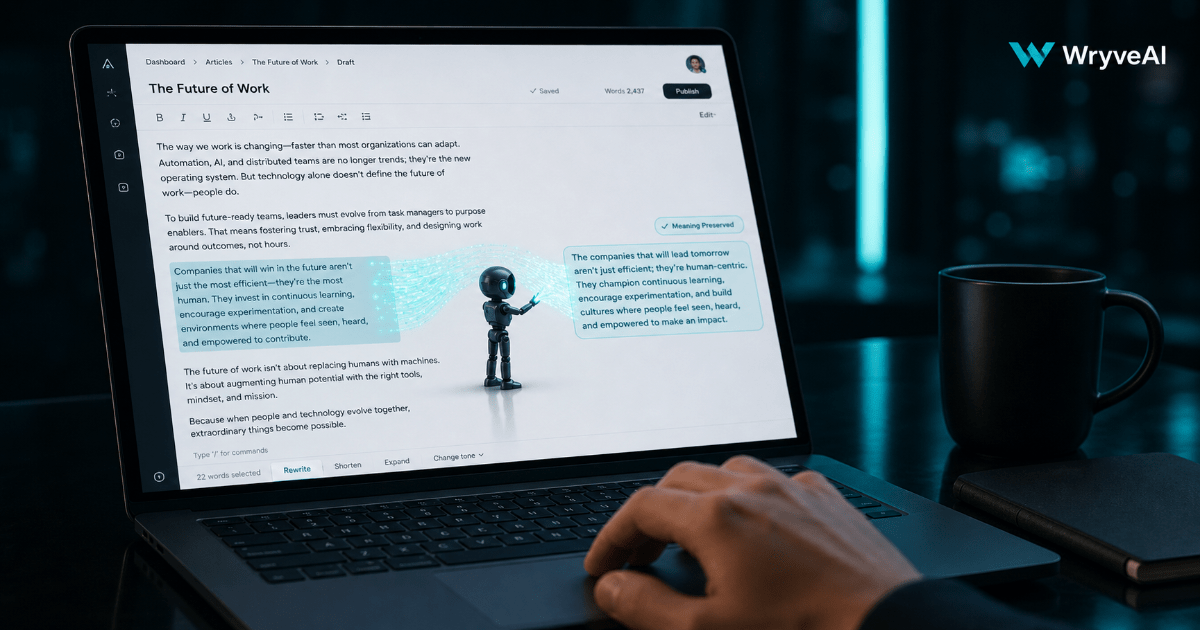
A paragraph rewriter is an online tool designed to rephrase or rewrite a paragraph while preserving its original meaning. It takes your text and presents the same core idea using different words and sentence structures. The quality gap between tools, however, is enormous.
Simple synonym-swapping tools replace words with dictionary alternatives. They ignore context entirely. The result is text that reads like a robot swallowed a thesaurus, which is exactly the failure this article set out to fix.
Modern AI paragraph rewriter tools work differently. They use language models that understand context, learning patterns, grammar, and vocabulary from vast amounts of text data. That knowledge lets them generate human-like text based on your specific input.
The distinction matters because it changes what the tool can do. A synonym swapper cannot grasp that “ran” and “sprinted” carry different emotional weight. An AI model can. It understands that a word’s meaning shifts depending on the sentence around it.
That is why the best tools let you rewrite text without changing its meaning. They preserve the original message while improving clarity and flow. This is the standard for quality, and it separates useful tools from word-shuffling toys.
The practical takeaway is simple. When you paste a paragraph into a rewriter, you are not asking for synonyms. You are asking for a structural rethink that keeps your idea intact. Tools built on language models, like those from Ahrefs’ writing suite, are designed for exactly that task.
Understanding this difference protects you from wasting time on weak tools. It also sets the expectation for what a good rewrite should deliver: the same thought, expressed with better rhythm and sharper clarity. That is the standard on which the rest of this guide builds.
That distinction is reflected in the output. A synonym swap produces text that needs another rewrite to sound natural. A model-based rewrite often needs only light editing, which is the outcome most users actually want.
Before choosing a tool, test it with a paragraph that contains idioms or technical terms. If the rewrite mangles those phrases, the tool lacks the contextual understanding your writing needs. Context awareness is the single feature that determines whether a paragraph rewriter saves you time or costs you more of it.
The Rewriting Process That Protects Meaning
Most rewriting processes fail because they start with the wrong action. Writers open a paragraph rewriter and paste text before they have actually understood what the paragraph is trying to say. That single mistake guarantees a shallow result.
Step 1. Read the original paragraph until you can state its core point without looking. You cannot preserve meaning you do not understand. If you cannot summarize the paragraph in one sentence, you are not ready to rewrite it.
Step 2. Identify the tone and the intended audience. A paragraph aimed at a board of directors demands different rhythm than one written for a blog readership. This decision shapes every word choice that follows.
Step 3. Write a fresh version from memory of that core point, not from the original sentences. Look away from the source text entirely. This forces you to rebuild the structure instead of tweaking the existing one.
Step 4. Compare your draft against the original to check for lost nuance or shifted emphasis. The original may carry a cautious tone you flattened into certainty. It may hedge a claim you made absolute. Catch that drift now.
Step 5. Read the new version aloud to test its flow. Awkward rhythm becomes obvious when you hear it. Your ear catches clunky transitions that your eyes glide past.
This process works whether you are rewriting manually or using a paragraph rewriting tool as your starting point. The tool handles the heavy lifting of generating alternatives. Your job is to judge whether those alternatives actually serve the core idea. The result is text that reads like a skilled editor improved it, not like software processed it. That distinction is the entire point of rewriting well.
The most common failure appears in Step 4. Writers compare their draft to the original and decide that different means wrong. That instinct kills good rewrites.
Different structure with the same meaning is the goal. The original sentence order is not sacred. What matters is whether the paragraph still delivers the same point with the same weight behind it.
Rewrite a Paragraph Online With AI Assistance
Choosing to rewrite a paragraph online with AI assistance solves a real problem, but only when the workflow is structured correctly. The tool matters less than the method around it. Four decisions determine whether the output reads like a polished draft or a thesaurus spill. Each one maps to a different failure point.
Match the Tool to the Content Type
Academic writing demands precision and formal register, while marketing copy needs rhythm and persuasion. A tool tuned for one will mangle the other. Selecting a paragraph rewriter built for your domain cuts the cleanup work dramatically. General-purpose tools produce generic sentences that fit nowhere well.
Feed It a Complete Thought
Garbage input produces garbage output, and fragmentary input produces fragmentary output. A half-written paragraph gives the AI nothing to reconstruct.
Provide the full context, including the point you are making and the angle you are taking. The best way to rewrite a paragraph is to paste in a complete, well-structured version of it, and the output quality tracks the input quality directly.
Treat the Output as a First Draft
The AI produces a starting point, not a final answer. Personalizing the result to match your voice is the step most users skip. Read the generated text aloud and flag every sentence you would never write yourself. Swap those constructions for your natural phrasing, then tighten the rhythm.
Verify Accuracy and Flow Before Publishing
AI output can introduce subtle factual errors or shift emphasis in ways that change the meaning. Proofreading catches those shifts before they reach your reader. One pass for errors, one pass for flow, and one pass for voice. The entire process takes minutes, and it separates a rewrite that works from one that gets deleted.
QuillBot and Grammarly handle different failure modes, and knowing which one you need saves real time. QuillBot excels at sentence-level variation, while Grammarly catches structural issues that change meaning. Neither replaces the judgment call about whether the rewrite still says what you intended. That check is yours, and it never gets automated away.
Rewriting vs. Paraphrasing vs. Plagiarism
The terms get thrown around like they mean the same thing. They do not, and the difference determines whether your final text is an improvement or an ethical violation. The line between legitimate revision and academic or professional misconduct is not about how many words you change.
Paraphrasing is the narrower craft. It takes a single idea and expresses it in fresh language, often for clarity or to integrate a source into your own argument. It works well when the original structure is sound and you simply need a new coat of words. Where it falls short is scale. Paraphrasing does not fix a paragraph that is poorly organized, repetitive, or logically tangled.
Rewriting is the fuller operation. It restructures the entire paragraph, reorders the logic, tightens the sentences, and reshapes the rhythm while holding onto the core message. This is the standard for any serious editing task. A proper rewrite paragraph changes the structure, the vocabulary, and the sentence flow, not just the surface wording. It treats the original as source material, not as a template to be recolored.
Plagiarism sits on the other side of a hard line. Presenting someone else’s work or ideas as your own is plagiarism, even when every word has been swapped for a synonym. Changing the vocabulary without changing the thought is still theft. The intent matters less than the act. If the underlying idea and structure belong to another writer, a surface-level rewrite does not make it yours.
Rewriting only clears the ethical bar when you are working on your own text, or when the source is properly credited. That is the condition that separates editing from appropriation. A paragraph rewriter used on your own draft is a tool. The same tool applied to another author’s work is a disguise.
For most readers, rewriting your own draft is the only scenario that matters. Paraphrasing serves you when you need to borrow a single idea cleanly. Rewriting serves you when the whole paragraph needs to become better than it was. Plagiarism is never a technique. It is a failure to understand which text you are actually allowed to improve.
Is Using a Rewriter Considered Cheating?
The question gets answered wrong because it gets framed wrong. Cheating is not a property of the tool. It is a property of the relationship between the work and the person claiming credit for it.
Using a paragraph rewriter on your own draft is closer to asking a colleague for feedback than to plagiarism. The thought originated with you. The structure, the argument, the evidence, all yours. The tool tightens the prose the way a good editor would, and no one calls an editor a cheat.
Writer’s block dissolves when the blank page stops being the enemy. A rough paragraph fed into a rewriting tool comes back with a rhythm you did not see, and suddenly the next sentence is obvious. That is not automated authorship. That is a running start.
The line gets crossed when the idea is not yours to begin with. Submitting someone else’s work through a rewriter to dodge a plagiarism detector is fraud with extra steps. Presenting tool-generated content as entirely original thought, without your own input or judgment, fails the same test.
Academic policies vary, and some instructors ban these tools outright. Check the rules of your institution before relying on one for graded work. The ethical calculation changes when the assignment explicitly requires unassisted writing.
The distinction that matters is authorship. A tool that helps you say what you already think is an assistant. A tool that says things you never thought, which you then claim as your own, is a ghostwriter. Rewriting text without changing meaning is a skill. Delegating the thinking is something else entirely.
The uncomfortable part is that the line sits in different places for different people. What matters is whether the final text reflects your understanding. If it does not, no tool, no disclaimer, and no policy loophole makes it honest.
Consider how the same tool plays in different rooms. A blogger running a draft through a rewriter to sharpen a point is editing. A student feeding a purchased essay through the same tool is still submitting work they did not write.
The tool did not change. The authorship did. That is why the accusation of cheating so often misses the mark, and why the honest question is never about the software at all.
How to Keep Your Voice in Every Rewrite
The biggest risk with any paragraph rewriting tool is not meaning loss. It is voice loss. A tool can preserve your argument and still strip out the personality that makes the text yours. Here is what that looks like in practice. Take a simple opinion about remote work. A basic rewriting tool might produce something like this:
BEFORE: “Remote work offers numerous benefits for employees. It provides flexibility in scheduling and eliminates commuting time. Organizations also experience reduced overhead costs. This arrangement facilitates improved work-life balance for many individuals.”
That paragraph is technically correct. Every sentence is grammatical. The meaning survives. But it reads like a corporate memo written by a committee.
The rhythm is flat, every sentence runs the same length, and the vocabulary is so neutral it could belong to anyone. That is the failure state of a rewrite paragraph: correct but soulless. Now consider the same idea rewritten with attention to voice. The writer here favors short sentences and a direct tone:
AFTER: “Remote work changes the daily grind. No commute. No office politics at the water cooler. Just the work, on your terms, from wherever you focus best.
Companies save on rent; employees reclaim hours of their lives. That trade is worth making.” The difference is not vocabulary depth. It is rhythm and stance. The second version has a point of view. It makes a judgment call.
The goal is not to sound like a tool. The goal is to sound like a better version of yourself. That means treating the output of any paragraph rewriter as a starting point, then reshaping it until the sentences carry your cadence and your convictions.
This is where the SERP-first AI Content Engine approach earns its keep. It pushes you to define the voice before you generate, so the output aligns with your style from the first draft. Run your rewritten paragraph through that filter. If the result sounds like it could have been written by anyone, it was not written by you.
Rewrite Smarter, Not Harder
The point of rewriting was never word replacement. It is the act of making a thought clearer and stronger without losing what made it yours. That distinction separates every useful paragraph rewriter session from those that produce sterile, forgettable prose.
Run one paragraph through the five-step process tomorrow. Define the core point, set the tone, draft from memory, compare for drift, then read it aloud. The tool enters only after you know what the paragraph must say.
This skill compounds. Every paragraph you rewrite this way sharpens the next one you write from scratch. The result is writing that sounds like you, only better. That is the standard worth keeping.
Every claim in this article was checked against a real source before it was published.
WryveAI researches live search results, writes source-verified content, and publishes straight to WordPress, all in one platform.
Try WryveAI Free →No credit card required.
Paragraph Rewriting: Your Questions Answered
What is the difference between paraphrasing and rewriting a paragraph?
Paraphrasing expresses the same idea in new words while keeping the original structure largely intact. Rewriting goes further by restructuring sentences, changing rhythm, and rebuilding flow while preserving the core message, which is what a quality paragraph rewriter should do.
Can a paragraph rewriter help me avoid plagiarism?
A rewriting tool can help you rephrase text, but it cannot make borrowed ideas your own. Plagiarism is defined by the origin of the idea, not the vocabulary, so the tool only helps ethically when you are working on your own draft or properly citing the source.
How do I rewrite a paragraph without changing its meaning?
Read the original until you can state its core point from memory, then write a fresh version based on that understanding rather than the original sentences. Comparing your draft against the source catches shifted emphasis and lost nuance before you finalize it.
Will using an AI paragraph rewriter make my writing sound robotic?
It will if you paste the output straight into your document without touching it. Treat the tool’s result as a first draft, then adjust word choice and rhythm until the text matches your natural voice.
Is it ethical to use a paragraph rewriting tool for my assignments?
Using the tool to improve your own draft or overcome writer’s block is a legitimate workflow. Crossing the line happens when you submit tool-generated content as entirely your own work without any original input or thought behind it.


