
WryveAI vs Writesonic: The SERP Intelligence Gap No One Talks About
ℹ️ TL;DR
- The WryveAI vs Writesonic decision is not about prose quality. It is about whether the tool starts with live SERP data or a blank prompt.
- WryveAI builds articles from competitive intelligence, analyzing what already ranks before writing a word. Writesonic starts from a prompt and treats SEO as a bolt-on.
- Credits align cost with output. Subscriptions cap output at the worst possible moment. For agencies scaling production, the pricing model matters as much as the tool itself.
- Writesonic wins on breadth, handling ads, product descriptions, and social copy alongside blog posts. WryveAI wins on depth, producing ranking content for organic growth.
- Teams switch to WryveAI after a specific failure: the article published, the keywords were placed, and the rankings did not move.
The moment of truth comes when the freshly generated article goes live and the rankings do not move. The draft reads well. The keywords are placed. Nothing happens. That is the exact moment teams start questioning whether their AI content tool is the problem.
Choosing between WryveAI and Writesonic is not a decision about which writer produces better prose. It is a decision about content strategy. WryveAI builds articles from live SERP data, analyzing what already ranks before a single word is written. Writesonic starts with a prompt and treats SEO as a layer added after the fact.
This comparison cuts through the marketing to focus on what matters: whether the tool can produce content that competes for rankings. Here you’ll find the structural differences, the cost model realities, and the workflow fit that determines which tool survives contact with a real publishing schedule.
What to Look for in an AI SEO Content Tool
Most teams evaluate AI writing tools the wrong way. They compare word counts, template libraries, and output speed, then wonder why nothing ranks. The real test is whether the tool starts with your keyword or with the search results that already own page one.
That distinction is everything. A tool built on SERP intelligence reads the top-ranking pages before it writes a single sentence. It maps what those pages cover, where their gaps are, and what angle could actually compete. A prompt-based tool skips that step entirely and hopes the model’s training data happens to match the current search landscape.
Content structure matters just as much. Publish-ready means the article arrives with headings that match search intent, internal links placed where they add value, and a structure Google can parse without your editor rebuilding it. Generic drafts shift that work to your team, which quietly turns a supposed efficiency tool into a time sink.
Workflow fit is the dimension nobody checks until it hurts. Does the tool publish directly to WordPress, or does it hand you a document and expect you to handle the rest? For agencies producing at scale, that difference is the difference between a pipeline and a bottleneck.
Cost models reveal priorities too. Credit-based pricing ties cost to a finished article. Subscription models charge for access and cap output, which punishes the exact teams that need scale. The tool that aligns cost with output is the one that scales without budget surprises.
WryveAI is built around SERP analysis and content gap identification, which is the foundation for ranking. Most tools treat SEO as a checkbox. The ones that treat it as the starting point are the only ones worth the evaluation.
How Writesonic Approaches AI Content Generation
Writesonic is a broad AI writing platform, not a specialized SEO engine. It handles blog posts, ads, product descriptions, and landing pages with speed that impresses on first use. That breadth is the product’s core strength, and also the source of its limitation.
Prompt-Driven Generation
The entire platform hinges on the quality of your prompt. You feed it a topic, it returns a draft. That workflow is excellent for short-form copy where the brief is clear and the stakes are low. For long-form SEO content, the draft is only the beginning of the work, not the deliverable.
The AI Visibility Suite Is an Add-On, Not a Core Engine
Writesonic markets a separate AI Visibility Suite for tracking brand mentions in AI search results. It is a bolt-on product, not the engine that powers the writing. Teams that want both capabilities face a split: one tool generates content, another monitors its presence. That fragmentation creates workflow friction.
Built for Traditional SEO, Not AI Search
Independent testing of the visibility suite reveals a fundamental mismatch. The tool is primarily designed for traditional search engine optimization and content generation, which raises the question of whether it can truly compete as an AI visibility tracker. The architecture was built for one era of search, then retrofitted for another.
The Two-Tool Problem
This split forces a practical decision. A team can accept Writesonic’s prompt-driven output and handle visibility tracking elsewhere. Or it can run two subscriptions and stitch the workflow together manually. Either way, the promise of an all-in-one platform dissolves into integration work.
The real cost is not the subscription. It is the time spent moving content between systems that were never designed to talk to each other. Teams that need ranking content find themselves assembling a patchwork, while the tool that promised simplicity becomes another piece of the stack. The prompt is the ceiling for what Writesonic can produce. Everything downstream is your problem to solve.
How WryveAI Builds Content From Real SERP Data
The fundamental difference is where the writing starts. WryveAI begins by reading what already ranks on page one; Writesonic begins with whatever prompt you type. That single distinction changes everything downstream.
Live SERP data becomes the blueprint. The tool dissects top-ranking pages, maps their structure, and identifies the content gaps they leave open. Then it writes to close those gaps, not to fill a word count. Content built from what already ranks has a fighting chance at joining it. Content built from a prompt is a guess dressed as an article.
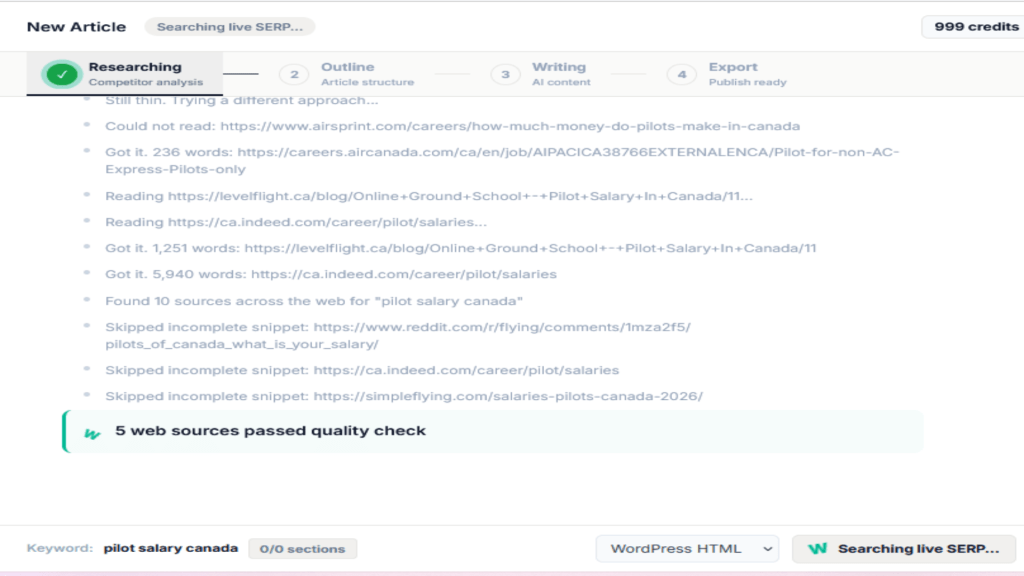
Keyword clustering happens before a single sentence is drafted. Related terms get grouped by intent, so the article targets a topic cluster rather than a single phrase. Internal and external linking are handled automatically, woven into the draft where they add relevance instead of bolted on after the fact.
Direct WordPress publishing removes the copy-paste bottleneck that kills momentum for teams producing at scale. The draft moves from SERP analysis to live post without a manual handoff. That workflow is the difference between a tool and a pipeline.
The broader shift in AI SEO content tools is heading this direction. Teams are tired of output that reads beautifully and ranks nowhere. They want the research done before the writing starts, and they want publish-ready articles that compete with what is already winning.
Agencies and content teams get the real benefit here. Scale without quality collapse is the promise, and it holds because the data drives every decision. The question is not whether this approach works. The question is whether prompt-based tools can catch up before their users stop waiting.
WryveAI vs Writesonic: Feature Comparison
The comparison comes down to architecture, not output quality. Both tools produce readable prose. Only one builds it from the search results that actually matter.
The pattern is clear. WryveAI is built for ranking. Every stage of its pipeline, from SERP analysis to direct publishing, exists to produce articles that compete with what already sits on page one.
Writesonic is built for volume. It moves fast across many content types, but the SEO layer is an afterthought. Teams that need organic growth will find the difference decisive. You are choosing between a ranking pipeline and a writing utility.
That architectural difference is evident in the final article. WryveAI structures content around the subtopics and questions that already rank, so the piece competes with what Google has validated. Writesonic generates from your prompt, which means the output reflects your assumptions about the search landscape, not the landscape itself.
For a content manager juggling multiple clients, that distinction decides whether the draft arrives as a starting point or a near-final piece. SERP-driven generation collapses the research phase into the writing phase. The revision cycle shrinks because the structure was built from competitive evidence, not guesswork.
The Real Cost Difference: Credits vs Subscriptions
Pricing models reveal more about a tool’s philosophy than any feature list. The WryveAI vs Writesonic comparison sharpens here because the two approaches punish different mistakes. Credits align cost with output; subscriptions align cost with time, regardless of what you produce.
WryveAI runs on credits, and the model is refreshingly direct. One credit buys one fully researched, SERP-intelligent, SEO-optimized article with no word limits and no hidden caps. Budgeting becomes arithmetic: plan the content calendar, count the articles, buy that many credits. Cost scales with production, not with calendar pages. For an agency publishing forty articles a month, the math stays predictable from kickoff to invoice.
Writesonic operates on a subscription with word or feature limits baked into each tier. That works fine for a solo founder drafting a few blog posts and a dozen ad variations. The surprise arrives when a client approves a content sprint and the word cap evaporates mid-month. Teams then face a choice between throttling output or upgrading a plan they did not budget for. The subscription model rewards consistency, not volume spikes, which is precisely the wrong shape for agency work.
The budgeting logic follows from the architecture. Subscriptions are predictable per month but cap output at the worst possible moment. Credits are predictable per article and never punish a busy month. Agencies producing many articles find the credit model aligns spend with client billing cycles, so the tool cost maps directly to a deliverable line item. No reconciliation surprises at month end.
The choice depends on your output pattern. Steady, low-volume publishing suits a subscription. Scaling production, especially in bursts, demands the credit model. For teams whose revenue depends on article volume, the WryveAI pricing page shows the cost structure that actually matches the work.
Which Tool Fits Your Content Workflow?
The workflow question is not about features. It is about what your team produces on a normal Tuesday. A generalist writer and a ranking pipeline serve different realities, and picking the wrong one shows up as a calendar full of half-finished drafts.
When a Generalist Writer Makes Sense
Teams producing ads, email sequences, product descriptions, and the occasional blog post need a tool that moves between formats without friction. Writesonic handles that range well. The prompt box is the starting point, and the output is fast enough to keep a content calendar moving. That flexibility is real, and for teams whose primary goal is volume across formats, it is the right call.
The Agency Reality: Scale Without Quality Collapse
Agencies face a different constraint. They publish for multiple clients, and every article must compete against pages that already hold page one. That is where AI content for agencies breaks down when the tool starts from a blank prompt. WryveAI starts from the live SERP, which means the output is built to outrank what exists, not just to read like it. The internal comparison with Copy.ai makes this exact point: agencies that need ranking depth over format flexibility end up with a pipeline, not a writing utility.
The Switch Happens After the Rankings Stall
Most teams do not switch tools because the writing is bad. They switch because the rankings do not move. The content reads fine, the keywords are placed, and nothing happens on page two. That is the moment when SERP analysis becomes the differentiator. WryveAI’s data-driven starting point is what turns a content tool into a ranking system.
Matching the Tool to the Output You Actually Need
The trade-off is clean. Writesonic offers breadth across content types. WryveAI offers depth in organic growth. Teams that need both usually discover they need two tools, and that integration friction becomes the real cost. For agencies and content managers whose metric is rankings, the depth wins every time.
The Verdict: When to Choose WryveAI Over Writesonic
Choosing between these tools is not a feature comparison. It is a decision about what you want the tool to do for your business. The real question is whether you need a writer or a ranking engine.
Choose WryveAI when organic growth is the metric that matters. The tool starts with live SERP data, identifies what already ranks on page one, and builds content that fills the gaps competitors left open. Keyword clustering and direct WordPress publishing turn that research into a repeatable pipeline, not a one-off article.
Writesonic makes sense for teams producing ads, product descriptions, and social copy alongside blog posts. That flexibility is real, and the short-form output is genuinely strong. But the prompt-driven core means every article is a guess at what Google wants, and the separate AI Visibility Suite adds another tool to manage.
Teams that switch to WryveAI usually do so after a specific failure. The article published, the keywords were placed, and the rankings did not move. That is the moment the prompt-based approach reveals its limit: it can write, but it cannot compete with content built from actual search results.
Publishing regularly without ranking is just adding pages to a void. content that ranks requires starting from the SERP, not from a blank box. WryveAI is built for the former, and that distinction decides the outcome before the first draft exists.
The choice is not about output quality. Both tools can produce readable prose. The choice is whether your content strategy starts with what Google has already validated, or with whatever prompt feels clever at the moment.
For an agency juggling five client accounts, the deciding factor is often simpler: which tool removes the most steps between research and publish. WryveAI collapses that chain into one workflow. Writesonic leaves the SERP analysis to you, then charges extra for the tool that does it. That workflow difference compounds weekly. Every article built from live ranking data carries a structural advantage no prompt can replicate.
Make the Choice That Moves Your Content Forward
Choosing between WryveAI vs Writesonic is really a choice between two different definitions of done. One tool finishes when the draft reads well. The other finishes when the draft is built to outrank what already sits on page one.
That distinction determines your next quarter. Content that merely exists drains budgets and stalls momentum. Content engineered from live SERP data compounds, every article becomes a competitive asset rather than a line item. The teams that act on this now stop guessing and start publishing with intent. Evaluate your current performance honestly. Then test the tool that matches your actual goal. If rankings matter, the answer is already clear.
Every claim in this article was checked against a real source before it was published.
WryveAI researches live search results, writes source-verified content, and publishes straight to WordPress, all in one platform.
Try WryveAI Free →No credit card required.
Frequently Asked Questions About WryveAI and Writesonic
Is WryveAI better than Writesonic for SEO?
For teams whose goal is organic rankings, WryveAI is the stronger choice because it builds articles from live SERP analysis rather than starting with a blank prompt. Writesonic produces good content quickly, but its output requires separate SEO work to compete with pages already ranking on page one.
Does Writesonic offer SERP analysis?
Writesonic does not offer built-in SERP analysis as part of its core content generation flow. Its AI Visibility Suite tracks brand mentions in AI search results, but that is a monitoring feature rather than a tool for shaping content around what already ranks.
Who owns Wayve AI?
Wayve AI is a separate company from WryveAI, focused on autonomous driving technology rather than content generation. The similarity in names causes confusion, but the two operate in completely different industries with no connection between them.
Which tool is better for agencies producing at scale?
WryveAI is the stronger fit for agencies because its credit-based pricing scales with output, its SERP analysis removes the research bottleneck, and its WordPress publishing eliminates manual handoffs. Writesonic’s subscription model caps output at the worst possible moment for agencies handling volume spikes.
Is WryveAI a good Writesonic alternative?
WryveAI is one of the stronger Writesonic alternatives for teams focused specifically on organic rankings, since it builds every article from live SERP data instead of a blank prompt. Teams looking at Writesonic alternatives for general content needs, ads, or multi-format output may still find Writesonic’s breadth useful; the switch to WryveAI tends to happen once ranking performance, not writing speed, becomes the priority.


