AI Content Tool vs Hiring a Writer: Which Saves You More?

ℹ️ TL;DR
- Evaluating an AI content tool vs hiring a writer requires measuring the total cost per publishable article rather than comparing software invoices to freelance rates.
- AI tools eliminate blank-page friction and speed up research, but ungrounded drafts shift heavy editing, fact-checking, and voice correction onto your internal team.
- Hiring human writers secures brand nuance and editorial judgment, yet introduces briefing cycles, onboarding overhead, and single points of failure.
- A hybrid model pairing automated SERP research with human editorial oversight delivers the lowest total cost while maintaining E-E-A-T quality standards.
- Audit your team’s editing hours on recent posts to determine whether your bottleneck is drafting capacity or post-production cleanup.
Comparing a monthly subscription to a per-article rate settles almost nothing. That framing is why teams pick an AI content tool vs hiring a writer, feel decisive for a week, then discover the invoice they chose was never the real bill.
The cost that actually matters sits in the hours around the draft. Research, editing, rework, and the quiet expense of publishing something that never ranks.
This article breaks down the full cost of both paths, including the quality trade-offs most comparisons avoid. You’ll finish with a decision framework built on your team’s real situation, not a feature list.
The counter is that AI tools keep getting cheaper and faster. True, and irrelevant if the output needs a rewrite. Run the math on your last five articles. Count the hours spent after the first draft. That number is your real baseline.
The Real Cost Is Never the Invoice
A draft is not a deliverable. That distinction decides whether an AI content tool or hiring a writer saves you money, and almost nobody accounts for it.
The invoice covers the cheapest part of the work. Research, editing, fact-checking, and rework live outside it, and they scale with how far the raw output sits from publishable. A subscription that produces a draft in minutes still leaves you paying an editor to rebuild the argument, verify the claims, and rewrite the opening.
Teams compare a monthly fee to a per-article rate and call that a decision. Then they pay twice: once for the tool or the writer, and again for the hours spent turning output into something they’d put their name on. Total cost per publishable article is the only number worth comparing.
Picture a team that drafts ten posts a month with a generic tool. The subscription looks trivial next to a freelance rate. Then two editors spend their week correcting voice, cutting filler, and chasing citations the tool invented. The real cost of publish-ready articles lands far above either sticker price.
The same trap catches teams who hire badly. A cheap per-article rate from a writer who needs three revision cycles costs more than a higher rate from someone who nails the brief first time. The hours attached to each option decide it. The question stops being what you pay and becomes what you pay per piece that actually ships, ranks, and holds up.
What an AI Content Tool Actually Costs You
The subscription is the line item every team sees and the one that matters least. Budget for an AI content tool and the real spend lands in the hours your people pour into prompting, correcting, and rescuing drafts that miss the mark. That gap between the invoice and the true cost is where budgets quietly break.
| Cost Factor | AI Content Tool (Standalone) | Freelance Writer | Hybrid (WryveAI + Editor) |
|---|---|---|---|
| Direct Invoice Cost | Low ($30 to $100 per month) | High ($300 to $1,000 per article) | Balanced (Software fee + internal editor hours) |
| Research Overhead | Shifted to editor to verify accuracy | Absorbed by writer (billed in rate) | Automated via live SERP analysis |
| Editing & Rework Hours | Heavy (restructuring, tone fixes) | Moderate (briefing & revision cycles) | Minimal (final voice pass & review) |
| Brand Voice Consistency | Generic without deep prompting | High (requires initial onboarding) | High (driven by stored brand profiles) |
| Production Velocity | Instant drafts, slow publishing cleanup | Slow (dependent on writer schedule) | Fast (rapid publish-ready throughput) |
The subscription is a rounding error next to the labor it triggers. A tool that hands your team a blank prompt just relocates the research and editing burden onto the person who has to fix the result. WryveAI starts from live SERP research and verified sources instead of a blank page, which cuts the editing and research overhead at the source. The cheapest tool is the one that leaves the least for your team to clean up.
The counter-argument arrives fast: the tool costs $30 a month, a writer costs thousands. That math only works if the draft ships untouched. It rarely does.
Track one article end to end and the hidden lines surface. Count the prompt revisions, the fact-check pass, the structural rebuild, the voice rewrite. That total is the number your budget actually feels.
What Hiring a Writer Actually Costs You
The per-article rate is the number every team negotiates and the one that tells you least. What you actually pay is that rate plus briefing time, revision cycles, ramp-up, and the risk of leaning on one person. Each hides in a different part of your week, which is why they never show up on the same invoice.
The rate you see and the rate you pay
A senior freelancer charging premium rates can be cheaper than a junior charging half as much. The junior needs more briefing, more revision, and more of your editor’s attention to reach the same publishable standard. The Bureau of Labor Statistics writer outlook describes a field where pay and experience track closely, which is why the cheap rate rarely stays cheap.
Briefing and revision cycles eat the savings
A writer who has never read your positioning will produce a first draft that sounds like a stranger wrote it. Two revision rounds on a single article can consume more of your editor’s day than writing it in-house would have.
Ramp-up is a cost you pay once per writer
Every new freelancer spends their first few assignments learning your voice, your customers, and your house style. That learning curve is billable time spent producing work you will partly rewrite. The onboarding cost is real even when nobody invoices it.
One writer is a single point of failure
A reliable freelancer who disappears mid-quarter leaves you with a stalled calendar and no backup. Building a bench costs management time, the overhead line teams forget to count. Compare that fragility against AI versus human writing results before assuming the human side is the safer bet.
AI Content Tool vs Hiring a Writer: Head to Head
The AI content tool vs hiring a writer comparison is usually framed as speed against quality. That framing is wrong. Both paths need a human in the loop, so the real question is where those human hours land.
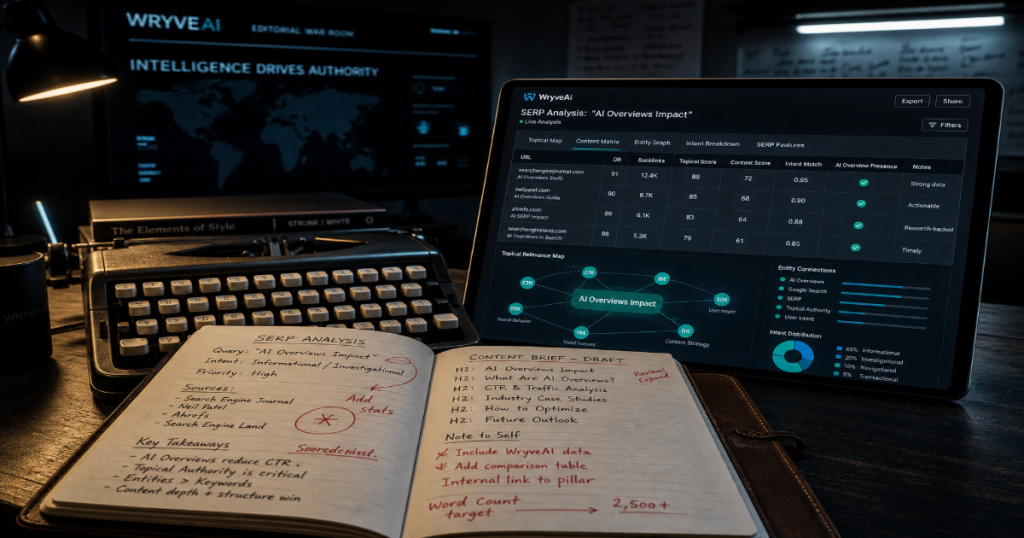
An AI content tool wins on research throughput and scale. It can pull SERP data, cluster keywords, and produce a first draft before a writer finishes an outline. Where it collapses is brand voice and intent. A tool with no memory of your positioning produces drafts that read fine and convert nothing.
Hiring a writer wins on voice fidelity and judgment. A strong freelancer absorbs your positioning, argues with your brief, and files copy that needs light edits. Where the arrangement breaks is coverage. One writer is a single point of failure, and ramp-up eats the first few assignments.
The trade-off is not speed versus quality. It is where the editing burden sits. With a tool, your team absorbs it. With a writer, you pay for it in revisions and management.
A strong writer using AI assistance beats both extremes. The writer keeps voice and judgment, the tool handles research and the blank page.
WryveAI runs the middle path deliberately. Its human editing requirement for E-E-A-T and its quality gate before export keep a person on voice and accuracy, while SERP research and drafting run automatically.
Choose the tool when you have an editor who owns voice. Choose the writer when you have no editing capacity at all. Choose the hybrid when you have both and want the hours spent on judgment.
Where AI Output Still Fails Without a Human
AI content tools fail in places you can predict before you hit generate. That predictability tells you where the editing hours will go in the AI content tool vs hiring a writer decision.
- Missing search intent. A tool that never read the SERP writes to the topic, not the query. The draft answers a question nobody searched, so it ranks nowhere.
- Flat brand voice. Without a memory of your positioning, the output defaults to a neutral register that could belong to any competitor.
- Thin E-E-A-T signals. A model cannot cite lived experience, a client story, or a hard-won lesson. It produces claims with no proof, and readers notice.
- Copyright exposure. Publishing AI output as original work carries real risk, and the US Copyright Office AI guidance sets the boundaries on what you can actually own.
- Confident wrongness. A model states a fabricated fact with total assurance. Your editor catches it, but only after spending the time you thought you saved.
Every failure lands on the same person: the editor. The tool doesn’t remove the human work; it relocates it to the back end. That is where the editing cost hides, and why a cheap subscription can still be the expensive choice.
Structural fixes beat prompting tricks. SERP analysis and search intent read before drafting closes the first gap, and a stored brand profile closes the second. WryveAI builds both into the workflow so the draft starts from verified research, not a blank prompt.
The Hybrid Model That Beats Both Options
The winning setup is not a choice between software and a person. It’s a division of labor where each side does only what it’s actually good at. A tool that researches first and drafts from verified sources, paired with an editor who owns voice and judgment, beats both pure options on total cost.
The mechanism is simple to describe and hard to fake. The tool absorbs the blank-page hours and the SERP reading, pulling structure and sources before a human types a word. The editor then spends their time on the two things software cannot do: catching what’s wrong and making it sound like you.
Strip out the research load and the editing burden shrinks with it. An AI writer that researches first hands your editor a draft grounded in what actually ranks, not a plausible guess. That’s the difference between editing for accuracy and editing for existence.
WryveAI runs this model end to end. SERP research feeds a brand profile, the brand profile shapes the draft, and publishing goes straight to WordPress without a formatting pass. The human hours land on judgment, not cleanup.
Skip the human and the model collapses. A tool alone still ships flat voice and thin authority, and the rework lands back on your desk later. The hybrid isn’t a compromise between the two options. It’s the only version where the savings survive contact with a publishable article.
Which Option Fits Your Team Right Now
Team structure, not budget, decides which side of the AI content tool vs hiring a writer question wins. The same spend produces wildly different total costs depending on who is already on staff to edit.
- Solo founder, few posts monthly. A tool plus your own editing hours beats a freelance rate, because your judgment is the only voice that matters.
- In-house team with an editor. The tool wins outright, since the editor already absorbs the cleanup the subscription leaves behind.
- Agency juggling client voices. white label AI content for agencies only pays off with per-client brand profiles, or editing time balloons.
- Zero writing capacity. Hire a writer, because an unedited tool draft is a liability dressed as a deliverable.
- High-volume publishing schedule. A tool with a human gate scales; a single freelancer becomes your bottleneck and your risk.
- Regulated or technical niche. A specialist writer costs more per article but saves the rework a generic draft guarantees.
Read the list again and notice what it never asks: which option is cheaper on paper. Every bullet resolves to the same variable, the hours someone spends turning a draft into something publishable. The decision is a staffing question disguised as a purchasing one. Teams that skip this framing buy the wrong thing and pay twice.
Decide by Total Cost, Not Sticker Price
The AI content tool vs hiring a writer question collapses the moment you stop counting invoices and start counting hours. A publishable article is the only unit that matters, and every hour between draft and publish is money you already spent.
Teams that track this find the cheaper option was never the cheap one. A tool that produces a draft in minutes but eats an afternoon of editing costs more than a writer who files clean copy. The same logic runs in reverse for a writer who needs three revision rounds to learn your positioning. Price tags measure inputs; publishable articles measure output.
Run the audit this week. Pull your last five published pieces and log the editing hours each one consumed, then compare that total to the subscription or rate you paid. That ratio is your real cost per article. Whichever option shrinks it is the one worth keeping.
Every claim in this article was checked against a real source before it was published.
WryveAI researches live search results, writes source-verified content, and publishes straight to WordPress, all in one platform.
Try WryveAI Free →No credit card required.
Questions Teams Ask Before They Choose
Are content writers being replaced by AI?
Writers are being redefined rather than replaced, because the AI content tool vs hiring a writer decision still lands on a human who owns voice and accuracy. The role shifts toward editing and judgment, and the writers who adapt stop drafting from a blank page and start directing output.
Which AI tool is better for content writing?
The better tool is the one that researches before it writes, pulling from live search results and verified sources instead of guessing at a topic. A tool with a brand profile remembers your positioning across every article, which is the difference between a usable draft and one your editor rebuilds.
Which AI tool is the best for writers?
Writers get the most from a tool that handles the research and structural grunt work so their hours go to argument and accuracy. The trap is a tool that produces polished prose with no sourcing, because the writer then spends the saved time fact-checking every claim it invented.