
SEO Content Strategy for SaaS: Build From Bottom-of-Funnel in 2026
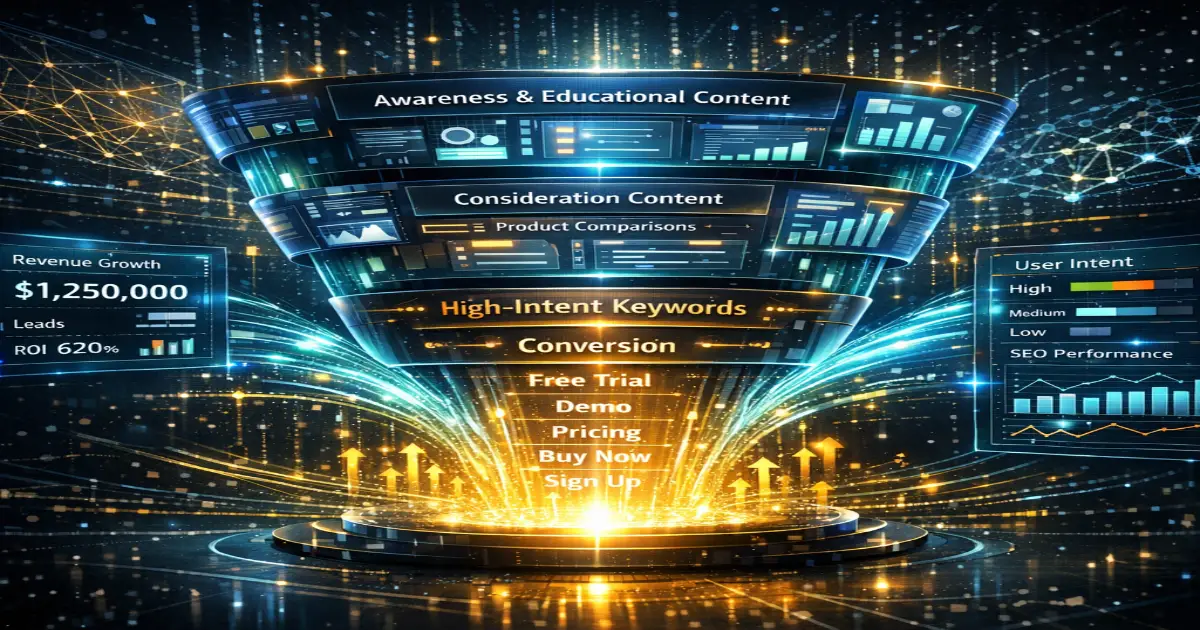
Table of Contents
Most SaaS SEO strategies fail because they target the wrong funnel stage. Prioritizing top-of-funnel content first is a 2023 tactic that burns budget in 2026. This outdated approach ignores the immediate revenue capture that defines modern SaaS growth.
Generic SEO advice does not address your specific business model. It misses audience pain points and the need for a full-funnel strategy. The 2026 playbook inverts this logic entirely. You must start with bottom-of-funnel content to secure customers now.
This guide explains the inverted funnel methodology for SaaS. You will learn distinct blueprints for product-led and sales-led growth models. You will understand how to build authority upward from a revenue foundation. This is the essential SEO content strategy for SaaS in 2026.
Why Generic SEO Fails B2B SAAS
Generic SEO fails B2B SaaS. It confuses casual browsers with serious business buyers. A proper SEO content strategy for SaaS must solve commercial problems. It targets a considered purchase journey.
Generic advice chases top-funnel traffic volume. This creates a leaky bucket. You attract visitors searching for “what is CRM.” You miss those ready to buy, like “salesforce alternatives for mid-market.” Ahrefs data shows commercial intent keywords drive higher conversion value.
The 80/20 rule applies here. In SaaS, 80% of qualified leads come from 20% of content. This is bottom-funnel material: comparison guides, pricing pages, and integration details. Starting your strategy here captures immediate revenue. It also provides crucial conversion data.
This data lets you build middle and top-funnel authority intelligently. Your content shifts from a cost center to a growth channel. You replace vague blog posts with assets answering final buying questions. This approach makes organic traffic a sustainable marketing engine.
How to Build a SaaS-First SEO Strategy
To pivot from generic SEO, follow this commercial framework:
- Map the Commercial Journey: Document every question a serious buyer asks before purchase, from integration checks to competitor comparisons.
- Prioritize Bottom-Funnel: Create definitive content for high-intent keywords first, like “[Your Tool] vs [Competitor]” or implementation case studies.
- Instrument for Data: Track how this content generates leads and pipeline revenue, not just traffic.
- Expand with Authority: Use proven conversion data to justify creating top-funnel educational content that supports the commercial core.
This reverses the traditional funnel, building your SEO content strategy for SaaS on a revenue foundation.
How an SEO Content Strategy for SAAS Inverts the Funnel
A modern SEO content strategy for SaaS flips the traditional funnel. It begins by targeting bottom-funnel content to secure immediate revenue. This directly addresses commercial intent and accelerates pipeline growth. You need four core components.
- A documented strategy aligned with your SaaS business model
- A full-funnel keyword map prioritizing bottom-funnel terms
- Dedicated resources for consistent execution
- A system to measure impact on pipeline and revenue
Conventional wisdom says SEO builds awareness first. The inverted model targets commercial queries from day one. For a sales-led CRM, a bottom-funnel keyword could be “salesforce alternative for mid-market.” This captures users actively comparing solutions. Ahrefs data shows these high-intent terms convert far better than informational queries. This is the 80/20 rule for SaaS SEO.
Correct application shifts content from a cost center to a revenue driver. Qualified leads can enter your pipeline in weeks. This strategy creates commercial assets that answer buying questions. Organic traffic is still vital for B2B SaaS. The inverted funnel makes that traffic pay for itself immediately.
Your SEO Content Strategy for SAAS: PLG vs. Sales-Led
Reverse the funnel for your SEO content strategy for SaaS. Begin with bottom-funnel content to capture immediate revenue, then build mid-funnel authority before establishing top-funnel awareness. This blueprint diverges for product-led and sales-led models.
Following the 80/20 rule, this inverted approach targets high-intent keywords first to secure qualified leads, forming the core of modern SaaS growth.
1. Capture Revenue with Bottom-Funnel Content. Sales-led SaaS demands detailed comparison pages, while PLG models need specific integration guides and tutorials. One targets “salesforce alternative,” the other “how to connect [Your Tool] to Slack.”
2. Build Authority with Mid-Funnel Problem Solving. Address “how-to” and “why” questions with comprehensive solution guides. This problem-focused content earns backlinks and supports your commercial pages directly.
3. Establish Awareness with Top-Funnel Education. Finally, target broad informational keywords with educational pieces. This attracts a wider audience and creates a self-sustaining content ecosystem.
For B2B SaaS, organic traffic is essential. This model captures revenue now while systematically building market authority, transforming your content into a predictable growth engine.
The Best Tools for SEO Content Strategy for SAAS Right Now
A modern SEO content strategy for SaaS needs tools for the inverted funnel. Prioritize commercial intent analysis over generic research. The right stack captures revenue from bottom-funnel queries. It also builds topical authority.
Intent and Keyword Intelligence
Ahrefs is essential for keyword difficulty and SERP features. Target “vs” and “alternative” queries immediately. This bottom-funnel focus drives revenue. Hubspot confirms organic traffic’s B2B importance in 2026.
Content Optimization and E-E-A-T
Use WryveAI or Clearscope to grade content against competitors. They go beyond keyword density. These tools help demonstrate experience and answer questions directly. This builds authority for YMYL SaaS topics.
Technical and Performance Auditing
SEMrush Site Audit or Screaming Frog finds critical site errors. Page speed and Core Web Vitals impact commercial page rankings. A fast, clean site supports conversions. Fixing issues protects revenue content.
Analytics and Attribution
Google Analytics 4 with event tracking is mandatory. Connect organic sessions to demos, trials, or purchases. This shows which content fuels pipeline growth. Without this link, your strategy operates blindly.
Why Most SAAS Content Never Ranks
Most SaaS content fails by targeting the wrong audience. It speaks to generic information seekers, not commercial buyers. This mismatch wastes effort on traffic that never converts.
HubSpot confirms organic traffic is essential for B2B SaaS. Yet teams chase broad top-funnel keywords with low conversion rates. They ignore bottom-funnel commercial terms that drive real revenue. That small percentage difference creates a massive revenue gap.
The SEO 80/20 rule shows 80% of leads come from 20% of content. Most SaaS blogs achieve the opposite. They produce endless top-funnel articles, hoping for a trickle-down effect that never comes.
SEO has evolved into a full-funnel commercial engine. A proper SEO content strategy for SaaS must solve specific business problems. It must target the buyer’s journey from consideration to purchase.
Applying this shifts content from brand awareness to revenue capture. You stop writing for everyone and start writing for your next customer. This focus separates ranking content from wasted effort.
Measuring ROI Beyond Organic Traffic
A proper SEO content strategy for SaaS must measure ROI through pipeline velocity and revenue, not just traffic. This validates the inverted funnel by proving bottom-funnel content accelerates sales. Track content-attributed opportunities and deal size.
HubSpot data confirms organic traffic is essential for B2B SaaS. Yet this alone cannot justify your budget. The critical metric is the conversion rate into sales-qualified leads. Avoid celebrating traffic spikes that generate zero pipeline.
Apply the 80/20 rule to your content audit. Identify the twenty percent of pages driving eighty percent of qualified leads. Double your investment in that high-converting content format and intent. This shifts resources from vanity to value.
Correct execution unites marketing and sales on a single dashboard. They will see which search terms and guides shorten sales cycles. This alignment transforms SEO into a predictable revenue engine.
Scaling Your Strategy in 2026
Scaling an inverted funnel is a natural outcome of authority building. A proper SEO content strategy for SaaS uses bottom-funnel revenue to fund mid-funnel content, creating a self-reinforcing loop.
Scaling Requires Conversion Data
Conversion data is essential for scaling. While top-funnel content brings traffic, bottom-funnel content captures commercial intent. User queries and behavior from these pages reveal the precise language needed for your authority pieces. Ahrefs confirms that commercial keywords build topical authority faster.
The 80/20 Rule for SaaS SEO
Apply the 80/20 rule. Most revenue comes from a small core of high-intent content. The rest of your output supports this core by building mid-funnel authority and top-funnel awareness, preventing resource dilution.
SEO is Evolving, Not Dead
Organic traffic remains essential, but the strategy shifts from generic volume to commercial intent. This demands a full-funnel, bottom-up approach. Scaling means replicating your initial commercial success across related areas.
The Operational Blueprint for Scale
Scale by templating success. Document what works for winning bottom-funnel pages and apply that blueprint to adjacent topics. Use the resulting revenue data to justify expanding into mid-funnel clusters. This disciplined approach is how you scale effectively.
Your Next 90-Day Action Plan
Start a 90-day revenue sprint focused on bottom-funnel commercial intent to capture immediate deals and fund your broader content engine. Build ten to twelve core conversion assets first, like solution comparisons and pricing justification guides, each answering a specific commercial query from a final-stage buyer. This applies the 80/20 rule, letting high-intent content drive most pipeline value.
Real authority stems from conversion, not just backlinks. A guide that closes a deal builds trust and signals topical authority, capturing the most valuable segment of organic traffic. The objective is a measurable SEO revenue stream within one quarter.
This sprint generates critical conversion data, showing which commercial terms drive pipeline velocity. That intelligence then informs your mid-funnel authority content next quarter, creating a powerful, self-funding loop for your SEO content strategy for SaaS.
The 80/20 Rule for SAAS SEO
Apply the 80/20 rule to your SEO content strategy for SaaS. Focus 80% of your effort on bottom-funnel commercial intent to capture revenue from ready buyers. Use the remaining 20% to build top-funnel authority for future growth.
This model corrects the common error of prioritizing broad awareness. Generic top-funnel content wastes resources on audiences not ready to buy. Bottom-funnel keywords convert at a much higher rate, justifying the concentrated effort.
Begin by mapping commercial queries like “alternatives to [competitor]” or “[category] pricing justification.” Every piece must resolve a final-stage buying objection to accelerate pipeline velocity.
With organic traffic essential for B2B SaaS, this inverted approach ensures traffic directly fuels revenue. You can close content-attributed deals in weeks, not quarters. That success then funds your broader authority-building efforts.
Ready to Build Your 2026 SEO Playbook?
Your SEO content strategy for SaaS must now invert the funnel to capture revenue, prioritizing commercial intent over generic awareness. This directly solves the problem of irrelevant traffic. The blueprint differs for product-led and sales-led models, ensuring every piece targets a real business outcome.
Applying this model means your content will directly influence pipeline velocity. HubSpot confirms organic traffic is essential for B2B SaaS marketing, making this strategic pivot non-negotiable for 2026. The evolution of SEO demands a focus on commercial outcomes, not just visibility.
Begin by auditing your existing content for bottom-funnel gaps. Next, map ten high-intent commercial queries to your core conversion assets. Finally, commit to a 90-day sprint focused solely on this revenue layer. Your next step is to implement the playbook that turns search intent into closed deals.
Every claim in this article was checked against a real source before it was published.
WryveAI researches live search results, writes source-verified content, and publishes straight to WordPress, all in one platform.
Try WryveAI Free →No credit card required.
Frequently Asked Questions About SEO Content Strategy for SaaS
What is the 3 3 2 2 2 rule of SaaS?
A content structure for sales-led SaaS: three awareness pieces, three consideration guides, two conversion assets, and two each for retention and advocacy.
What is the SEO strategy for SaaS?
A modern SEO content strategy for SaaS inverts the funnel. Start with bottom-funnel content to capture immediate revenue from B2B buyers.
What is the 80/20 rule in SEO?
Apply 80% of effort to bottom-funnel commercial queries to drive pipeline. Use 20% for top-funnel authority and long-term growth.
Is SEO dead or evolving in 2026?
SEO is evolving. The 2026 playbook prioritizes commercial intent and revenue capture. Organic traffic remains essential but more targeted.
How do I start an SEO content strategy for SaaS?
Begin with a 90-day revenue sprint. Build 10-12 core conversion assets targeting bottom-funnel intent to fund and validate the model.


