
Best Content Marketing Tools: The Top 5 for Next-Level Success in 2026

ⓘ TL;DR
- Most content tool lists are affiliate-driven noise. The only question that matters is which tool kills your specific bottleneck, whether that is SERP analysis, drafting, or publishing.
- A tool that generates text without first analyzing ranking pages is solving the wrong problem. SERP intelligence has to come before the draft, not after.
- Keyword clustering, internal linking automation, and direct CMS publishing are not nice-to-haves. Teams that skip them produce orphan content that never builds authority.
- AI tools do not replace editors. They buy back the hours spent on research and formatting so human judgment can go where it actually counts: strategy, fact-checking, and E-E-A-T.
- The cheapest tool on paper is usually the most expensive one in practice. Hidden costs live in lost rankings, manual handoffs, and workflows that were never built to scale.
That moment when you open a content marketing tool list and find forty-seven options, none of which explain how to produce articles that actually rank. The real bottleneck is not generating text. It is generating text that competes against pages already dominating the search results.
Most teams solve the wrong problem. They add more writers or faster AI tools to a workflow that never addresses the strategic gap: what content exists, what ranks, and where the openings are. More volume without competitive intelligence just produces more noise.
This article narrows the field to five tools that solve the specific pain point of producing SEO content that ranks. You will learn what separates a tool that generates drafts from one that analyzes SERP data, identifies competitor gaps, and automates the publishing workflow. The best content marketing tools in 2026 do not just write. They think first.
What Makes a Content Marketing Tool Worth Using in 2026
The bar for content marketing tools shifted in 2025 and most vendors missed it. A tool that only schedules posts or generates drafts is now a liability, not an asset. The market moved from volume to strategic content, and the tools that survived are the ones that do the work most teams skip.
SERP intelligence analysis is no longer optional. A tool must scan ranking pages before it writes a single sentence. It must identify what competitors cover, what they miss, and where the content gap lives. Without this step, every article starts blind.
Keyword clustering matters more than keyword volume. The best content marketing tools group terms by search intent and competition level automatically. They prevent the cannibalization that kills domain authority. They map topics so every piece of content earns its place in the architecture.
Internal linking automation is the hidden efficiency gain. A tool that handles link placement during content creation saves hours per article. It also strengthens site structure in ways manual linking never achieves consistently. Publishing directly to the CMS closes the loop without handoffs.
Tools like WryveAI exemplify this new standard. They analyze ranking pages to uncover competitor gaps before generating structured articles. The generation step comes last, not first. That reversal is what separates tools that produce content from tools that produce content that ranks.
The old question was which tool writes fastest. The new question is which tool writes smartest. Most teams are still asking the wrong one.
The Top 5 Content Marketing Tools for 2026
The best content marketing tools in 2026 do not just generate output. They solve a specific bottleneck in the pipeline from research to ranking. Each tool on this shortlist earns its place by excelling at one distinct function that the others cannot replace.
Here are the five that deliver measurable results.
WryveAI: SERP Intelligence That Drives the Draft
Most AI writing tools generate text from a prompt and hope it ranks. WryveAI works differently. It analyzes ranking pages first, identifies competitor content gaps, and then generates structured articles built to compete for search intent from the first sentence. The tool also automates keyword clustering, internal linking, and direct WordPress publishing in a single workflow. This is the only tool on this list that treats SERP intelligence as the starting point, not an afterthought.
Ahrefs: The SEO Research Engine
Ahrefs remains the definitive tool for understanding what your competitors are doing and why it works. Its Site Explorer reveals the exact pages driving traffic to rival domains, while the Content Gap feature surfaces topics your site should cover but does not. No content marketing tool can replace the depth of backlink analysis and keyword data Ahrefs provides. Use it to build the research foundation that every other tool in your stack depends on.
Canva: Visual Content at Scale
Search engines increasingly reward content that includes original visuals, infographics, and branded imagery. Canva solves the production bottleneck for teams that lack dedicated designers. Its template library and brand kit features let content teams create consistent, publication-ready graphics in minutes. The tool belongs on this list because visual assets are no longer optional for competitive content, they are a ranking signal.
Semrush: Content Optimization and Keyword Strategy
Semrush combines deep keyword research with on-page content optimization tools that guide writers toward higher rankings. The SEO Content Template analyzes top-ranking pages for a target keyword and recommends word count, readability targets, and related terms to include. For teams managing content across multiple clients or markets, Semrush provides the strategic layer that keeps every piece of content aligned with search intent. It is the planning tool that prevents wasted effort.
HubSpot: The All-in-One Marketing Platform
HubSpot connects content creation directly to lead generation, CRM data, and campaign performance tracking. Its content strategy tool suggests topics based on existing site authority and search volume, while the built-in SEO recommendations guide optimization before publication. For organizations that need a single platform to manage the entire marketing funnel, HubSpot eliminates the integration headaches that slow down smaller tool stacks. It is the right choice when the bottleneck is coordination, not creation.
Each of these tools solves a different problem. The best content marketing tools for your team are the ones that address your specific bottleneck, whether that is SERP analysis, visual production, or cross-team workflow. Choose the one that closes the gap between where your content is and where it needs to be.
How to Evaluate a Content Marketing Tool Before You Buy
Most teams pick a tool based on features they saw in a demo, not the bottlenecks they face daily. That mismatch costs months of productivity. The best content marketing tools earn their place by eliminating specific friction points in the workflow, not by having the longest feature list.
A proper evaluation starts with seven non-negotiable capabilities. Skip one, and the tool becomes another subscription that collects dust.
- SERP analysis capability
- Keyword clustering by search intent
- Internal linking automation
- Direct CMS integration
- Content optimization scoring
- Team collaboration workflows
- Performance reporting dashboards
Each capability solves a specific failure point. SERP analysis prevents writing content that competes against established authority pages. Keyword clustering stops cannibalization before it starts. Internal linking automation ensures every article strengthens the site’s topical architecture rather than creating orphan pages.
The pattern is clear: the tools that deliver results don’t just generate output. They provide intelligence that shapes what gets written and how it connects. A tool that handles all seven criteria eliminates the busywork that consumes most of a team’s week, research, organization, formatting, and publishing. What remains is the work that actually matters: strategy, topic selection, and editorial judgment.
Start your evaluation by mapping your team’s current time allocation. Find the single task that consumes the most hours. Then pick the tool that automates that task first. Everything else is secondary. A focused evaluation against real bottlenecks beats a feature comparison every time. For a broader look at how these criteria apply across different platforms, review this content marketing tools comparison.
Why Most AI Content Tools Produce Generic Articles
The core problem is not the technology itself. It is the assumption that generating text is the same as creating content that ranks. Most AI tools produce generic SEO articles because they write into a vacuum, with no awareness of what already occupies the top positions on page one.
Before: The old approach is simple: type a prompt, get a draft. The tool pulls from its training data, assembles a competent article, and calls it done. The result reads fine but competes against nothing. It does not address the specific angles, formats, or depth that already satisfy searchers. It is a generic answer to a question that has already been answered better by ten other pages.
After: The correct approach starts before a single word is generated. A tool must first analyze the ranking pages for the target query. It identifies what those pages cover, where they overlap, and where they leave gaps. Then it generates a structured article that fills those gaps and targets search intent directly. WryveAI follows this exact method, using SERP intelligence to build content that competes from the first draft.
This is the difference between writing what sounds good and writing what earns placement. One produces articles that disappear. The other produces content that has a reason to exist.
The Cost of Choosing the Wrong Tool
The cheapest content marketing tool on paper often becomes the most expensive one in practice. The comparison below reveals why picking a tool based on price alone ignores the hidden costs of lost rankings, wasted editorial time, and fragmented workflows.
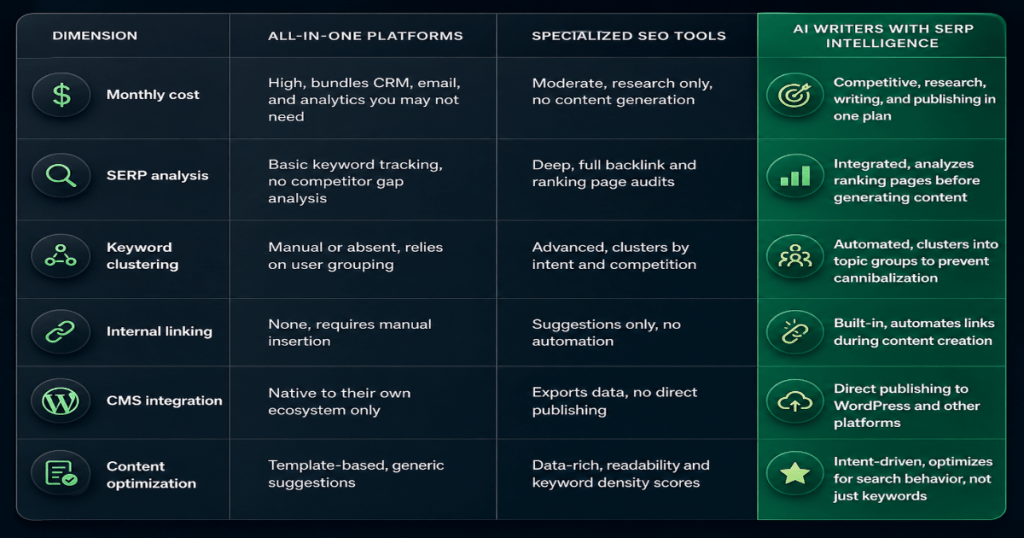
The all-in-one platform bundles features you may never use. The specialized SEO tool gives you data but no way to act on it. The AI writer with SERP intelligence collapses research, drafting, and publishing into a single workflow, and that integration is where the real savings live. For teams producing content at scale, the tool that eliminates handoffs between separate systems is the one that actually pays for itself.
Choosing a tool without evaluating these dimensions means accepting hidden costs that compound with every article. The best content marketing tools on the market today prove that integration beats feature count every time.
How to Build a Content Workflow That Actually Scales
Most content workflows collapse not because the writing is slow but because the steps before writing are missing entirely. Teams jump straight to drafting without analyzing what already ranks, then wonder why their articles disappear into page five of search results. A scalable workflow front-loads the intelligence work so every piece of content competes from the moment it is published.
Step 1. Analyze SERP data to identify content gaps and ranking opportunities. Pull the top ten results for your target keyword and map what each page covers, what angle it takes, and what format it uses. Skip this step and you will write articles that say the same things as every competitor, offering no reason for Google to rank you higher.
Step 2. Cluster keywords into topic groups to avoid cannibalization. Group related search terms under a single pillar page rather than scattering them across dozens of thin articles. Without clustering, your own pages compete against each other and none of them build enough authority to rank.
Step 3. Generate structured articles using a tool that incorporates SERP intelligence. The tool should analyze ranking pages before it writes, not after. This ensures the draft targets the search intent that already works rather than guessing at what readers want.
Step 4. Automate internal and external linking during content creation. Manual linking is the first thing teams drop when deadlines hit, leaving orphan pages that search engines cannot navigate. Tools that handle AI internal linking SEO during generation ensure every new article connects to existing content without a manual audit.
Step 5. Publish directly to your CMS and monitor performance. Direct publishing eliminates the export-import-format loop that eats hours per article. After publication, track which pages gain impressions and which stall, then feed that data back into step one.
Completing this process turns content production from a guessing game into a repeatable system. The workflow itself becomes the competitive advantage, not the tool, not the writer, but the sequence that ensures every article has a reason to exist before a single word is written.
The Human Role in a Tool-Driven Content Strategy
The best content marketing tools are multipliers, not replacements. The teams that treat them as the latter produce content that reads like it was assembled by a machine, because it was. The gap between good content and great content is not in the drafting. It is in the decisions made before and after the tool runs.
Tools handle the heavy lifting. Research, drafting, publishing, all of it gets faster with the right stack. But tone is not a prompt parameter. Fact verification is not a toggle. The human editing requirement for AI content is not a bug in the workflow. It is the feature that separates content that ranks from content that fills space. Editors catch the nuance that SERP data cannot capture. They kill the sentence that sounds right but says nothing.
E-E-A-T signals do not come from a tool. They come from a writer who knows the industry well enough to spot a weak claim, a missing citation, or a paragraph that reads like a textbook. Tools like WryveAI free up the hours that used to go into research and formatting. Those hours get reinvested into the strategic work that no tool can automate: content audits that reveal what is actually working, topic selection that targets real audience needs, and performance analysis that tells you what to do next.
The teams that win are not the ones with the best tools. They are the ones that use the tools to buy time for the work that only humans can do. The tool handles the draft. The human decides whether the draft earns its place in the world.
Pick the Tool That Matches Your Strategy
The best content marketing tools are not the most popular ones. They are the ones that kill your specific bottleneck.
Every team has one. Maybe it is SERP analysis that takes too long. Maybe it is content generation that reads like a robot. Maybe it is the publishing workflow that eats hours every week. The right tool eliminates that single pain point and makes everything else faster.
Act now and the gap widens. Competitors using tools with real SERP intelligence will publish content that ranks while your team still debates which keyword to target. The cost of inaction is not a missed opportunity. It is a steady loss of ground to teams that already fixed their bottleneck.
Audit your current process today. Find the step that wastes the most time. Pick the tool that removes it. Then move on to the next bottleneck.
Every claim in this article was checked against a real source before it was published.
WryveAI researches live search results, writes source-verified content, and publishes straight to WordPress, all in one platform.
Try WryveAI Free →No credit card required.
Frequently Asked Questions About Content Marketing Tools
Which platform is best for content marketing?
The best platform depends entirely on your specific bottleneck, whether that is SERP analysis, content generation, or workflow automation. A tool like WryveAI, which combines SERP intelligence with AI writing and direct CMS publishing, solves the most common bottleneck for teams producing SEO content at scale.
What features should I look for in a content marketing tool?
Look for a tool that integrates SERP analysis, keyword clustering, and internal linking automation into a single workflow rather than requiring multiple subscriptions. The feature that separates useful tools from expensive distractions is whether they analyze ranking pages before generating content, not after.
Can AI content tools replace human writers?
No, AI content tools are multipliers that handle research, drafting, and publishing, but human editors must still refine tone, verify facts, and ensure E-E-A-T signals. The best tools buy time for strategic work like content audits and topic selection that no automation can fully replace.


