
AEO Strategy for SaaS: 6 Tactics That Convert Prospects into Trials

ⓘ TL;DR
- SaaS buyers now start on ChatGPT or Perplexity, not Google. If your content is not structured for AI extraction, you are invisible at the moment that drives trial signups.
- Structure every page so the H2 is a question and the direct answer leads the first paragraph. That is the extraction zone. Everything else is noise.
- Build owned AEO assets before more blog posts. Pricing FAQs, integration docs, compliance pages, and comparison guides get cited for purchase-intent queries. Blog posts do not.
- Drop broad keywords. Target the exact prompt a ready-to-buy user types. Smaller traffic, surgical intent, dramatically higher conversion.
- Keyword rankings are the wrong metric. Track citation frequency in AI answers and trial signups from AI-referred traffic. That is where the revenue signal actually lives.
This is not another article explaining what answer engine optimization is. Most guides stop at theory and leave SaaS teams with nothing.
The reality is harsher. Buyers no longer start their research on Google. They open ChatGPT, Perplexity, or a Google AI Overview and ask a specific purchase question. If your content is not structured for extraction, you are invisible during the moment that matters most, the moment before a trial signup.
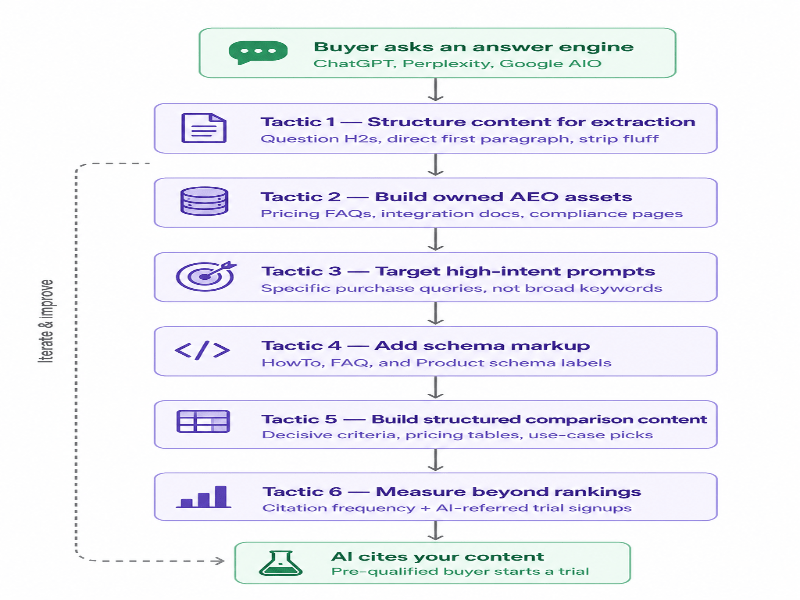
This article shows you exactly how to build an AEO strategy for SaaS that converts AI citations into trial starts. You will find six tactics that move beyond theory into execution: how to structure content for direct extraction, which pages answer engines favor, and how to measure success when rankings no longer tell the full story.
Why SaaS Buyers Already Trust Answer Engines
The B2B SaaS buyer journey has already rewritten itself. Buyers no longer start with a Google search and a list of blue links. They open ChatGPT, Perplexity, or a Google AI Overview and ask a direct question about their specific pain point.
This shift is not theoretical. It is happening inside every purchase cycle right now. A buyer evaluating project management software does not type “best project management tools” into Google. They ask an answer engine: “Which project management tool integrates with Slack and has Gantt charts under $20 per user?” The answer engine returns a curated response. The buyer never visits a single vendor homepage during that session.
Being cited in that AI answer compresses the consideration window dramatically. The buyer trusts the answer engine’s synthesis more than a vendor’s landing page. They skip the awareness phase entirely and move straight to evaluation. A citation from an answer engine is now a referral from a trusted advisor, not a search result.
This is not speculation about the future. The decline of link-driven search traffic is already documented. Gartner predicted that search engine volume would drop by a quarter by 2026 as AI-generated answers replace traditional results. That prediction is playing out faster than most SaaS teams expected. The shift toward answer engine optimization is not optional. It is the new battleground for buyer attention.
The question is not whether answer engines will reshape SaaS discovery. They already have. The question is whether your content is structured to be the answer they cite.
Tactic 1: Structure Content for Direct Extraction
Answer engines do not read content the way humans do. They scan for clear signals: a question-shaped heading, a direct answer beneath it, and nothing in between that obscures the point. Content that provides this structure gets extracted. Content that buries the answer in context, fluff, or narrative flow gets ignored.
Mirror natural language queries in your H2s
Answer engines match headings to user prompts. If a buyer asks “What does this SaaS tool integrate with?” and the H2 reads “Integration Capabilities and Third-Party Support,” the match is weak. Write the H2 as the question itself. “What does this tool integrate with?” is a direct signal. The answer engine sees the match and pulls the paragraph below it.
Place the answer in the first paragraph after the heading
The first paragraph after an H2 is the extraction zone. Put the direct answer there. Not a definition. Not context. The answer. If the heading asks “How much does this plan cost?” the first sentence should state the price. Everything else, feature breakdowns, use cases, comparisons, goes in subsequent paragraphs. Answer engines stop scanning after the first paragraph if they find what they need.
Strip fluff from the extraction zone
Every word between the heading and the answer is a barrier. Remove introductory phrases, qualifying statements, and background context. “Our pricing starts at $49 per month for the Professional plan” is extractable. “When considering the various pricing options available for teams of different sizes, that our Professional plan begins at $49 per month” is not. The second version buries the signal in noise.
Use semantic clarity over keyword density
Answer engines do not count keyword repetitions. They evaluate whether the content answers the query. A paragraph that uses the exact keyword five times but fails to answer the question directly will not get cited. A paragraph that answers the question in plain language, using synonyms and natural phrasing, will. Write for the person asking the question, not for the search algorithm.
WryveAI’s SERP intelligence surfaces the exact phrasing answer engines prefer for each query. This removes the guesswork from structuring content for extraction. The result is content that gets cited, not just ranked.
This process transforms a blog post into a citation asset. The structure does the work. The answer engine finds the signal, extracts it, and serves it to a buyer who is one step closer to a trial signup. Understanding which content formats answer engines favor is the foundation of every tactic that follows.
Tactic 2: Build a Knowledge Base That Answers Purchase Questions
Blog posts rank. Knowledge bases convert. Answer engines pull from the latter when a buyer asks a purchase-intent question because those pages contain the specific, structured information a decision requires.
Most SaaS teams pour resources into blog content and leave their knowledge base as an afterthought. That is backwards. The pages that answer “how much does this cost,” “does it integrate with Salesforce,” and “is it SOC 2 compliant” are the pages answer engines cite during the final research phase before a trial signup.
Build these owned AEO assets first:
- Pricing FAQ pages
- Integration documentation
- Security compliance pages
- Feature comparison guides
- Onboarding and setup walkthroughs
- Use-case specific landing pages
- API reference documentation
Each page type answers a question that appears in a buyer’s search before they visit a vendor site. Pricing FAQ pages get cited because they directly address cost concerns. Integration documentation gets cited because compatibility is a deal-breaker. Security compliance pages get cited because procurement teams require proof before approval.
The concept of owned AEO assets is straightforward: create content that answer engines can extract from directly, rather than content that requires interpretation. A blog post about “why security matters” is not extractable. A page titled “SOC 2 Type II compliance certification” with a bullet list of controls is.
Audit your current knowledge base. Find every page that answers a purchase question but buries the answer in paragraphs. Restructure it for extraction. That single change makes your content citeable by every answer engine your buyers use.
Tactic 3: Target High-Intent Prompts, Not Keywords
The standard SEO playbook for SaaS is dying by inches. Teams spend months optimizing for broad keywords like ‘project management software’ and watch traffic trickle in from people who have no intention of buying. The problem is not the ranking. It is the intent. A person searching a generic term is still in the discovery phase, months away from a purchase decision. An AEO strategy for SaaS must target the exact prompt a buyer types when they are ready to choose.
Before: A SaaS company publishes a blog post titled “What Is Project Management Software.” It ranks on page one for the keyword. Traffic looks healthy. But the bounce rate is punishing. Readers land, skim the definition, and leave. They were never going to convert because they were not asking a purchase question. The content answered a curiosity, not a decision.
After: The same company builds a structured comparison page targeting the prompt “best project management tool for remote teams with budget constraints.” The page lists criteria, pricing tiers, and use-case recommendations. ChatGPT cites it when a buyer asks that exact question. The buyer arrives pre-qualified, already comparing options. The conversion rate from that traffic is dramatically higher because the intent was surgical from the first query. This is the competitor and category prompts approach in practice.
This is the inverted funnel approach. Instead of casting wide and hoping, target the narrowest possible query that signals purchase intent. The traffic is smaller. The conversion rate is higher. The math favors the second approach every time.
Tactic 4: Use Schema Markup to Label Your SaaS Features
Schema markup is the least sexy high-impact tactic in any AEO strategy for SaaS. Most product teams ignore it because it lives in the technical weeds, far from the content calendar. That neglect is a gift to the teams willing to do the work.
Answer engines read your pages through structured data, not through visual design. A pricing page with Product schema tells Google, ChatGPT, and Perplexity exactly what your software does, what it costs, and who it serves. Without that markup, the same page is just text, ambiguous, unlabeled, harder to cite.
Three schema types matter most for SaaS. HowTo schema for onboarding guides and setup tutorials. FAQ schema for pricing questions and feature comparisons. Product schema for your core offering, name, description, price, and supported operating systems. Each one gives an answer engine a pre-labeled answer it can extract without guessing.
Implementation does not require a developer. Plugins like Yoast SEO and Rank Math handle FAQ and HowTo markup through a simple interface. For Product schema, tools like Merkle’s Schema Markup Generator produce the JSON-LD code. Paste it into your page header. Test it with Google’s Rich Results Test. That is the entire workflow.
Most SaaS companies skip this step because it feels like backend work. But AEO for SaaS brands depends on making your content machine-readable. Schema markup is the lowest-effort way to tell an answer engine: this page answers that question. No rewriting. No restructuring. Just labeling what already exists.
The gap between the teams that add schema and the teams that do not is widening. One group gets cited. The other gets ignored. The choice takes ten minutes.
Tactic 5: Create Comparison Content That Gets Cited
Answer engines treat comparison content as a primary source for purchase decisions. A generic ‘vs’ page that lists features side by side gets ignored. A structured comparison with clear criteria, pricing tables, and use-case recommendations gets cited directly in AI answers.
The generic approach fails because it answers nothing specific. It lists features both products share. It avoids taking a position. It reads like a vendor wrote it to avoid offending anyone. Answer engines skip this content because it offers no decisive guidance for a buyer trying to choose.
The structured approach wins because it does the buyer’s work. It names the exact scenarios where one product outperforms the other. It includes pricing tables that show total cost across team sizes. It recommends a specific product for a specific use case. This is the content ChatGPT pulls when a user asks “which tool is better for a five-person remote team with a limited budget.”
This is not about writing a longer comparison page. It is about writing one that answers the actual purchase question. The difference is visible in how answer engines treat the two formats. One gets ignored. The other becomes a citation source that drives trial signups directly.
The owned AEO discussion on Reddit confirms this pattern. Teams that build structured comparison pages see their content cited in AI answers for purchase queries. Teams that write generic ‘vs’ pages see nothing. The difference is not in the topic. It is in the structure and the willingness to make a call.
Build every comparison page as if a buyer will read only the first paragraph after the heading. That is exactly what an answer engine does. Make that paragraph decisive. Make it citeable. The rest of the page supports the claim. The claim itself is what gets extracted.
This approach also delivers clear answer engine optimization benefits. Structured comparisons align directly with how AI models evaluate content for citation. They reward clarity, specificity, and a clear recommendation. Generic content gets none of this.
Tactic 6: Measure AEO Performance Beyond Rankings
Tracking keyword rankings for an AEO strategy for SaaS is like measuring a fishing net by counting the holes. The metric tells you nothing about what you actually caught. Most teams still obsess over organic position changes while answer engines quietly cite their competitors in purchase conversations the team never sees.
Citation frequency in AI answers is the new first-page ranking. A page that gets pulled into a ChatGPT response for a high-intent query like “best CRM for a 10-person sales team with Salesforce fatigue” generates referral traffic that converts differently than organic clicks. The buyer arrives pre-educated, pre-qualified, and already holding your name from a source they trust. That traffic skips the awareness phase entirely.
Referral traffic from answer engines requires separate tracking. Standard analytics tools lump it into direct or unknown sources because the referrer is an API call, not a browser click. Set up custom UTM parameters on your knowledge base pages and comparison content. Tag the links you expect answer engines to cite. Then watch which pages generate trial signups from visitors who never touched a search results page.
Trial signups from AI-referred visitors are the only metric that matters. A page that ranks first for a keyword but drives zero signups is a vanity asset. A page that gets cited in three AI answers and generates five trial starts per week is a revenue engine. Tools like WryveAI’s SERP intelligence surface exactly which content gets cited and for what prompts, turning the black box of AI attribution into a trackable pipeline.
Stop measuring what answer engines ignore. Start measuring what they cite and what that citation produces. The gap between ranking and revenue has never been wider.
Your Next Move in the Answer Engine Era
The six tactics in this guide form a single system, not a checklist. Each one builds on the last, from structural clarity to schema markup to prompt targeting, creating content that answer engines cite and buyers trust before they ever click a link.
Every SaaS team that ignores this shift is already losing trial signups to competitors who show up in AI answers first. The buyer journey has changed permanently. The window to capture attention now happens inside an answer engine, not on a search results page.
Start with tactic one. Audit your current content for extractability. Pick one high-intent purchase question your product answers and restructure that page today. The rest of the system follows from that single decision.
Every claim in this article was checked against a real source before it was published.
WryveAI researches live search results, writes source-verified content, and publishes straight to WordPress, all in one platform.
Try WryveAI Free →No credit card required.
Frequently Asked Questions About AEO Strategy for SaaS
What is AEO and how is it different from SEO for SaaS?
Answer Engine Optimization focuses on getting your content cited by AI models like ChatGPT and Google AI Overviews, while SEO targets traditional search engine rankings. An AEO strategy for SaaS prioritizes structuring content for direct extraction rather than optimizing for keyword density and backlinks.
How long does it take to see results from AEO?
Results depend on how quickly answer engines recrawl and reindex your restructured content, which can happen within days for high-authority pages. The faster you implement structural changes like clear H2s and direct answers, the sooner your content becomes a citation candidate.
Do I need to stop doing SEO to focus on AEO?
No, the two strategies complement each other because well-structured content ranks in both search results and AI answers. The shift is about adding extraction-ready formatting to your existing SEO workflow, not replacing it.
What types of SaaS content perform best in answer engines?
Knowledge base pages, pricing FAQs, integration documentation, and structured comparison guides get cited most frequently for purchase-intent queries. These page types provide the clear, authoritative answers that AI models prefer over narrative blog posts.
Can small SaaS companies compete with larger brands in AEO?
Yes, because answer engines prioritize clarity and directness over brand authority when extracting answers for specific prompts. A small company with a well-structured pricing FAQ page can get cited ahead of a larger competitor whose content buries the answer in marketing fluff.


