
Semantic SEO: The Strategy That Matches How Google Actually Thinks
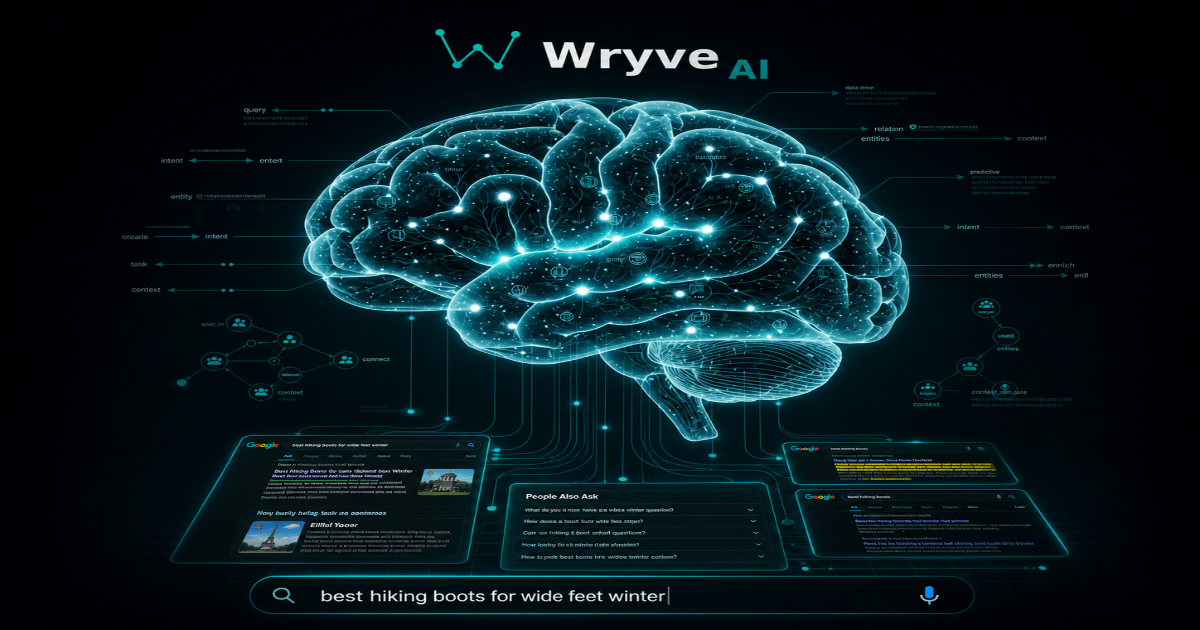
ⓘ TL;DR
- Semantic SEO is not a tactic. It is a mental model. Google stopped matching keywords years ago and started matching meaning, entities, and the relationships between them.
- A keyword-first page fights for one search query. A semantic page built around entities and topic depth owns an entire conversation and ranks for dozens of related queries at once.
- Semantic SEO is not a fourth type to add to a checklist. It is the strategic overlay that determines whether your on-page, off-page, and technical work actually produces rankings.
- Structure is a primary ranking signal. H2s as topic pillars, H3s as subtopic expansions, internal links as entity connections, and schema as explicit meaning all work as a system. Weak H3s under strong H2s mean the page is not finished.
- The same semantic foundation that earns traditional search rankings also satisfies AI answer engines. Entity coverage and intent clarity are not channel-specific. They are the baseline for all search visibility in 2026.
The realization lands at a specific moment. You published the keyword-optimized guide with exact match in the H1. Nothing happens. The page sits on page four, buried under content that covers the topic more thoroughly.
That moment reveals the flaw. You optimized for a search engine that no longer exists. The system now understands language through meaning, relationships, and context. Semantic SEO is not a different type of SEO. It is a mental model that changes how you think about every decision you make.
This article strips away surface-level guides treating semantic SEO as a keyword clustering tactic. You will learn what real depth requires: how to build content around entities and intent, not just phrases. You will see why teams adopting this mental model consistently outrank those chasing exact-match volume.
What Semantic SEO Actually Means
Most SEO practitioners treat semantic SEO as a checklist. Add related terms. Include a FAQ schema. Write longer paragraphs.
This misses the entire point of the shift. Semantic SEO is not a different type of SEO that requires wildly different tactics. It is a mental model that advances how you approach every decision you already make.
The practice is deceptively simple. Build content around topics and entities rather than keywords. A keyword is a string of text a user types into a search bar. A topic is a sphere of connected ideas, questions, and concepts that a user genuinely wants to understand.
An entity is a distinct thing, a person, a place, a product, a concept, that a search engine can identify and connect to other entities. The difference between targeting a keyword and covering a topic is the difference between answering one question and satisfying an entire line of inquiry.
This distinction matters because modern search engines no longer match strings. They build maps. Google’s Knowledge Graph connects entities to each other, forming a web of meaning that goes far beyond the literal words on a page. When you optimize for a single keyword phrase, you are speaking to a system that stopped listening that way years ago. When you structure content around entities and their relationships, you are speaking the language the system actually uses to rank results.
The Ahrefs guide on semantic SEO captures this cleanly. It frames the approach as a mental model that advances everything you already do, keyword research, content structuring, internal linking, rather than a separate discipline requiring new tools. The implication is sharp. Adopting semantic SEO does not mean learning new tactics. It means unlearning the keyword-first instinct and replacing it with entity-first thinking.
Why Keywords Alone Fail in 2026
The old keyword-first approach fails because it optimizes for a search engine that no longer exists. Semantic SEO demands a shift from targeting single phrases to covering the full landscape of a topic. The gap between these two mindsets is where rankings are lost.
This mistake persists because the old method feels safe. Target a keyword, repeat it in the H1, the meta description, and a few body paragraphs. Check the box. Move on.
The reasoning breaks down the moment a competitor publishes a guide that answers every related question a searcher might have.
Before: A travel site wants to rank for “Cinque Terre hiking trails.” It publishes a 600-word post with the keyword in the title, three subheadings, and a dozen mentions. The page ranks on page three for that exact phrase. It captures nothing else.
A searcher lands, finds the trail info, but leaves to Google the question about when to go. The site loses the visitor. The effort yields a single keyword win and a high bounce rate.
After: The same site builds a comprehensive guide to Cinque Terre. It covers the five villages, the best times to visit, how to train between towns, and where to eat. This is a semantic content approach that treats the topic as a web of related entities. Lonely Planet’s Cinque Terre guide ranks in the top spot for 109 keywords. One piece of content captures traffic for trail routes, ferry schedules, and restaurant recommendations. The visitor stays. The page earns authority.
The contrast reveals a hard truth. A keyword-first page fights for a single search query. A semantic page owns the entire conversation. The reader gets everything they need from one source, and Google rewards that completeness.
Building a topic map beats repeating a phrase every time. The question is not which keywords to target. It is which topic deserves a definitive guide.
How Google Understands Topics, Not Words
Search engines stopped matching strings of text years ago. The system now builds knowledge models from entities and their relationships, not keyword frequencies. This shift is the foundation of topical authority SEO and why thin keyword content fails.
Understanding how Google processes language requires looking at four distinct mechanisms. Each one changes how content earns relevance.
Entities as the Atomic Unit of Meaning
Google’s Knowledge Graph stores entities, people, places, concepts, things, as discrete nodes. A page about “Paris” connects to “France,” “Eiffel Tower,” and “romantic travel” through defined relationships. Content that names and links these entities signals depth. The process of giving more meaning and thematic depth to web content is what semantic SEO requires.
Relationships Between Entities Create Context
A single entity means nothing without its connections. “Apple” could be a fruit, a company, or a record label. Google determines which meaning applies by examining the surrounding entities. A page mentioning “Cupertino,” “iPhone,” and “Tim Cook” resolves the ambiguity instantly. The relationship map is the context.
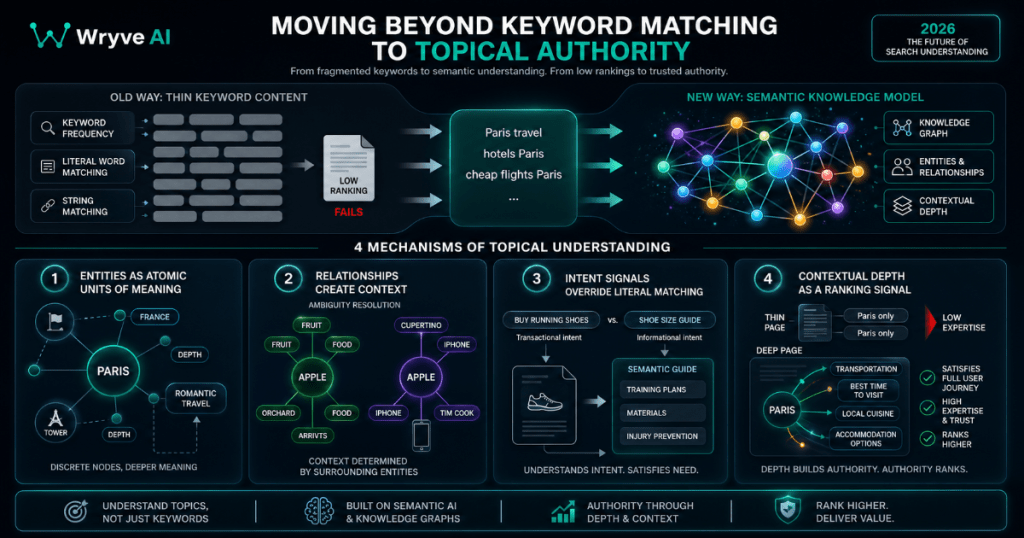
Intent Signals Override Literal Word Matching
Google classifies queries by intent, informational, navigational, commercial, transactional. A page optimized for “buy running shoes” fails if the searcher wants a shoe size guide. Semantic content satisfies the underlying need, not the surface phrase. This is why a guide covering training plans, shoe materials, and injury prevention outranks a product page for “best running shoes.”
Contextual Depth as a Ranking Signal
Google evaluates whether a page covers a topic comprehensively enough to satisfy a user’s full journey. A thin page that mentions one aspect of a topic signals low expertise. A page that addresses related subtopics, answers follow-up questions, and connects to authoritative sources earns higher trust. The depth is measurable in entity coverage and internal link structure.
Each mechanism reinforces the same truth. The system rewards content that mirrors how humans naturally think about subjects, through connected ideas, not isolated keywords. Writing for entities and intent is the only path that survives algorithm updates.
The 4 Types of SEO and Where Semantic Fits
Most SEO guides treat on-page, off-page, technical, and semantic SEO as four separate checklists. This framing misses the relationship that determines which approach actually drives rankings. Semantic SEO is not a fourth type to tick off, it is the strategic overlay that makes the other three work correctly.
On-page SEO optimizes individual pages for specific queries. It handles title tags, headers, and keyword placement. Without semantic thinking, on-page SEO produces pages that match a query but fail to satisfy the broader topic landscape the query belongs to.
off-page SEO in 2026 still relies on backlinks and brand signals. Semantic thinking changes how you earn those signals. A page built around entity depth and topic authority attracts natural editorial links because it answers questions other pages leave open. The link-building tactic becomes secondary to the content quality that earns the link.
Technical SEO ensures search engines can crawl, index, and render pages. Semantic depth informs technical decisions about site architecture and internal linking structure. A semantic topic cluster demands a different information architecture than a flat keyword-targeted site. The technical setup follows the semantic strategy, not the other way around.
Semantic SEO is the only type that is not a standalone discipline. It is a way of thinking that changes how you execute the other three. An SEO who masters on-page, off-page, and technical tactics without semantic depth will produce technically sound content that ranks for nothing. The overlay is the difference between execution and strategy.
Consider how WryveAI handles this. Its SERP analysis surfaces the entity relationships top-ranking pages use. The tool does not just match keywords. It maps the topic landscape a query lives in, then structures content around that semantic territory.
Semantic Keyword Research That Actually Works
Most keyword research tools return a list of phrases and call it done. That approach misses the entire point of semantic SEO, you are not collecting words, you are mapping a topic landscape. The process requires four deliberate steps that build depth rather than density.
Step 1. Identify the core entities for your topic. These are the people, places, concepts, and objects Google expects to see on an authoritative page. Skip this step and your content will lack the foundational signals search engines use to verify relevance.
Step 2. Build a topic cluster around each entity. A cluster is not a list of related keywords. It is a structured set of subtopics that answer the questions a reader would genuinely ask after landing on your page.
Each subtopic earns its place by satisfying a specific search intent.
Step 3. Mine related terms from actual SERP analysis, not from a keyword planner. Open the top-ranking pages for your target topic. Read the headings, the subheadings, the entity mentions, and the internal link anchors.
These reveal the semantic signals Google already rewards. A tool like WryveAI can surface these patterns automatically from its SERP intelligence layer.
Step 4. Map every term and subtopic to a search intent. Informational terms feed the top of the funnel. Commercial terms build the middle.
Transactional terms close the bottom. Content that mixes intents in a single page confuses both the reader and the ranking algorithm.
Completing this process produces a SEO content brief that functions as a semantic blueprint. Every section has a purpose. Every entity has a home. The page stops competing for single keywords and starts owning an entire topic cluster, which is exactly how modern search engines measure authority.
Structuring Content for Semantic Depth
Structure is the primary signal a page sends about what it means and how deeply it covers a topic. A page with flat, undifferentiated headings tells Google the author skimmed the surface.
A page with deliberate, layered structure tells Google the author understands the subject well enough to organize it. That trust translates directly into ranking confidence. The human editing requirement here is about verifying that the structure maps to real entity relationships, not just keyword placement.
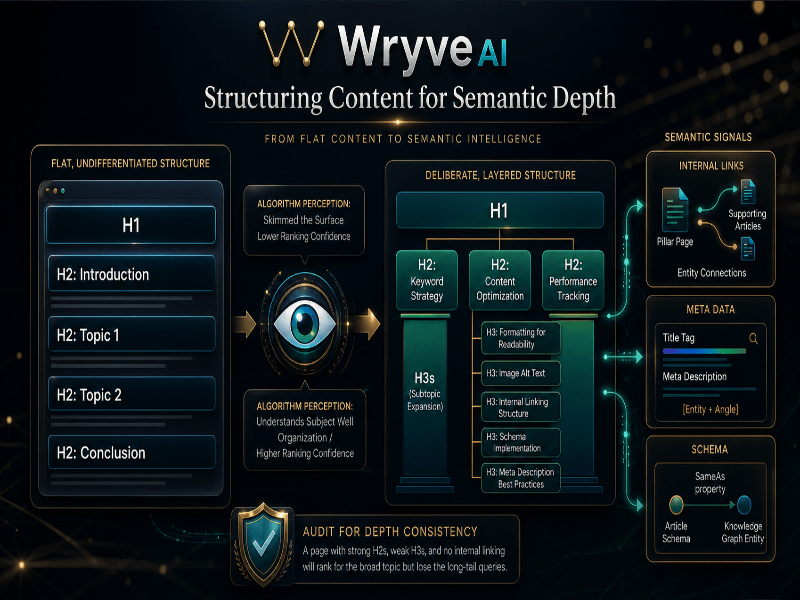
- H2s as topic pillars. Each H2 should represent a core entity or major dimension of the topic. If an H2 cannot survive removal without collapsing the page’s meaning, it belongs there.
- H3s as subtopic expansions. H3s break the pillar into its component parts. A single H2 with five H3s beneath it signals depth more clearly than five H2s that each make a shallow point.
- Internal links as entity connections. Every internal link is a vote that two concepts belong in the same conversation. Linking from a pillar page to a supporting article tells Google those two pages share an entity relationship.
- Meta data as semantic signals. The title tag and meta description are the first place Google checks whether the page aligns with the entity it claims to cover. A title that names the entity and the angle outperforms a title that stuffs keywords.
- Schema as explicit meaning. Structured data tells Google exactly what kind of thing the page is about. An Article schema with a
sameAsproperty linking to a Knowledge Graph entity removes all ambiguity.
These five signals work as a system. A page with strong H2s, weak H3s, and no internal linking will rank for the broad topic but lose the long-tail queries that drive conversions. The structure must hold at every level. Audit your own pages for depth consistency. If the H3s are thinner than the H2s, the page is not finished.
Is SEO Dead or Evolving in 2026?
The question keeps surfacing because something real is shifting. SEO is not dying. It is evolving into a discipline that rewards depth over density and meaning over matching. The practitioners asking whether SEO is dead are usually the ones still optimizing for a search engine that stopped existing three years ago.
Two forces are accelerating this transformation. Generative engine optimization, or GEO, changes how content surfaces in AI-generated answers. Answer engine optimization, or AEO, redefines visibility when users expect direct responses rather than link lists. Both demand the same foundation semantic SEO provides: entity coverage, intent clarity, and structured depth.
Tools like WryveAI already optimize for E-E-A-T, GEO, and AEO because the signals overlap. A page built around entities and relationships satisfies a traditional search engine and an AI assistant equally. The content that ranks in Google’s top three positions is the same content an answer engine pulls for its summary. The discipline is converging, not splitting.
An AEO strategy for SaaS requires the same semantic groundwork as a traditional SEO campaign. The entity map, the topic cluster, the intent alignment, these are not optional for one channel and optional for another. They are the baseline for all search visibility in 2026. The question is not whether SEO is dead. The question is whether your content has the depth to survive both systems.
The practitioners who will thrive are the ones who stop treating semantic SEO as a tactic and start treating it as the operating system for every piece of content they produce. Those who do not will keep asking the same question next year, and the year after, while the gap between their content and the search results widens.
Build a Semantic SEO Strategy That Lasts
Semantic SEO is not a tactic you bolt onto an existing workflow. It is a mental model that rewires how you think about content from the first blank page. The reader who finishes this article understands something most SEOs still miss: Google stopped matching keywords years ago and started matching meaning.
Acting on this now changes what your content can achieve. Content built around entities and intent earns ranking trust across dozens of related queries at once. Content built around keywords earns visibility for exactly one phrase until an algorithm update erases it.
Audit your current library for entity coverage and intent alignment. Strip out the keyword-stuffed pages that serve no real reader. Build the next piece of content around a topic map instead of a keyword list. That single shift changes everything that follows..
Every claim in this article was checked against a real source before it was published.
WryveAI researches live search results, writes source-verified content, and publishes straight to WordPress, all in one platform.
Try WryveAI Free →No credit card required.
Frequently Asked Questions About Semantic SEO
What is a semantic SEO example?
A semantic SEO example is a piece of content that ranks for dozens of related queries by covering an entire topic landscape rather than a single keyword. A travel guide that includes sections on local cuisine, transportation, and seasonal weather for a destination, instead of just repeating the city name, is a classic semantic approach.
What is the difference between semantic SEO and SEO?
Traditional SEO optimizes individual pages for specific keywords to match search queries. Semantic SEO shifts the focus to entities, topics, and the relationships between them, building content that satisfies the full range of user intent around a subject.
What are the 4 types of SEO?
The four types are on-page SEO, off-page SEO, technical SEO, and semantic SEO. Semantic SEO functions as a strategic overlay that informs how you execute the other three, ensuring every technical fix and backlink serves a coherent topical narrative.
Is SEO dead or evolving in 2026?
SEO is not dead, but it is evolving into a semantic-first discipline where search engines and AI answer engines both pull from the same entity-rich content. The practitioners asking whether SEO is dead are usually the ones still optimizing for keyword density rather than topical authority.


