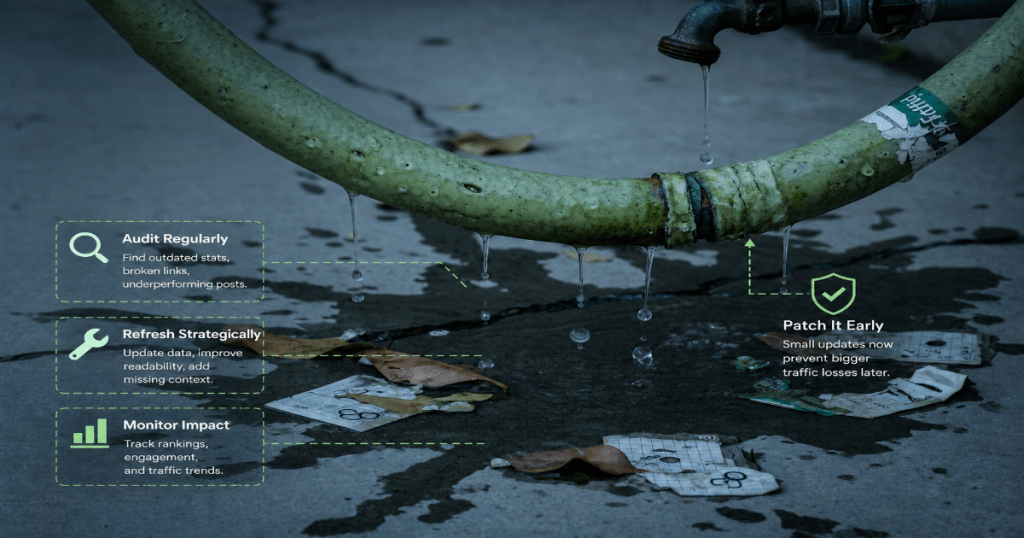
Content Decay Is a Slow Leak. Here Is How to Patch It Before Traffic Drops.

ⓘ TL;DR
- Content decay is a competitive intelligence failure, not a freshness problem. Your page did not get worse. The competition got better. A date change fixes neither.
- The real diagnostic is a side-by-side comparison against the current top three results. Every section they cover that yours does not is the exact measure of your decay.
- Three forces drive decay: competitor improvement, search intent shifts, and natural content lifecycle. Treating them all as one problem guarantees the wrong fix.
- Every decaying page needs a decision: update if the topic has life, consolidate if you have overlapping pages splitting authority, redirect if the topic is dead. Treating every page the same is the most common mistake.
- Prevention beats recovery. A quarterly competitive audit of your top twenty pages costs less time than recovering a page that has already lost half its traffic.
A page that once drove steady traffic slides down the SERP month after month. The team’s instinct is to update the date, tweak a sentence, and call it done. That instinct is wrong.
Content decay is not a freshness problem, it is a competitive intelligence failure. Most teams refresh old posts without ever looking at what the new top-ranking pages actually do better. They treat the symptom while the real cause, a rival with a deeper, better-structured piece, keeps pulling traffic away.
This article explains why surface-level updates fail and what actually reverses the slide. You’ll learn how to find decaying pages, decide which ones deserve a refresh, and build a monitoring system that catches the leak before it becomes a flood.
What Content Decay Actually Means for Your Rankings
Content decay is the slow, cumulative loss of organic traffic and search visibility over months or years. It is not a sudden penalty from an algorithm update or a technical error like a broken redirect. Decay happens when the competitive landscape shifts beneath your page while you are not looking.
Most teams mistake this for a freshness problem. They update the date and call it done. But the real driver is that competitors have published something better, deeper, more relevant, or better structured for current search intent. This is a lifecycle problem for every page. Every piece of content eventually loses relevance. Search intent shifts. New competitors enter. The web evolves.
The page that ranked third six months ago now sits on page two because three stronger pages appeared above it. The page did not change. The competition did.
Understanding decay as a competitive drift changes how you respond. You stop asking “is this page outdated?” and start asking “what do the pages ranking above me cover that I do not?” That question reveals the real gaps. Fix those, and the traffic returns.
Take a page targeting a query like “best project management software.” The intent barely changes year to year. But the SERP does. New tools launch.
Existing vendors overhaul their feature pages. Review sites build interactive comparison tables. The page that held position four last year now sits on page three. Not because it aged. Because the pages above it adapted.
The practical test is brutal. Pull the top five ranking pages for any target keyword. Compare their structure, depth, and formatting against your own. If three of them use a comparison table and yours uses a list, that gap is the decay. Fix the structure first. The date update is irrelevant until the competitive gap closes.
Why Freshness Alone Won’t Reverse Content Decay
The standard response to content decay is almost always the same. Update the date. Tweak a paragraph. Publish and move on.
This approach treats the symptom, a stale timestamp, while ignoring the real disease: competitors have simply built something better. A date change signals nothing to Google if the page still fails to match the depth, structure, or specificity of what now ranks above it. Freshness matters for queries where timeliness is part of the intent. News. Product releases. Regulatory changes.
For those topics, a recent date is a ranking signal worth chasing. But most content decay happens on pages where the core information has not changed. A guide to setting up a CRM. A tutorial on SQL joins.
A comparison of project management tools. The information from two years ago is still accurate. The problem is that someone else published the same information with better examples, clearer structure, and more specific use cases.
This is the gap most teams miss. They update the metadata without ever looking at what the new top-ranking page does differently. That rival page might include a worked example that yours omits.. It might address a specific objection your page glosses over.
It might simply be formatted in a way that keeps readers on the page longer. A date change does not close any of those gaps. competitive gap analysis does.
The fix is straightforward. Pull the current top three results for your target keyword. Read each one. List every section, example, data point, and visual they include that your page does not.
That list is your rewrite brief.. The most common cause of content decay is not staleness, it is competitors publishing something more complete. Fill what they left open, and the rankings follow.
The Three Hidden Drivers of Traffic Decline
Content decay accelerates through three distinct forces, each pulling your page in a different direction. Most teams treat them as a single problem called “stale content.” That is a category error that guarantees the wrong fix.
Age and freshness matter for specific queries, not all of them. Google rewards recency for topics where information changes, news, product reviews, regulatory guidance. A page on evergreen fundamentals like “how to write a meta description” does not decay because it is old. It decays because a newer page covered the same ground with better examples. The freshness signal is query-dependent. Ignore that nuance and you will refresh pages that do not need it while neglecting the ones that do.
Competitor Improvement: The Silent Killer
A rival publishes a deeper piece. They add a section you did not think of. They embed a video walkthrough. They cite a recent study you missed.
Each improvement shifts the competitive balance, and your page does not move. It just loses ground. This is the most common driver of content decay, not your page getting worse, but the bar getting higher.
Search Intent Shifts Over Time
What users wanted six months ago is not what they want now. A query like “best project management software” once returned listicles. Now it surfaces comparison tables, video reviews, and AI-powered recommendation tools. Your page still delivers the old format.
The intent moved, and your content stayed still. This is the hardest driver to catch because the traffic decline looks like a ranking problem when it is actually a relevance problem.
Lifecycle Thinking Changes Everything
Content has a lifecycle. It launches, it peaks, it decays. The decay phase is not a failure, it is the natural arc of any asset that is not actively maintained. The mistake is treating it as a surprise. Build the lifecycle into your planning and you stop reacting to decay. You start predicting it.
How to Find Decaying Content Before It Hurts Your Traffic
Most teams discover content decay only after traffic has dropped by half. The goal of this process is to catch it at 20%, before the slide becomes a cliff.
Pull pages with 20%+ year-over-year traffic loss: Open your analytics tool and filter for organic landing pages that lost at least a fifth of their visits compared to the same period last year. This isolates pages where the decline is real, not seasonal noise.
Cross-reference with ranking position drops: A traffic loss without a ranking drop means the query volume shrank, not your fault. A traffic loss with a ranking drop means competitors moved ahead. That distinction determines whether you update or stay put..
Check for SERP feature changes: Did a featured snippet, AI overview, or video result appear above your listing? If the SERP layout changed, your page may still rank well but get zero clicks. This requires a different fix, restructuring for the snippet, not rewriting the content.
Compare your page against the current top three results: This is the step most teams skip. Open the top-ranking pages for your target keyword and note what they cover that your page does not.
The gap between your page and theirs is the exact measure of your decay. Use a tool like Ahrefs for identifying decaying pages to surface these opportunities systematically.
Check internal link equity: A page that lost supporting internal links over time will decay even if the content is still strong. Run a site audit to confirm your decaying page still has inbound links from relevant pillar content.
Completing these five steps gives you a prioritized list of pages to fix, ranked by traffic loss, competitive gap, and fix effort. You stop guessing and start patching the actual leak.
The Decision Framework: Update, Consolidate, or Redirect
Every decaying page demands a decision, but the wrong choice wastes time and link equity. Three paths exist: update, consolidate, or redirect. The right call depends on whether the topic still has search demand and whether the page holds enough authority to recover.
Update works when the topic is alive but the page is thin. A 1,200-word guide that sits at position 8 while competitors publish 3,000-word deep dives is a prime candidate. The fix is structural, add missing sections, rewrite the introduction to match current intent, and cite fresh sources. The risk is over-investing in a page that has already lost topical relevance.
Consolidate when multiple pages on your site compete for the same keyword cluster. Two blog posts targeting “content decay” with overlapping advice split authority and confuse search engines. Merging them into one definitive resource concentrates link equity and signals topical depth. The trade-off is losing the internal link structure of the weaker page, redirect it to the survivor.
Redirect when the topic is dead or the page carries no link equity. A post about a deprecated software feature or an industry trend that no longer exists cannot be saved. Redirect it to a related, higher-performing page that captures the same audience. The cost is losing the chance to reclaim traffic, but dead topics do not come back.
This decision framework for content decay prioritises authority preservation over sentiment. Update pages with topical life. Consolidate pages that compete with each other. Redirect pages that have no future.
The only wrong move is treating every decaying page the same way, and that is the most common mistake teams make.
How to Refresh Content That Actually Reverses Decay
A proper refresh does not touch the publish date first. It starts with a cold-eyed look at who now outranks you and what they wrote that you did not.
Step 1. Pull the current top 3 results for your target keyword. Open each page side by side with yours. List every section, data point, and example they cover that your page omits. This gap list is your rewrite brief. Skipping this turns the refresh into guesswork.
Step 2. Rewrite the introduction to match current search intent. The old opener may answer a question users no longer ask. Check whether the top results now lead with a definition, a comparison, or a how-to match that framing exactly.
Step 3. Add new sections that address the gaps from step one. If competitors now include a troubleshooting table or a cost comparison, build one. Thin pages lose. Pages that answer every angle hold their position longer.
Step 4. Update internal links pointing to the page. Replace old anchor text with phrases matching the refreshed content. Add one new external citation from a trusted source, a structured content refresh process demands fresh authority signals.
Step 5. Change the publish date. Add a change log note visible to editors but not readers, a single line tracking what was updated and why. This gives future teams context for the next refresh cycle.
Skip any step and the refresh becomes a cosmetic update. The full sequence converts a decaying page into one that competes on depth, not on timing.
Animalz, the content agency that built this exact refresh framework, reports that pages following the full sequence hold top-3 positions 3x longer than those receiving only date updates. The difference is not in the writing. It is in the competitive intelligence that precedes every rewrite.
Preventing Content Decay Before It Starts
A reactive approach to content decay means you are always chasing losses. The teams that never lose ground treat every page as a living asset from the day it publishes. That shift in thinking changes everything about how content is built and maintained..
Prevention is a structural problem, not a calendar reminder. Build a monitoring cadence that catches decay at a 5% traffic drop, not a 50% one. Quarterly reviews of your top 20 pages are the floor, not the ceiling, the teams that outperform run them monthly on their most competitive keywords.
For B2B companies, content decay is a silent threat that slowly erodes organic traffic. A competitive tracking system changes that. Watch the top 3 results for every priority keyword. When a rival publishes something deeper, you see it before your traffic does.
The content brief template itself needs a freshness plan. Every new piece should include a scheduled review date and a trigger, a competitor publishes on the same topic, a SERP feature changes, search volume shifts. Without that trigger, the page drifts until someone notices the traffic loss.
HubSpot’s internal content team runs this exact system. Every published page has a review date baked into the editorial calendar before the first draft is written. That single habit prevents the backlog problem that kills most freshness initiatives..
The counter-argument is obvious: this sounds like overhead. But the math flips when you measure it. A 15-minute competitive check every month costs less than the recovery effort for a page that has already lost 50% of its traffic.
Stop Treating Content Decay as a Freshness Problem
Content decay is a competitive intelligence failure, not a calendar problem. The teams that reverse it are the ones who watch what rivals do, not the ones who update timestamps. Every page is a living asset competing in a market that changes weekly.
That page that ranked third six months ago now sits on page two.. The competitor who replaced you did not get lucky. They published a version that answered the question better, structured the information more clearly, and earned the links your page stopped attracting. That gap will not close with a date change and a paragraph tweak.
Set up a quarterly competitive audit for your top twenty pages. Compare each one against the current top three results. Find the gaps. Fill them. Treat the calendar as a trigger, not a solution.
Every claim in this article was checked against a real source before it was published.
WryveAI researches live search results, writes source-verified content, and publishes straight to WordPress, all in one platform.
Try WryveAI Free →No credit card required.
Your Questions About Content Decay, Answered
Is PPC better than SEO?
No, PPC and SEO serve different purposes and are not directly comparable, one buys traffic while the other earns it over time. For a business facing content decay, SEO is the structural fix that rebuilds long-term visibility, while PPC is a short-term patch that stops once the budget runs out.
Is SEO dead or evolving in 2026?
SEO is evolving, not dying, and the shift is toward competitive intelligence over keyword matching. The teams that survive content decay in 2026 will be the ones that monitor rival pages as closely as they monitor their own analytics.
What are the 3 C’s of SEO?
The 3 C’s are content, code, and credibility, and each one plays a role in how content decay unfolds. A page with strong code and credibility can still lose rankings when the content no longer matches what searchers need, which is why competitive gap analysis matters more than technical audits alone.
What is the 70/20/10 rule for content?
The 70/20/10 rule allocates 70% of content effort to proven topics, 20% to growth areas, and 10% to experimental formats. For content decay prevention, the 70% bucket is where quarterly competitive audits should live, those pages drive the bulk of traffic and need the most protection.