Intent-Based Marketing: The Strategy That Targets Buyers, Not Just Audiences

ⓘ TL;DR
- Intent-based marketing targets behavior, not demographics. A buyer showing purchase signals right now beats a perfect ICP match who is not looking.
- Timing changes the probability of action more than any demographic variable. A message that lands when someone is already looking does not need to persuade. It only needs to answer.
- First-party data is your most reliable signal and the most underused. Pricing page visits, repeated returns, and content downloads tell you more than any third-party broker list.
- Segment by signal strength, not job title. Cold, warm, and hot audiences need different content. Sending the wrong message to the wrong intent level trains buyers to ignore you.
- Single data sources kill intent campaigns. Cross-reference third-party signals against first-party behavior before routing any account to sales. Fewer accounts, more closes.
This is not another article about how to guess what buyers want based on their job title.
Intent-based marketing starts from a different premise entirely. It assumes readiness matters more than demographics. A buyer who fits the perfect profile but has no active need is less valuable than one showing clear purchase signals right now.
Most marketing targets audiences. This targets behavior. The difference is the difference between broadcasting and connecting.
Here you will find a practical framework for identifying purchase-ready buyers using signals already sitting in your analytics, CRM, and content platform. No expensive data contracts required. Just a new way of seeing what is already there.
What Intent-Based Marketing Actually Means
Intent-based marketing is the practice of targeting buyers based on their real-time behavior and purchase signals rather than static demographics. It shifts the focus from who someone is to what someone is doing right now. This distinction changes everything about how campaigns are built and measured.
Most marketing still operates on assumptions about a person’s role or company size. A VP of Sales at a 500-person company gets the same message as everyone else in that bucket. Intent-based marketing rejects that approach entirely. It asks a different question: did this person just visit the pricing page, download a comparison guide, or search for a specific problem your product solves?
The approach rests on three pillars that set it apart from traditional targeting. Context matters, where the buyer is in their journey. Targeting narrows, not by job title but by signal strength. Behavioral insights drive the decision, what the buyer actually did, not what their profile suggests they might do. These three features, outlined in a detailed breakdown of intent-based marketing frameworks, form the operational core of the strategy.
This is not a new channel. It is a new filter for how you use existing channels. The same email platform, the same ad network, the same website, but now you send the right message to the person who just raised their hand.
Why Timing Beats Demographics Every Time
A buyer who fits the ideal customer profile but has never heard of a product is a stranger. A buyer who just landed on the pricing page is a prospect. The difference is not demographic. It is readiness.
This is the core insight behind intent-based marketing approaches. A sale has two parts: connection and action. Connection happens when a message reaches the right person. Action happens when that person is ready to move. Most marketing optimizes for connection alone. It finds the right job title, the right company size, the right industry. Then it sends a message and waits. The action never comes because the readiness was never there.
Consider a SaaS company with two targets. One is a VP of Engineering at a funded startup. Perfect ICP match. The other is a mid-level manager at a smaller firm who just spent ten minutes on the pricing page. The VP has never heard of the product. The manager is actively evaluating. Intent-based marketing targets the manager first. Not because the manager is a better fit on paper. Because the manager is ready now.
Timing changes the probability of action more than any demographic variable ever will. A message that lands when someone is already looking does not need to persuade. It only needs to answer the question they are already asking.
The implication is uncomfortable for teams built around firmographic scoring. The perfect prospect who is not looking will always lose to the imperfect prospect who is.
Where Intent Data Comes From
Intent-based marketing only works when the signals feeding it are real. Most teams chase the wrong data sources first.
Three categories of intent data exist. Each reveals something different about buyer readiness. Each has a blind spot that practitioners ignore at their own cost.
- First-party: your own site behavior and CRM activity
- Third-party: purchased from data brokers tracking external browsing
- Search intent: keyword queries and topic clusters
- Content engagement: downloads, video views, email clicks
- Review and social signals: product comparisons, forum mentions
- Event triggers: job changes, funding announcements, regulatory filings
- Technographic data: tools a company uses that signal a need
The list makes one thing clear: no single source is enough. Third-party data tells you a company is researching a category but not whether they care about your solution. Search intent shows raw curiosity but not purchase readiness. First-party data is the most reliable signal of genuine interest, yet it is the source most teams under-invest in.
The reason is simple. Most businesses track page views and form fills but ignore micro-behaviors: how long someone stayed on the pricing page, which comparison article they read, whether they returned to the same page three times in a week. Those small actions are the difference between a curious browser and a buyer. Intent-based marketing strategies that rely only on broad third-party signals miss this entirely. Start with what your own data already tells you. The rest is noise until you prove otherwise.
How to Build an Intent-Based Marketing Strategy
Building an intent-based marketing strategy requires a shift from guessing who might buy to acting on who is already signaling readiness. Most teams skip the hardest step, defining what a real signal looks like, and end up chasing noise instead of buyers.
Step 1. Define your intent signals with surgical precision. A page visit means nothing. A visit to the pricing page after downloading a case study means everything. Map every micro-behavior, content downloads, search queries, feature page views, to a specific stage of the buying journey. Skip this step and your data will tell you everyone is interested, which is the same as knowing nothing.
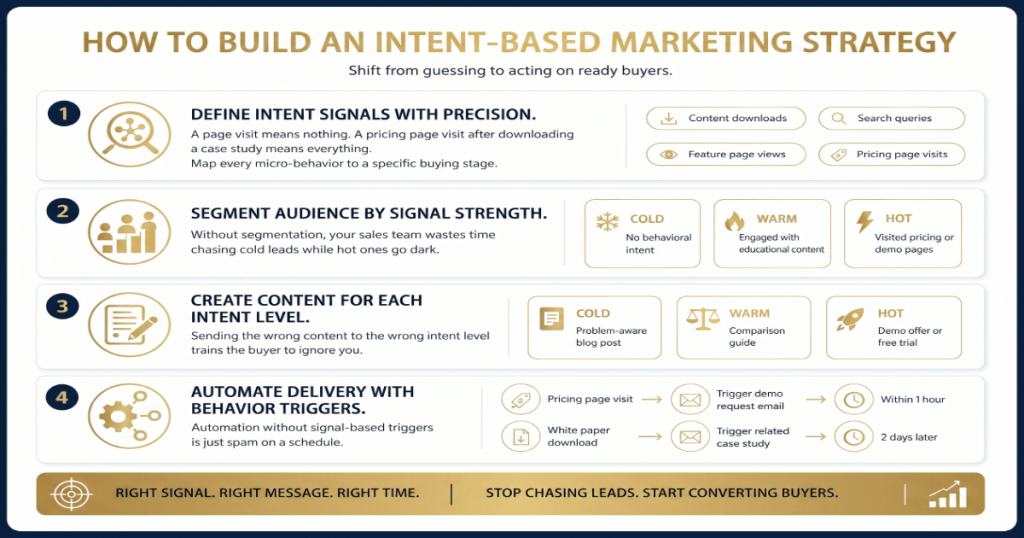
Step 2. Segment your audience by signal strength into three buckets: cold, warm, hot. Cold audiences have shown no behavioral intent. Warm audiences have engaged with educational content. Hot audiences have visited pricing or demo pages. Without this segmentation, your sales team wastes time chasing cold leads while hot ones go dark.
Step 3. Create content that matches each intent level. A cold prospect needs a problem-aware blog post. A warm prospect needs a comparison guide. A hot prospect needs a demo offer or a free trial. Sending the wrong content to the wrong intent level is worse than sending nothing, it trains the buyer to ignore you.
Step 4. Automate delivery with triggers tied to specific behaviors. When a user visits the pricing page, trigger a demo request email within an hour. When they download a white paper, trigger a related case study two days later. Automation without signal-based triggers is just spam on a schedule. This entire approach belongs in any serious digital marketing playbook because it turns passive campaigns into responsive systems.
The divide and conquer approach works because it forces clarity at every step. Completing this process turns a messy lead list into a prioritized queue where every action has a reason and every message has a context. The outcome is not more volume, it is higher relevance, which drives faster decisions on both sides of the sale.
Real Examples of Intent-Based Marketing in Action
A mass email nurture to five thousand prospects and a micro-targeted ABM program to fifty high-intent accounts are not the same strategy scaled differently. They are different strategies entirely. The difference reveals what intent-based marketing actually prioritizes: precision over volume.
The old way sends the same sequence to everyone who fits a demographic profile. It assumes readiness follows a calendar. It works when the list is large enough that statistical probability delivers a few conversions. But it wastes most of its energy on people who are not ready to buy and never will be from that message.
The intent-based way starts with a smaller list. Those fifty accounts have shown real behavior, a pricing page visit, a content download, a product comparison search. The message matches the signal. The ABM program delivers a demo offer to the pricing page visitor and a case study to the content downloader. Every touch has a reason to exist. The conversion rate is higher because the connection was earned, not guessed.
Consider retargeting. The standard approach targets anyone who abandoned a cart. That signal is weak, cart abandonment can mean distraction, comparison shopping, or a technical glitch. The stronger signal is a user who spent ten minutes on the pricing page. That user has done the work. They understand the value. They are comparing options, not browsing. Retargeting that user with a time-sensitive offer or a direct consultation link respects the effort they already made. It converts because it arrives at the right moment, not because it was the most recent option in the ad pool.
The winning approach is not about choosing one channel over another. It is about letting behavior decide which accounts get the full treatment. Intent-based marketing examples consistently show that smaller, signal-driven programs outperform larger demographic campaigns because they start with a connection that already exists.
The 3-3-3 Rule for Sales and Marketing Alignment
The sales team’s research phase is where most deals die before a conversation even starts. Three hours of digging through a prospect’s digital footprint, their recent funding news, their org chart, their tech stack, all before a single email gets written. That is the first third of the 3-3-3 rule, and it is where intent-based marketing changes the game entirely.
Marketing can deliver intent-scored leads that cut that three-hour research window to something closer to thirty minutes. When a prospect visits the pricing page three times in a week, downloads a case study, and searches for a competitor comparison, the sales rep does not need to guess whether this account is worth the time. The data-driven framework has already done the work. The rep opens a profile and sees exactly what signals triggered the lead assignment.
The remaining two thirds of the rule, three touches and three follow-ups, become more effective when the first third is accurate. A rep who knows a prospect is actively evaluating competitors can tailor the first touch around a direct comparison. A rep who sees a prospect has been reading implementation guides can skip the introductory pitch and go straight to a demo offer. The touches land differently because the context is already there.
This is where most alignment efforts break down. Marketing hands over a list of names that fit the ideal customer profile. Sales spends the three hours verifying whether those names are actually in market. The handoff becomes a handoff of work, not a handoff of intelligence.
The practical shift is simple. Use intent data to decide which accounts get the full 3-3-3 treatment and which get a lighter sequence. Not every lead needs three hours of research. Some need a single email and a call. The ones that do, the ones showing clear purchase signals, deserve the investment.
Common Missteps That Undermine Intent-Based Campaigns
The most expensive mistake in intent-based marketing is trusting a single data source. Third-party intent providers sell signals that look precise but often arrive too late or too broad to act on.
Before: A team buys a list of accounts showing “high purchase intent” from a third-party vendor. They route every one of those accounts into a standard sales sequence. The result is a pipeline full of leads that never convert. The data was accurate at the aggregate level but useless at the individual one. The team spent budget on a list and got noise in return.
After: The same team takes that third-party list and cross-references it against first-party signals. A visitor from a target account who also downloaded a pricing guide and returned to the site three times in a week gets priority. An account that only appeared in the third-party feed with no internal validation gets a lower score. This enriched profile of buyer behavior, built from multiple sources, separates real readiness from statistical noise. The team now acts on fewer accounts but closes more of them.
The same logic applies to message delivery. A pricing page visitor who receives a demo offer converts. A blog reader who receives the same demo offer unsubscribes. Matching the message to the specific signal is not a refinement. It is the entire point.
Start Targeting Readiness, Not Demographics
Intent-based marketing is not another channel to add to the stack. It is a different filter for the channels already running.
The teams that act on this now will stop wasting budget on people who look right but are not ready. The teams that wait will keep filling pipelines with names that never convert.
Audit the lead scoring model this week. Add one behavioral signal, a pricing page visit, a demo request, a specific search query. Let that signal decide who gets the next campaign. The rest can wait.
Every claim in this article was checked against a real source before it was published.
WryveAI researches live search results, writes source-verified content, and publishes straight to WordPress, all in one platform.
Try WryveAI Free →No credit card required.
Frequently Asked Questions About Intent-Based Marketing
What is the 3 3 3 rule in sales?
The 3-3-3 rule in sales is a framework that allocates three hours of research, three touches, and three follow-ups per prospect. Intent-based marketing makes this rule far more effective by delivering pre-scored leads that cut the research phase down to minutes.
What is an example of intent marketing?
A SaaS company retargeting a user who spent ten minutes on the pricing page with a live demo offer is a textbook example of intent marketing. The message matches the signal, turning a passive browser into a high-priority conversation.
What are the 4 types of intent?
The four types of intent are navigational, informational, commercial, and transactional. Each type reveals a different stage of buyer readiness, from learning about a problem to actively comparing purchase options.