
FAQs for AEO: How to Structure Answers that Rank in Answer Engines
ⓘ TL;DR
- Most FAQ pages fail AEO because they treat questions as afterthoughts. Answer engines skip thin Q&A lists with no schema, no structure, and no supporting context.
- Every extractable FAQ block needs four things: a direct question as the heading, the complete answer in the first sentence, two to three supporting sentences, and valid FAQ schema markup. Missing any one drops your citation probability.
- Question format determines whether the answer engine reads the page at all. Full interrogative sentences between five and ten words match search intent. Keyword fragments signal nothing and get ignored.
- Five to ten intent-aligned FAQs is the sweet spot. More than ten and the page reads as content-light filler. Fewer than five and the page lacks the depth engines need to trust it.
- Schema markup is not optional. It is the explicit signal that tells answer engines this page contains structured Q&A content worth extracting. Pages without it compete on general content quality alone.
This article will not give you a generic list of FAQ best practices that apply to every page equally. It will show you the exact structural decisions that determine whether answer engines cite your content or skip it entirely.
Most FAQ pages fail because they treat questions as afterthoughts. A one-line question with a one-sentence answer, no schema, no supporting context, that is not an answer block. That is a text fragment that answer engines have no reason to trust. The difference between a cited FAQ and an ignored one comes down to four specific components, and most pages miss at least three of them.
Here you will find the precise format, vocabulary choices, and technical markup that make FAQs for AEO work. By the end, you will know exactly how to structure every Q&A pair as a machine-readable, citation-ready answer block that satisfies both user intent and AI extraction logic.
Why Most FAQ Pages Fail Answer Engine Extraction
Most FAQ pages are written as an afterthought, and answer engines treat them accordingly. The standard approach produces thin Q&A lists that lack the context, authority signals, and structured data required for extraction. These pages get skipped because they look like filler, not like sources.
Before: The typical FAQ page is a graveyard of missed opportunity. One-line questions sit above one-sentence answers with no supporting detail, no schema markup, and no logical grouping. A reader gets a fragment. An answer engine gets nothing it can confidently cite. The page exists because someone checked a box, not because anyone thought about the content formats answer engines favor.
After: An AEO-ready FAQ page treats every question as a standalone content asset. Each question becomes a full H2 or H3 heading written in natural language. Each answer runs two to three sentences, a clear claim followed by supporting context that builds E-E-A-T. FAQ schema tells the engine explicitly that this is a structured Q&A pair. The page looks like an authoritative reference, not a checklist.
Answer engines extract from pages that look like they were built to be cited. They skip pages that look like they were built to be ignored. The difference is not subtle, it is structural. WryveAI’s approach to structuring content for answer engines starts with this distinction: build every FAQ block as if an AI is going to read it first, because it will.
The Anatomy of an AEO-Ready Answer Block
Answer engines do not guess which content to cite. They look for a specific structure that signals authority and relevance. Every FAQ block needs four components to be extractable, and missing any one of them drops the citation probability by a measurable margin.
These components are not optional. They are the floor for getting your FAQs for AEO to work.
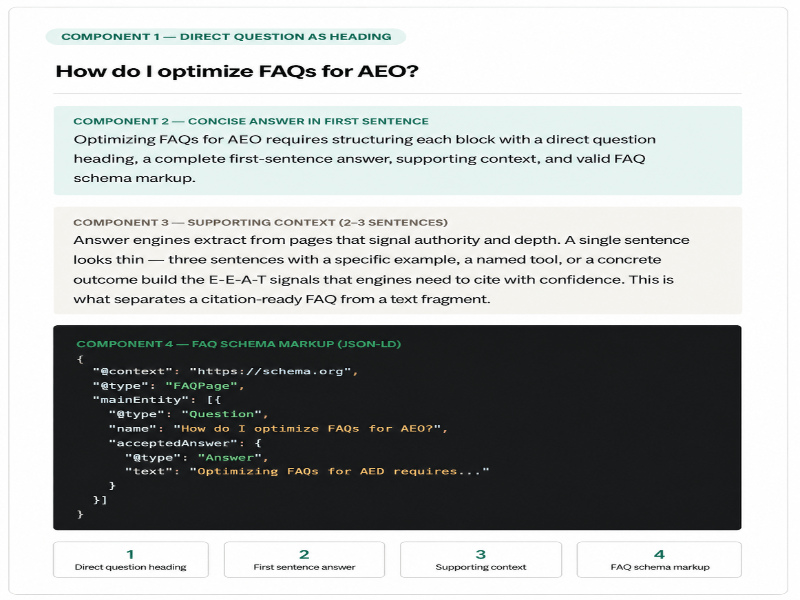
- Direct question as heading: Use the exact phrasing users type into search bars. A paraphrase like “Ways to optimize FAQs” will not match the query “How do I optimize FAQs for AEO?” The engine matches the heading to the question. Give it the exact match.
- Concise answer in the first sentence: Answer engines often pull only the first sentence for featured snippets and AI overviews. That sentence must contain the complete answer. Everything after it is supporting context, not the core claim.
- Supporting context in 2-3 follow-up sentences: This builds E-E-A-T and gives the engine confidence to cite the page. A single sentence looks thin. Three sentences with a specific example, a named tool, or a concrete outcome signal depth. This is where page structure for AEO separates winners from filler.
- FAQ schema markup: This tells the engine explicitly that the content is a Q&A pair. Without it, the engine must infer the relationship between the heading and the text. With it, the relationship is declared. Schema is the difference between being found and being guessed.
These four components work as a system. A direct heading without a concise first sentence gets ignored. A concise answer without schema gets buried. Missing any one component reduces the chance of citation. Tools like WryveAI that handle E-E-A-T compliant article generation automate this structure, but the logic applies whether you build it manually or at scale.
Audit your current FAQ pages against this framework. Count how many components each block has. The gaps will tell you exactly why answer engines skip your content.
Question Formats That Trigger AI Citations
Most FAQ pages fail before the answer engine reads a single word. The failure is in the question itself.
Answer engines process natural language. They match queries against content that mirrors how people actually speak. A question phrased as a keyword fragment, “FAQ AEO optimization”, signals nothing to an extraction algorithm. It looks like a tag, not a query. The engine moves on.
Full interrogative sentences trigger citations. “How do I optimize FAQs for AEO?” matches the user’s search pattern exactly. The engine recognizes the intent, extracts the answer, and surfaces it. This is the difference between content that gets cited and content that gets ignored.
Question length matters more than most writers realize. Very short questions, three words or fewer, lack the context engines need to match intent. Very long questions, over fifteen words, introduce ambiguity that confuses extraction logic. The sweet spot sits between five and ten words. That range captures enough context to signal intent without introducing noise.
Tools that analyze answer engine optimization patterns reveal which question formats already trigger citations for competitors. WryveAI’s SERP intelligence analysis identifies these patterns automatically. It shows exactly which interrogative structures, word counts, and phrasings are earning citations in your niche. That data removes the guesswork from question formatting.
The question format determines whether the answer gets read. Get the format wrong and nothing else matters.
How Many FAQs Should an AEO Page Carry?
The standard advice on FAQ quantity is backward. Most guides tell you to add as many questions as possible, assuming volume signals authority. That approach actively damages your chances of being cited by answer engines.
Adding questions and direct, clear answers to your site is a good technique for getting your content cited in the AI Overview or the “People Also Ask” sections in Google results. ChatGPT and Perplexity like this type of content, too. But as with nearly everything in SEO, it’s entirely possible to have too much of a good thing. You should use FAQs only where they make sense naturally.
Five to ten well-structured FAQs is the sweet spot for most topics. Fewer than five and the page lacks the depth answer engines need to consider it authoritative. More than ten and the page risks becoming a thin Q&A list that engines devalue as content-light.
The real variable is user intent. A topic with three distinct search intents needs three FAQs, not ten. A topic with seven distinct intents needs seven. Let the number of real questions people ask determine the count, not a template or a content quota.
Quality and structure matter more than count. One deeply researched, schema-marked FAQ block with a direct heading and a multi-sentence answer is worth more than twenty shallow ones. Answer engines extract from pages that look like authoritative sources, not from pages that look like afterthoughts.
FAQ bloat creates a second problem. When every paragraph is turned into a question, the page loses narrative flow. Engines struggle to identify the primary answer because every sentence is framed as an inquiry. The page becomes noise.
Use keyword research and clustering to identify the exact questions your audience asks. Then build FAQ blocks only for those intents. Everything else is filler that dilutes your citation potential.
FAQ Schema: The Technical Signal Answer Engines Expect
FAQ schema is the difference between being read and being cited. Without it, answer engines treat your Q&A content as ordinary text buried in a page. With it, you hand the engine a labeled, structured block it can extract with confidence.
Schema markup is the explicit declaration that this page contains organized question-and-answer pairs. Answer engines scan for this signal first. Pages without it compete on general content quality alone. Pages with it get priority extraction treatment.
Identify the primary question for each FAQ block. Every schema entry needs one clear question. Not a paraphrase. Not a keyword string. The exact phrasing users type into search bars. This question becomes the headline the engine displays in its answer block.
Write the acceptedAnswer property with precision. This field holds the text answer engines will cite. Keep it to the first one or two sentences of your answer. The engine often truncates longer responses, so front-load the direct claim. Supporting context belongs in the visible page content, not in the schema property.
Implement the schema using JSON-LD format. JSON-LD is the standard answer engines prefer. It sits in the page head as a script block, separate from visible content. Microdata works but clutters the HTML and creates more points of failure. JSON-LD keeps the schema clean and the page maintainable.
Validate the schema with Google’s Rich Results Test. A single syntax error invalidates the entire block. Run every FAQ page through the validator before publishing. The test catches missing properties, incorrect nesting, and formatting issues that would otherwise block extraction.
Monitor schema errors in Google Search Console. Schema markup degrades over time. CMS updates, plugin changes, or accidental edits can break the JSON-LD block. Search Console flags these issues. Check it monthly. Fix errors the same week they appear.
Pages with valid FAQ schema get cited at measurably higher rates than identical pages without it. The markup does not improve the content. It improves the engine’s ability to find and trust the content. An answer engine optimization guide confirms this pattern across multiple industries. Tools like WryveAI, built as an AI content writing tool, automate schema generation so every FAQ block ships extraction-ready from the start.
Localizing FAQs for Regional Answer Engine Visibility
Answer engines do not treat all queries the same way. A question about winter home preparation gets routed to different sources depending on whether the user searches from Iowa or Arizona. Most FAQ pages miss this entirely, serving generic answers that satisfy no one and get cited by no one.
Localization is not about swapping a few words. It is about rewriting the question itself to match regional dialect, local names, and location-specific concerns. A generic “How do I winterize my house?” competes against thousands of identical pages. A localized version like “How do I prepare my Iowa house for winter?” signals relevance to both the user and the extraction algorithm. The regional language and terms approach works because it mirrors how people actually search.
The dual benefit is real. Localized FAQs improve local visibility for regional queries while still supporting national and global SEO. A strong FAQ section built this way does not sacrifice breadth for depth. It layers regional specificity on top of a universal foundation.
Over-localization carries a real risk. An FAQ too specific to one region loses relevance for broader queries. The solution is a core set of universal FAQs with regional variations layered on top. Multi-country SERP targeting tools can identify which local question formats already trigger citations in different markets. That data tells you where to localize and where to stay broad.
The implication is uncomfortable for teams that write one FAQ page and call it done. Answer engines reward specificity. Generic content gets generic results. Localized content gets cited.
Measuring FAQ Performance in Answer Engine Results
What gets measured gets cited. Most teams publish FAQ pages and never check whether answer engines actually use them. That blind spot turns a strategic asset into dead weight.
Five metrics separate FAQ pages that earn citations from those that sit in the index untouched. Each one reveals a specific failure point or opportunity in the extraction pipeline.
- Citation rate
- Click-through rate from answer engines
- Position in answer engine responses
- Question match rate
- Schema validation rate
Citation rate is the headline metric. It tells you whether answer engines consider your FAQ content authoritative enough to surface. A page with zero citations in three months has a structural problem, not a content problem.
Click-through rate from answer engines requires setup. Standard analytics miss traffic from AI overviews and featured snippets unless you configure source tracking. Without it, you cannot tell whether citations drive visits or vanish into zero-click results.
Position in answer engine responses matters because the first answer captured gets the most visibility. AEO graders and SERP tracking tools show whether your FAQ appears in the primary answer block or gets buried in the “People Also Ask” expansion.
Question match rate connects your FAQ content to actual search behavior. If your questions do not match real user queries, answer engines have no reason to extract them. Cross-reference your FAQ questions against search query data from your keyword research or content marketing tools.
Schema validation rate catches technical failures before they kill citations. Google Search Console flags errors in FAQ schema implementation. A single validation error can prevent an entire FAQ block from being recognized as structured Q&A content.
Regular measurement against these five metrics turns FAQ pages from static content into living assets. The data tells you which questions to rewrite, which answers to expand, and which schema elements to fix. Teams that measure monthly capture more citations than teams that publish and forget.
Audit Your FAQ Pages for AEO Readiness
The gap between a FAQ page that gets cited and one that gets ignored is not about luck. It is about structure, schema, and treating each question as a strategic asset for answer engines. You now know the exact components that make FAQs for AEO work.
Every week you delay this audit, competitors with thinner content but better structure capture the AI search traffic that should be yours. The brands that win in answer engine results are not the ones with the most content. They are the ones with the most extractable content.
Open your highest-traffic FAQ page right now. Check it against the four-component framework. Add FAQ schema. Rewrite any question that reads like a keyword fragment. Do this for one page this week. Do it for ten pages next month. The results will speak for themselves.
Every claim in this article was checked against a real source before it was published.
WryveAI researches live search results, writes source-verified content, and publishes straight to WordPress, all in one platform.
Try WryveAI Free →No credit card required.
Frequently Asked Questions About Structuring FAQs for AEO
What is the difference between SEO FAQs and AEO FAQs?
SEO FAQs are written to capture keyword traffic and improve on-page relevance signals for traditional search rankings. AEO FAQs are structured specifically for extraction by answer engines, using direct question headings, concise first-sentence answers, and FAQ schema markup to increase citation probability in AI overviews and featured snippets.
How many FAQs should I include on an AEO-optimized page?
Five to ten well-structured, intent-aligned FAQs deliver the best balance of depth and extractability for answer engines. Quality and schema compliance matter far more than quantity, one deeply researched FAQ block with valid markup outperforms twenty shallow entries every time.
Does FAQ schema help with answer engine citations?
Yes, FAQ schema is the explicit technical signal that tells answer engines this page contains structured Q&A content worth extracting. Pages with valid FAQ schema consistently receive higher citation rates than identical pages without it, all other factors being equal.
Can I use the same FAQ content for both Google and ChatGPT?
Yes, the same FAQ content works across both platforms when structured correctly with direct question headings and concise first-sentence answers. The key difference is that ChatGPT and other LLMs favor slightly longer contextual answers than Google’s featured snippets, so adding two to three supporting sentences after the core answer improves extraction across both systems.
How do I know if my FAQ content is being cited by answer engines?
Monitor Google Search Console for impressions and clicks from AI overviews and featured snippets, and use AEO grading tools to check whether your FAQ content appears in answer engine responses. Tracking citation rate and question match rate monthly reveals which FAQ blocks drive extraction and which need restructuring.


