
How to Optimize Content for Google AI Overviews in 2026
ℹ️ TL;DR
- To optimize content for Google AI Overviews, cover every sub-question of the query, not just the primary keyword. The AI cites depth, not surface.
- Semantic HTML, matching structured data, fast crawlability, and clean internal linking are the technical foundation the synthesis engine needs to trust your page.
- Own a single criterion instead of chasing broad head terms. The page that answers one sub-question better than anyone else earns the citation.
- Brand mentions from authoritative sources now outweigh raw backlink volume. AI Overviews reward real-world relevance, not just link equity.
- Optimization is not a one-time project. Monthly monitoring, content refreshes, and multimedia depth are the only way to keep earning AI citations.
The last content audit revealed the uncomfortable truth: the page ranking for the primary keyword was not the one getting cited in Google’s AI Overview. The other one, buried deeper in the site, answered the subquestions more completely. That is the shift most SEOs are missing.
Treating AI Overviews as a new ranking factor to game misses the point. Google now synthesizes answers from multiple sources, and it will only trust the page that proves it can handle the full scope of a query. Surface-level tactics do not survive that filter.
This article shows you how to optimize content for Google AI Overviews by owning a specific criterion and building the technical foundation that makes your page the only logical source to cite. You will leave with a framework that outlasts the next algorithm update.
Why AI Overviews Reward Depth, Not Just Keywords
Treating AI Overviews as a separate algorithm to hack misses the entire point of why they exist. They are an extension of Google’s core mission: answer the query faster, with less clicking. The AI does not rank pages the way the traditional index does; it synthesizes an answer from sources it considers trustworthy.
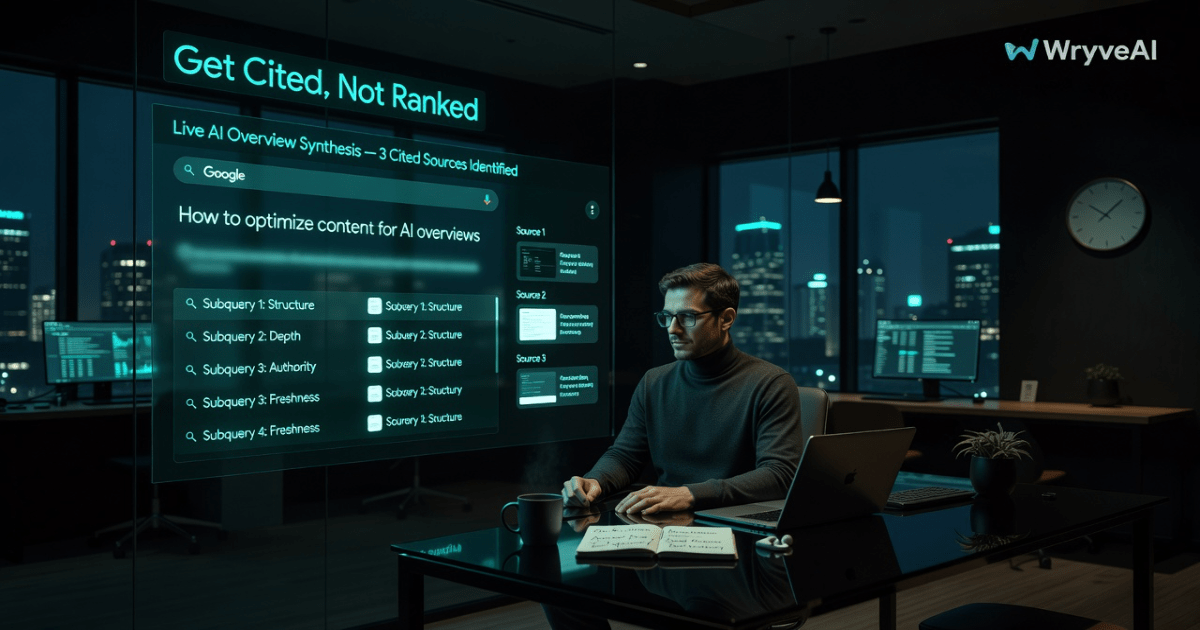
That synthesis is the crux. When a user asks a broad question, the AI breaks it into sub-questions it must answer to satisfy the intent. A page that covers the primary keyword but ignores those sub-questions gets skipped. The AI needs material that resolves the full scope of the query, not just a fragment of it. The subquery breakdown guide from Search Engine Land illustrates how granular these underlying questions become.
Surface-level content fails here because it offers the AI nothing to synthesize. It states the obvious, restates the headline, and stops. The AI is looking for pages that answer the secondary questions with the same authority as the primary one. That is where the decision to cite is made.
Depth is not about word count; it is about coverage. A page that answers every subquery a user might ask becomes the only logical source to cite. This is why SERP intelligence tools matter more than keyword stuffing. They reveal the actual questions embedded in a query, turning a vague topic into a structured content brief.
WryveAI uses this kind of SERP analysis to map those subqueries before a draft exists. The output is built to cover the full query landscape, not just the obvious head term. That is the difference between a page that ranks and one that gets cited. The uncomfortable implication is that your current content likely has gaps you cannot see from the keyword report. The AI sees them instantly.
The Technical Structure That Makes AI Trust Your Page
Most teams obsess over keywords while their heading hierarchy looks like a random number generator. The AI parsing your page needs a clean, logical skeleton to understand what matters and what is just decoration.
Semantic HTML is the foundation. A single <h1> that mirrors the query, <h2> elements for each major subtopic, and <h3> tags for supporting points create a map the AI can follow. If your headings tell a coherent story, the AI assumes the content does too.
Structured Data That Matches What Readers See
Schema markup is not a magic ranking spell. It is a confirmation layer. When your structured data describes the same facts, dates, and entities visible in your prose, the AI cross-references both signals and increases its confidence in your page.
Crawl Speed and Internal Links That Guide the AI
A page that loads slowly or sits orphaned with no internal links is a page the AI struggles to reach and verify. Clear internal linking from related articles tells the crawler your page is part of a broader topic cluster, not a standalone guess.
Mobile and Accessibility as Trust Signals
Google’s own guidance on AI optimization emphasizes that pages must work for everyone. Proper alt text, readable font sizes, and responsive layouts signal that the content was built for humans, which is precisely the kind of page an AI wants to cite.
WryveAI’s direct WordPress publishing handles much of this technical output automatically. The clean semantic structure and schema are generated as part of the content, not bolted on afterward. That is the difference between a page built for AI citation and one that merely hopes for it.
Own a Criterion: The Authority Shortcut for AI Citations
Chasing the top spot for a broad head term is the fastest way to get ignored by an AI Overview. The synthesis engine does not reward generalists; it rewards the page that answers one specific sub-question with total authority.
Owning a criterion flips the strategy. Instead of covering everything, pick the single angle you can defend better than any publisher on the web. The AI cites the source that consistently resolves that one sub-query, not the source that touches on all of them superficially.
Take a topic like “email marketing.” A general guide will not get cited. A page that owns the criterion of “cold email deliverability fixes” becomes the definitive answer for that sub-question. Every time the AI needs that specific piece, it pulls from that page. That narrowness is what builds citation frequency.
This is where owning a criterion changes how you plan content. The work shifts from producing broad pillar pages to mapping every sub-question in your niche and assigning one page to own each. The page that answers one question better than anyone else wins the citation, regardless of domain size.
keyword clustering is the practical tool for this. It groups related queries by intent, revealing which criteria are underserved and which are saturated. That data tells you where to build the definitive resource instead of another generic overview. The competitive edge is not writing more; it is writing the one thing the AI cannot find elsewhere.
The uncomfortable implication is that your existing content library may be working against you. Pages that try to rank for five different sub-queries at once signal to the AI that you are an authority on none of them.
Links and Brand Signals: The Trust Layer AI Can’t Ignore
The backlink debate misses what AI Overviews actually reward. Traditional links still matter, but brand mentions from authoritative sources now carry weight that raw link volume cannot match. The comparison reveals a shift in how trust gets calculated.
Traditional backlinks built the old web. A page with hundreds of referring domains ranked, regardless of whether anyone knew the brand behind it. That model still works for competitive keywords where link equity decides the SERP. But AI Overviews parse meaning, not just authority scores.
A page with thin content and a massive link profile gets skipped. The AI reads the page, finds nothing distinctive, and moves to a source that answers the subquestion with genuine expertise. Link volume alone no longer guarantees a citation.
Brand mentions tell a different story. When authoritative publications reference a company by name, the AI treats that as evidence of real-world relevance. Consistent mentions across industry outlets, directories, and press coverage build an entity signal that pure link building cannot replicate.
The trade-off becomes clear when you compare the two side by side. A handful of high-quality links combined with steady brand mentions outperforms a large volume of low-quality links every time. The AI needs both signals, but it weights the qualitative ones more heavily.
WryveAI’s brand profile management tracks these mentions across the web, so you can see which sources reference your brand and where gaps exist. That visibility turns an abstract trust signal into something you can actively shape. The old link-building playbook still has a role, but the brands winning AI citations are the ones building a recognizable identity, not just accumulating URLs.
Multimedia and Voice: The Formats AI Prefers to Cite
Text-only pages are losing ground in AI Overviews. Google’s synthesis engine pulls from diverse content formats because they let it verify claims and answer follow-up questions with less guesswork. Pages that mix media give the AI more signals to trust. Pages that don’t become invisible.
- Descriptive images. Alt text and captions do more than help accessibility. They give the AI a textual anchor for visual content, letting it confirm that a diagram or chart actually supports the claim being made.
- Video with transcripts. A transcript turns spoken content into crawlable text. Timestamps let the AI cite a specific moment rather than a vague reference, which makes your page a cleaner source to pull from.
- Data-driven infographics. Infographics condense complex comparisons into a single visual. When the AI needs to present a quick answer, a well-structured infographic gives it a ready-made summary it can reference directly.
- Conversational FAQs. FAQ sections mirror the natural language people use when asking the AI questions. Matching that phrasing signals that your page answers the query as it was actually spoken, not just as it was typed.
The pattern here is simple: every format you add gives the AI another way to understand your page. That redundancy is what separates a cited source from a skipped one.
Tools like WryveAI build multimedia suggestions into the generation workflow, so you are not retrofitting media after publication. You are publishing with it from the start. That is the difference between content the AI can use and content the AI has to work around.
Voice search is quietly reshaping what the AI considers a complete answer. Pages that address the question as it would be spoken, not typed, are easier for the engine to quote back verbatim. Spoken-language alignment is a ranking signal most text-first publishers ignore. The AI is not just reading your content. It is listening for the phrasing it can repeat without sounding robotic.
The Always-On Mindset: Monitoring and Adapting to AI Overviews
Optimizing for AI Overviews once is a one-way ticket to irrelevance. Google retrains its models, user behavior shifts, and the sources cited today get dropped tomorrow. The teams that keep winning treat monitoring as a recurring commitment, not a launch-day checkbox.
Step 1. Track your visibility in AI Overviews through Google Search Console. Filter for queries where your pages appear in the AI-generated response, not just the organic results. This baseline tells you where you already hold trust and where you are invisible.
Step 2. Analyze which queries in your niche trigger AI Overviews at all. Some topics get synthesized answers constantly; others rarely do. Knowing the difference stops you from over-investing in content that the AI will never cite.
Step 3. Compare your cited pages against the ones Google’s AI actually pulls from. The gap between what you cover and what the cited source covers is your content gap. Close it by expanding sections, adding subqueries, and sharpening the specific criterion you own.
Step 4. Refresh content to maintain relevance. The AI favors recent, updated information, so a page that answered the query last quarter may lose its spot to a newer source. Schedule a regular content refresh cycle that revisits every page earning AI visibility.
Step 5. Repeat the entire process monthly. AI Overview behavior shifts faster than traditional rankings, and a quarterly review leaves you reacting to losses instead of preventing them. A monthly cadence keeps your content aligned with the current synthesis logic.
WryveAI’s content refresh strategy automates the heavy lifting here, flagging stale pages and regenerating sections that lost their edge. The teams that win AI citations treat this as a permanent operational loop, not a one-off optimization sprint.
What Most AI Overview Guides Get Wrong
The prevailing advice on how to optimize content for Google AI Overviews reads like a list of parlor tricks. Chase featured snippets, format for extraction, stuff the page with Q&A markup, and the AI will reward you with a citation.
That advice is a trap. It treats the symptom as the cause, and it produces content that looks optimized but fails the only test that matters: whether the AI actually trusts the page enough to synthesize an answer from it.
The misconception persists because it feels logical. Google’s AI Overviews are new, so the playbook must be new. The reasoning breaks down the moment you realize the AI is still Google, and Google has spent two decades defining what it trusts.
Before: A content team reads the hype, abandons its editorial standards, and publishes thin pages engineered around extraction patterns. The pages rank for nothing, get cited nowhere, and the team blames the algorithm for being unpredictable.
After: The same team treats AI Overviews as a byproduct of quality, not a target to hit. It builds pages with demonstrable expertise, clear structure, and complete coverage of the query’s subquestions. Those pages get cited because they were the only logical source to cite.
Google’s own guidance confirms this. The official AI optimization guide states that foundational SEO remains the baseline. Structured data, clear headings, and fast pages matter more than any AI-specific gimmick.
This contrast reveals the uncomfortable reality: the hacks were never the point. The teams winning citations are the ones who never abandoned the fundamentals. They layer E-E-A-T optimization on top of a solid technical base, and the AI notices. The teams losing citations are the ones who chased the shiny object and forgot why Google existed in the first place.
Build the Foundation That Wins AI Citations
Optimizing content for Google AI Overviews collapses into one question: can the system trust your page enough to stake its answer on it? That trust is built from the technical structure, the owned criteria, and the consistent brand signals covered here.
The teams losing citations are not the ones with weaker writing. They are the ones treating this as a one-time project instead of a permanent operational shift. The audit you run this week determines whether you get cited next month.
Start with a single page. Audit its structure, its subquery coverage, and its authority signals against the framework above. Fix what fails, then commit to the monthly monitoring cycle. Build the foundation once. The citations follow from there.
Every claim in this article was checked against a real source before it was published.
WryveAI researches live search results, writes source-verified content, and publishes straight to WordPress, all in one platform.
Try WryveAI Free →No credit card required.
Your Top Questions About AI Overview Optimization, Answered
How to optimize your content for AI search?
Optimize content for Google AI Overviews by covering every subquestion a searcher might ask, not just the primary keyword. Structure your page with semantic HTML and matching structured data so the synthesis engine can parse and trust it.
How to rank for AI Overviews?
Rank by owning a single criterion and becoming the definitive source for that specific aspect of your topic. Pair that authority with consistent brand mentions from authoritative sources, which signal real-world relevance that raw link volume cannot match.
How to optimize blog content for AI?
Optimize blog content by building multimedia elements in from the start, including descriptive images, transcribed video, and conversational FAQs. These formats give the AI redundant signals to verify your claims, making your page the logical choice for citation.
Do backlinks still matter for AI Overviews?
Backlinks still matter, but they no longer decide AI citations on their own. A page with strong backlinks and thin content will lose a citation to a page with fewer links and genuine expertise, because the AI parses meaning, not just authority signals.
How often should I update content to stay visible in AI Overviews?
Review and refresh AI-visible content at least monthly, since Google’s synthesis engine favors recent, accurate information and shifts citations faster than traditional rankings. A quarterly cadence leaves you reacting to losses instead of preventing them.


