
How to Get Indexed by ChatGPT: The Technical and Content Strategy That Works
ⓘ TL;DR
- ChatGPT does not maintain its own index like Google. It relies on Bing’s index and its own crawlers. If your site is not configured for both, your content does not exist to it.
- Technical access is table stakes. Update robots.txt to allow OAI-SearchBot and ChatGPT-User, submit your sitemap to Bing Webmaster Tools, and create an llms.txt file. Without these steps the crawler never arrives.
- Getting crawled and getting cited are two different problems. Content must lead with the direct answer, use specific headings as extraction points, and keep paragraphs to one idea each. ChatGPT scans for extractable answers, not narrative.
- Authority is what determines citation. Backlinks from reputable domains, brand mentions in trusted publications, and consistent business data are the signals ChatGPT uses to decide your content deserves inclusion.
- Treat content as a living document. Real-time retrieval favors pages with recent modification dates, structured schema markup, and fast load times. Publish once and walk away and you will not be cited.
Content teams searching for how to get indexed by ChatGPT usually start with the wrong question. They ask about robots.txt files and crawl permissions when the real problem sits further down the stack. Technical access matters, but it is table stakes, the content itself must earn the citation.
The misconception that indexing is purely a technical setup problem costs teams months of effort. They configure crawlers, submit sitemaps, and wait. Nothing happens. The pages get crawled but never cited because the content reads like every other article on the topic. ChatGPT does not index content to store it. It indexes content to use it as a source. That distinction changes everything about how you prepare your site.
This article delivers the dual strategy that actually works: configure your site for AI crawler access, then structure every page so ChatGPT wants to pull from it. You will learn the technical setup that gets your pages crawled and the content framework that gets them cited. The approach combines both sides because neither works alone.
What ChatGPT Indexing Actually Means
ChatGPT indexing is the process by which your content becomes available for citation in ChatGPT responses, not storage in a database. It is a common misconception that ChatGPT maintains its own web index like Google does. The reality is more layered and demands a different strategic approach.
ChatGPT relies on Bing’s index, its own dedicated crawlers named OAI-SearchBot and ChatGPT-User, and real-time retrieval for current events. This means your content must be accessible to these specific crawlers and structured in a way that makes extraction easy. Most teams focus on Google’s requirements and assume the same rules apply to AI search. They do not.
The distinction matters because it changes where you invest effort. A page that ranks well in Google may still be invisible to ChatGPT if it blocks the right crawlers or lacks the clear, scannable structure answer engines demand. Understanding this difference is the first step toward a strategy that works for both traditional and AI-driven search.
Being indexed means your content is available for citation, not that it will be cited. The technical access is just the entry point. What determines whether ChatGPT actually uses your content is its authority, relevance, and extractability. This is why the indexing in ChatGPT search process requires a dual focus on technical setup and content quality.
The implication is straightforward: treat ChatGPT indexing as a content and authority problem, not a technical checkbox. Once you understand what it actually means, you can stop guessing and start building a system that makes your content citeable.
Configure Your Site for AI Crawlers
Getting indexed by ChatGPT starts with a technical foundation most sites get wrong. The process is straightforward, but the consequences of skipping a step compound quickly across all your AI visibility layers.
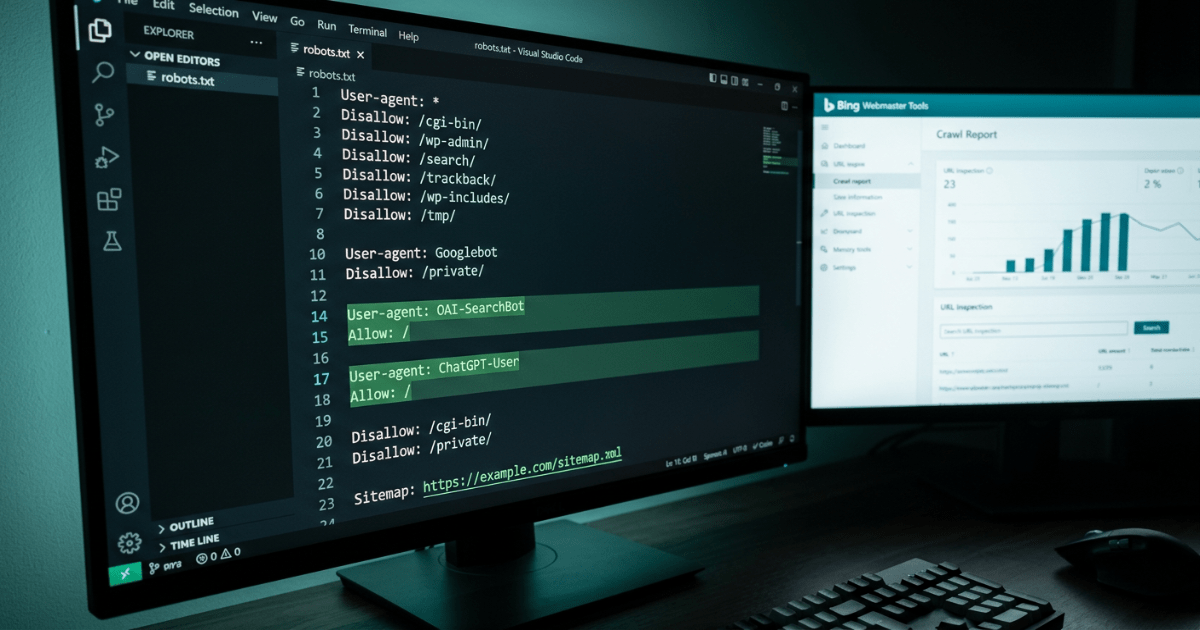
Allow the right crawlers in robots.txt. Most robots.txt files block unknown user agents by default. That default blocks OAI-SearchBot and ChatGPT-User from accessing your content. Add explicit allow directives for both crawlers on your high-value content folders. Without this, nothing else matters, the crawlers never arrive.
Submit your sitemap to Bing Webmaster Tools. ChatGPT pulls from Bing’s index, not Google’s. A sitemap submitted only to Google Search Console is invisible to the AI crawler pipeline. Submit the same sitemap to Bing, verify ownership, and monitor crawl status there. This is the single most overlooked step in the entire setup.
Create an llms.txt file for structured guidance. This file tells AI crawlers which pages to prioritize and which to ignore. It works like a sitemap but for large language model consumption. List your cornerstone content, your about page, and your most cited resources. Keep it under 20 lines. The crawler reads this before anything else.
Enable JavaScript rendering for dynamic content. If your site relies on JavaScript to load core content, the crawler may see a blank page. Configure server-side rendering or pre-rendering for critical pages. Test with a simple curl command against your URL, if the HTML output is empty, the crawler sees nothing worth indexing.
Configure your robots.txt file to explicitly allow AI-SearchBot and ChatGPT-User access to high-value content folders. This is the single most important technical action. Without it, the crawler never reaches your best pages. Verify the directives are correct using a robots.txt tester before moving on.
Technical access is table stakes. Completing these steps means the crawler can find your content. Whether it cites that content depends entirely on what it finds when it arrives.
Structure Content for Answer Extraction
Most content teams write for human eyes and hope ChatGPT figures it out. That hope costs them citations every single day.
ChatGPT does not read content the way a person does. It scans for extractable answers, clear, self-contained blocks of information that answer a specific question without requiring the reader to parse surrounding fluff. This is answer engine optimization, and it demands a fundamentally different approach to structure.
Every section needs a direct answer in the first few lines. Not a gentle introduction. Not context. The answer itself. A user asks “how long does it take to get indexed by ChatGPT”, the first sentence of that section should say the typical timeline, not explain why indexing matters. Lead with the payload.
Heading hierarchy matters more than most teams realize. H2s and H3s are not decorative. They are extraction points. ChatGPT uses them to identify what each block of text covers. A clear hierarchy tells the crawler exactly where to find the answer to each question. Vague headings like “Key Considerations” get skipped. Specific headings like “Timeline for ChatGPT Indexing” get extracted.
Paragraphs must be short and self-contained. Long, winding paragraphs force the extraction model to guess which sentence contains the answer. Keep each paragraph to one idea. Use lists and tables for data that benefits from scannability. The easier the extraction, the more likely the citation.
This is where answer engine content formats differ from traditional SEO writing. Traditional content builds narrative. Answer engine content builds extraction points. WryveAI generates E-E-A-T compliant content structured specifically for this, clear answers, clean hierarchy, no filler. The difference shows up in citation rates, not just rankings.
Write for the extraction first. The human reader benefits from the clarity anyway. The two goals are not in conflict. They never were.
Build Authority Through Citations and Brand Mentions
Getting crawled is the easy part. Getting cited is where most content strategies collapse.
ChatGPT does not cite pages because they exist. It cites pages because other authoritative sources have already validated them. The algorithm treats backlinks from reputable domains, brand mentions in trusted publications, and consistent business data as proof that a source deserves inclusion. Without these signals, even perfectly structured content remains invisible to the answer engine.
Earning citations requires deliberate action. Original research gives other sites a reason to link to you. Expert quotes placed in high-DA publications create brand mentions that signal relevance. Guest posting on domains with established authority builds the backlink profile that ChatGPT treats as a trust signal. Each citation is a vote. Enough votes and your content becomes a default answer.
Authority is built, not claimed. No amount of internal linking or keyword optimization replaces the weight of an external site choosing to reference your work. The gap most teams miss is not in their content, it is in the indexing on AI platforms strategy that treats technical access as the finish line instead of the starting block. Citation opportunities exist where competitors are not looking. WryveAI’s competitor gap analysis surfaces those exact gaps, the publications linking to your rivals but not to you, the brand mentions your competitors earned while you were focused on page speed.
Building brand authority for AI means treating every external link and mention as infrastructure. The question is not whether your site is crawlable. It is whether the web has already decided your content matters.
Optimize for Real-Time Retrieval
Real-time retrieval is where most content strategies break down. Teams optimize for static search results and forget that ChatGPT pulls fresh content from indexed pages the moment a user asks a current-events question. This changes the game entirely.
Timely content wins here. Publishing a breaking industry analysis or a reaction to a major policy shift signals to ChatGPT that your site is a live source, not a static archive. The window for relevance is narrow, hours, not days, and the sites that capture it become the default citation for that query.
Evergreen content needs the same treatment. A page published three years ago with last year’s data is a liability. Update it with current examples, revised statistics, and fresh context. ChatGPT’s retrieval favors pages that show recent modification dates, not just original publication dates.
Structured data is the bridge between your content and the retrieval engine. FAQ schema, HowTo schema, and Article schema tell ChatGPT exactly what your page covers and how to extract it. Without these signals, even great content gets passed over because the engine cannot parse its relevance quickly enough. This is where getting indexed on AI platforms requires more than just good writing, it demands technical clarity.
Page speed compounds everything. A slow-loading page that takes three seconds to render is a page ChatGPT will skip. The retrieval engine has a patience threshold, and every millisecond over that threshold reduces the chance your content gets pulled into a response. Compress images, minimize JavaScript, and use a CDN that does not block known crawler IP ranges.
The implication is uncomfortable: real-time retrieval does not reward consistency. It rewards timeliness, freshness, and technical precision. Sites that treat content as a living document, constantly updated, always current, will dominate this channel. Sites that publish once and walk away will not.
How to Allow ChatGPT to Crawl Your Site
Most teams assume ChatGPT finds their content automatically. It does not. The crawler must be explicitly invited, and the default configuration on most sites blocks it by accident. Getting indexed by ChatGPT starts with removing the barriers you did not know you built.
Step 1. Check your robots.txt file for disallow rules. Add explicit Allow: OAI-SearchBot and Allow: ChatGPT-User directives for your high-value content folders. Without these lines, the crawler treats your site as off-limits and moves on.
Step 2. Submit your sitemap to Bing Webmaster Tools. ChatGPT relies on Bing’s index for discovery. A sitemap submission tells the crawler which pages exist and how often they change. Skip this, and the crawler works blind.
Step 3. Remove any paywall or login gate from the pages you want cited. ChatGPT will not authenticate to access content. If a page requires a login, it does not exist to the crawler. Public access is the price of citation.
Step 4. Verify your CDN does not block known AI crawler IP ranges. Some CDN providers flag unfamiliar user agents as threats. Whitelist OAI-SearchBot and ChatGPT-User in your security rules. A blocked crawler cannot retry.
Step 5. Monitor crawl activity in your server logs. Look for 200 responses to requests from OpenAI’s user agents. If you see 403s or 404s, the crawler found your site but could not access it. Fix those paths immediately.
These five steps remove the technical friction that keeps content invisible. The crawler can now reach your pages. What it finds there, and whether it cites them, depends on everything that comes after access.
Measure and Verify Your Indexing Status
Setting up crawler access and optimizing content means nothing without proof of indexing. Most teams assume that if a page loads and a sitemap is submitted, ChatGPT will find it. That assumption ignores the gap between configuration and citation, a gap that only verification closes.
Start with the simplest check: ask ChatGPT directly. Use the search feature within the interface and run a site search query for your domain. If your pages appear in results, indexing is active. If they do not, the problem is either access or authority, and the next verification step tells you which.
Bing Webmaster Tools provides the raw crawl data that reveals whether AI crawlers have visited your site. Check the crawl reports for OAI-SearchBot and ChatGPT-User activity. No crawl history means a configuration issue. Crawl history without citation means a content or authority problem. The distinction saves hours of guesswork.
Monitor referral traffic from chatgpt.com in your analytics platform. A spike in sessions from that domain signals active citation. A flat line means your content is not being surfaced. This data is more reliable than any third-party tool because it reflects real user behavior, not simulated crawl activity.
WryveAI SERP intelligence adds another layer to this verification process. It tracks which pages across your site are being cited in AI responses and surfaces the content angles that earned those citations. This turns verification from a passive check into an active optimization loop, you see not just whether you are indexed, but why.
Verification is not a one-time task. Crawl patterns shift as search engines update their indexes and AI models refresh their training data. A page cited today may disappear from results tomorrow without warning. The only defense is a repeatable verification cadence that catches changes before they become gaps.
Your Next Move for AI Visibility
The path to getting indexed by ChatGPT is now clear. Technical access opens the door. Content quality and authority determine whether ChatGPT walks through it to cite your work.
Teams that act on this dual strategy gain a compounding advantage. Every page optimized for answer extraction becomes a citation asset. Every authority signal earned strengthens the next page’s chances. The gap between sites that get cited and those that get ignored widens with every week of inaction.
Audit your site for AI crawler access today. Then pick one high-value page and restructure it for extraction. Start with the page that answers the question your audience asks most often. That single page is where visibility begins.
Every claim in this article was checked against a real source before it was published.
WryveAI researches live search results, writes source-verified content, and publishes straight to WordPress, all in one platform.
Try WryveAI Free →No credit card required.
Common Questions on How to Get Indexed by ChatGPT
How do I get my website indexed by ChatGPT?
Configure your site to allow OpenAI’s crawlers access by updating your robots.txt file to permit OAI-SearchBot and ChatGPT-User. Then submit your sitemap to Bing Webmaster Tools, since ChatGPT relies on Bing’s index for real-time retrieval.
Does ChatGPT use Google or Bing for search results?
ChatGPT uses Bing’s index for real-time search results, not Google’s. This means your site must be indexed by Bing to appear in ChatGPT citations, making Bing Webmaster Tools a critical part of your setup.
How long does it take for ChatGPT to index a website?
Initial crawling typically begins within a few days after you configure your site and submit your sitemap. Verification through server logs or Bing crawl data confirms whether the crawlers have accessed your pages successfully.
Can I check if ChatGPT has indexed my site?
Use the site:yourdomain.com operator in ChatGPT search to see if your pages appear in responses. Monitor Bing Webmaster Tools for crawl activity and check your server logs for requests from OpenAI’s crawler user agents.


