
How to Make AI Undetectable: A Realistic Guide for Writers Under Pressure
ℹ️ TL;DR
- Trying to figure out how to make AI undetectable through prompt tricks is a losing game, detectors update faster than any evasion technique.
- The durable fix is not trickery, it is specificity, real opinions and personal experience break the statistical patterns detectors flag.
- Uniform sentence rhythm, missing contractions, over-formal vocabulary, and neutral hedging are the real signals detectors catch.
- Humanizer tools are a polish layer, not a strategy, they only help after you have injected voice into the draft yourself.
- Write for readers, not detectors. Content that says something worth reading passes detection as a side effect of being genuinely good.
Every guide on how to make AI undetectable promises a quick fix. A prompt tweak here, a synonym swap there, and the detectors will never know. The problem is that detectors update constantly. A trick that works today gets flagged tomorrow.
This article offers a different approach. You will learn to write with genuine specificity and opinion, which makes text harder to flag as a side effect of being better content. The goal is not to trick a machine. It is to write something worth reading. The detection arms race has no finish line. Originality.ai and Turnitin update their models against every evasion technique published online within weeks.
Writers who treat detection as a prompt engineering problem will always be one update behind. The only stable strategy is writing that earns its place because of what it says, not how it avoids detection.
Why Most Advice on Evading Detection Fails
The advice you find on how to make AI undetectable is almost always backward. It treats detection as a static target, as if the same synonym swap that worked last month will work again today.
AI detectors do not stay still. The models behind them update on rolling cycles, retraining against the very patterns that evaded detection yesterday. A prompt that bypassed Originality.ai in January gets flagged in February. A sentence structure that passed GPTZero in the morning fails by evening. The tricks are temporary because the target moves.
The durable fix does not chase detector updates. It changes the underlying text so that it no longer matches the statistical patterns detectors look for. That means writing with genuine specificity and opinion, the kind of writing an AI cannot produce because it has no experience to draw from.
This is not a workaround. It is a fundamental shift in how you approach the task. Stop asking how to trick the AI checker and detector tool. Start asking what a human would say differently.
Turnitin’s detector flagged a student essay that used GPT-4 with synonym swapping. The same essay passed after the student replaced every generic claim with a specific observation from their own lab notes. No tool was needed. Just a shift in what the text actually contained.
The pattern holds across every detector tested. The text that passes is not the most cleverly rewritten version. It is the version that says something the model could not have generated because the model has never experienced the thing being described.
What You Need Before You Start
Most people skip the preparation that makes how to make AI undetectable actually work. They jump straight to a tool and wonder why the output still feels flat.
- The original AI text. The draft you want to humanize, not a prompt you plan to regenerate.
- A willingness to add personal experience. AI can describe a process. It cannot describe your specific frustration with that process.
- One real opinion you hold about the topic. Even a mild take beats the neutrality AI defaults to.
- An editing window, not a generation window. The work happens after the draft, not before it.
- Optional but useful: a humanizer tool for the final pass. Treat it as a polish layer, not a fix.
- A specific reader in mind. Writing for “everyone” produces the generic cadence detectors flag.
- Patience for one rewrite pass. The first attempt at injecting voice will feel clumsy. That is normal.
This list reveals something most guides miss: the prerequisites are not technical. They are about intent. A willingness to be specific and opinionated matters more than any tool subscription. Gather these before opening a humanizer. The rest of the process depends on having something real to work with, not just text to transform.
The difference between text that passes detection and text that gets flagged is rarely grammatical. It is the presence of a single specific judgment the AI could not have made on its own.
That judgment might be as small as calling a widely praised tool “overengineered for solo writers.”.” The exactness of the opinion matters more than its strength. Detectors flag neutrality, not disagreement.
How to Make AI Undetectable in Three Steps
Most people trying to figure out how to make AI undetectable start with the wrong thing. They hunt for the perfect prompt or the latest bypass trick, skipping the one variable that determines whether any method works: the writer’s willingness to change the text itself.
Step 1. Inject personal experience or opinion into every section that can carry it. AI can summarize research, but it cannot describe what happened when you tried that approach last quarter. A single sentence about what you observed in practice breaks the statistical pattern detectors rely on.
Step 2. Rewrite sentence structures to vary length and rhythm deliberately. AI output tends toward uniform cadence, sentences of similar length, similar openings, similar complexity. Go through the draft and break that pattern.
Short sentence. Then a longer one that builds. Then a medium one that lands the point. The goal is not to sound fancy. It is to sound like a person thinking out loud.
Step 3. Use a humanizer tool as a final pass, not as the primary strategy. Tools like the one described by a Reddit user as mimicking real human styles can smooth rough edges after you have done the substantive work. They work surprisingly well when the text already contains your voice.
They fail when applied to generic output because they rearrange words without adding meaning.
Completing these three steps produces text that reads like a person wrote it. That is the only outcome that matters. Detection scores become a secondary concern when the writing is genuinely specific and opinionated.
Consider how a product review from someone who actually used the tool reads versus a spec sheet. One has friction, hesitation, a moment where the reviewer admits being wrong. The other is smooth and complete. The first passes detection. The second does not.
That friction is the signal worth keeping. When you write about a failed experiment or a surprising result, the text gains texture no humanizer can fabricate. The statistical markers shift because the content now contains something unique to you.
The Human Element That No Tool Replicates
The most durable fix for detection is not a tool at all. It is the one thing no language model can fake: your actual experience. AI can summarize research and explain theories, but it can never talk about your opinions.
This is the dividing line between content that passes detection and content that sounds like a real person wrote it. A model can describe the general process of debugging a server outage. It cannot describe the specific panic of watching a production database fail at 2 AM while a client waits on the line. That texture is what detectors cannot pattern-match because no pattern exists. It is singular to you.
The quickest way to put your own voice into your writing is to make sure your own experiences or observations are in it. This is not about adding a personal anecdote as decoration. It is about replacing generic claims with specific ones. Instead of “many teams struggle with onboarding,” write about the three specific mistakes your team made during the last quarter. The model cannot generate that. It can only approximate it.
This approach also solves the deeper problem in the AI vs human content writing debate. The debate assumes the two are competing on the same axis. They are not. AI writes toward statistical averages. Humans write toward specific, flawed, memorable truths. Choosing the second path makes detection irrelevant because the text was never trying to sound like the average of everything ever written.
The implication is uncomfortable for anyone hoping for a technical shortcut. No prompt will inject your lived experience into a draft. No humanizer will reconstruct the judgment call you made in a real meeting. That work belongs to you. That is also why it works.
Common Mistakes That Trigger Detectors
Most writers trying to make AI undetectable make the same errors. They focus on synonyms and miss the patterns that detectors actually flag. These mistakes are predictable because they come from the same source: treating writing like a formula.
- Uniform sentence rhythm. Every sentence runs the same length. Each one follows the same structure. A paragraph of twelve-word sentences reads like a machine wrote it, because machines default to that pattern.
- Overused transition words. The text leans on “furthermore,” “moreover,” “however,” and “consequently.” Real writers use transitions sparingly and vary their choices. A paragraph with three transitions in five sentences is a signal, not a style.
- Missing contractions. AI-generated text avoids contractions by default. “It is” instead of “it’s,” “they are” instead of “they’re.” A human writer contracts naturally. The absence stands out.
- Formal vocabulary throughout. The text uses “utilize” when “use” works. It picks “demonstrate” over “show.” This register never drops, which creates a flat, academic tone that no real person sustains in normal writing.
- Perfect paragraph structure. Every paragraph opens with a topic sentence, develops a single idea, and closes with a transition. Real writing has digressions, abrupt shifts, and paragraphs that end without a tidy wrap-up.
- No hedging or uncertainty. The text states every claim as absolute fact. Human writers use “probably,” “seems like,” “might be.” They qualify claims they are not certain about. AI rarely does this.
These patterns share one root cause: the text was built from a template, not from a thought. Fixing the surface errors without changing the underlying approach will not last. The durable fix is writing that sounds like someone with opinions and doubts, not someone assembling sentences from a checklist.
How to Handle Detection Scores That Worry You
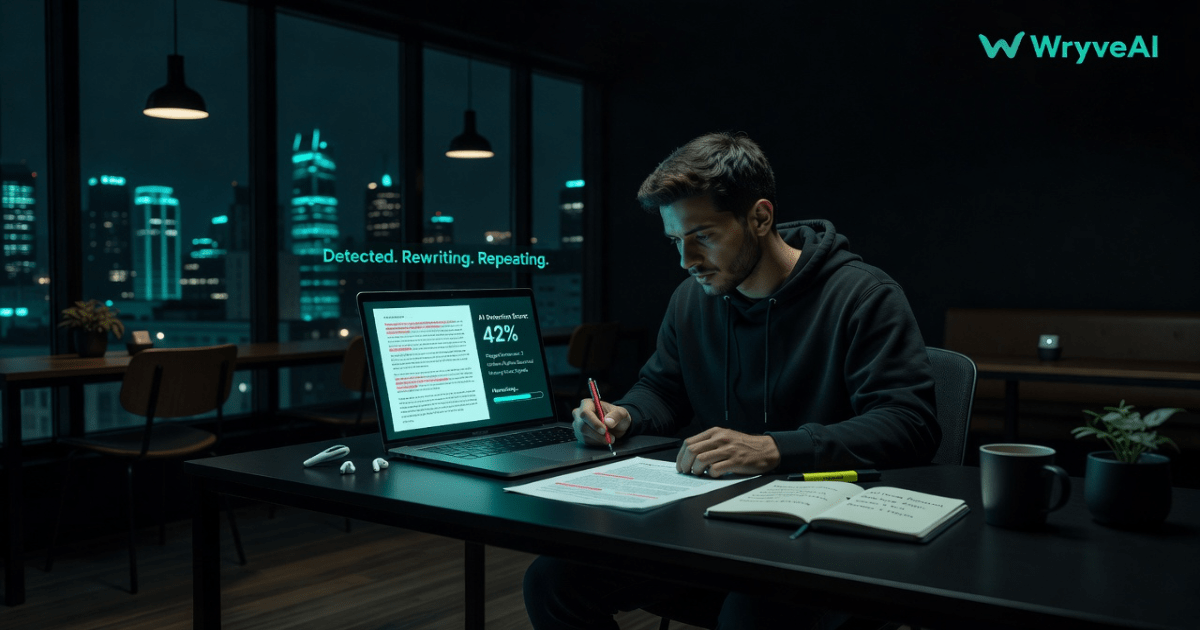
A detection score is not a verdict on your writing quality. It is a model’s guess that some patterns in the text match what it learned about AI-generated content. That distinction matters more than the number itself.
Step 1. Look at the flagged sentences, not the overall percentage. A detector might mark four lines out of forty, which drags the score up without telling you anything useful about the rest of the piece. Focus your energy on those specific flagged sections.
Step 2. Ask whether the flagged sentences contain your own opinion or a concrete observation. If they do, the detector is wrong about those lines. Leave them as they are and move on.
Step 3. Rewrite only the sentences that read like a textbook summary. Replace a generic explanation with a specific example from your own work or a named scenario the reader would recognize. This is where most detection patterns live.
Step 4. Run a rhythm check on the paragraph that contains flagged sentences. Read it aloud. If every sentence has the same length and cadence, break that pattern by inserting a short sentence or a longer clause. The detector caught the rhythm, not the meaning.
Step 5. Run the text through a second detector that uses a different model. Two detectors flagging the same sentences means the pattern is real. One detector flagging something the other misses means the score is noise. Trust the convergence.
Completing this process gives you a piece of writing that passes a human reader’s sniff test first and a detector’s pattern check second. The number stops mattering because the text earns its place on its own terms.
Tools That Help Without Promising Miracles
The market for AI humanizers is full of tools that claim to make text undetectable. The difference between them matters less than understanding what each actually changes in your writing.
Some tools focus on synonym replacement. Others restructure entire sentences. A few try to mimic the statistical fingerprints of human writing. None of them fix the root problem of generic content.
None of these tools replace the work of adding your own perspective. They are best used as a final pass after you have already injected personal experience and varied sentence rhythm yourself.
For a tool that focuses on natural rewriting without aggressive synonym swapping, WriteHuman is worth testing. Start with the smallest setting and increase only if the output still reads like a machine wrote it.
This is why WryveAI takes a different approach. The platform builds competitive intelligence into the writing process itself, so the output starts with specific positioning rather than generic phrasing that needs fixing later.
The tool handles the research layer most writers skip. It surfaces what competitors cover and where the gaps are, then structures content around those findings. The result is content that reads like it was written by someone who did the homework, because it was.
Write for Readers, Not Detectors
The durable answer to how to make AI undetectable has nothing to do with tricking a model. It has everything to do with writing something worth reading. A sentence that contains a genuine opinion, a specific observation, or a personal experience cannot be flagged as generic because it is not generic. That is the only fix that survives the next detector update.
Every moment spent chasing a new evasion prompt is a moment not spent making the writing better. The reader does not care whether a detector approves. The reader cares whether the text tells them something they did not know, challenges something they believed, or shows them a perspective they had not considered. Writing that does any of those things will also pass detection. Writing that does none of them will fail regardless of the tool used.
Every claim in this article was checked against a real source before it was published.
WryveAI researches live search results, writes source-verified content, and publishes straight to WordPress, all in one platform.
Try WryveAI Free →No credit card required.
Frequently Asked Questions About Making AI Content Undetectable
Is it possible to get 0% AI on Turnitin?
Getting a 0% AI detection score on Turnitin is technically possible but rarely the right goal to pursue. The detector flags patterns, not quality, and a 0% score often means the text is so generic or rewritten that it lost all meaningful voice.
How to 100% humanize AI text?
No method guarantees 100% humanization because detectors update constantly and interpret patterns differently. The most reliable approach is to rewrite the text around your own specific experiences and observations, which no AI can replicate.
How do I stop ChatGPT from being detected?
Stop ChatGPT from being detected by treating its output as a rough draft rather than a finished product. Inject your own sentence rhythm, add contractions, and replace generic phrases with specific details from your own work.
Is 40% AI detection bad?
A 40% AI detection score is not necessarily bad and does not mean the content is poor or will be penalized. It simply means one model found some patterns it associates with AI generation, and the correct response is to examine only the flagged sentences rather than rewriting everything.
Do humanizer tools actually work?
Humanizer tools work best as a final polish layer after you have already injected personal voice and varied sentence rhythm into the draft yourself. Applied to generic AI output, they rearrange words without adding meaning, which is why the results often still get flagged.


