What an AI Checker and Detector Tool Actually Tells You (And What It Doesn’t)
ℹ️ TL;DR
- An AI checker and detector tool returns a probability, not a verdict, treating the score as proof is a category error.
- Clear, structured human writing often triggers high AI scores because detectors reward predictability, not authorship.
- Different detectors disagree on the same text because each uses different training data, thresholds, and pattern definitions.
- A high score should trigger a closer human read, not an accusation, a rewrite, or a workflow overhaul.
- The real risk is writing for the detector instead of the reader, that path leads to sterile content and lost confidence in your own judgment.
Pasting text into an AI checker expecting a clean yes or no is a setup for confusion. The tool returns a percentage, not a verdict. That number is a probability, not proof.
Most people treat that score as definitive. They don’t realize the detector is making a statistical guess based on patterns in its training data. A high probability does not mean the text was written by AI, it means the text shares characteristics with AI-generated content.
This article explains what that AI checker and detector tool actually measures, why different tools disagree, and how to use the score without being misled. By the end, you will know when to trust the number and when to ignore it.
Why Detectors Give a Score, Not a Verdict
An AI checker and detector tool is a statistical model trained to recognize patterns common in machine-generated text. It does not detect intent, authorship, or deception. The tool compares your text against patterns it learned from training data, sentence structure, word choice frequency, the predictability of transitions. That comparison produces a probability, not a verdict.
This is where most readers get tripped up. A score of does not mean the text is likely to be AI-generated. It means the text shares of the patterns the model associates with AI writing. Those patterns overlap with good human writing more than the tool vendors admit.
Clear, structured prose by a skilled human writer can trigger a high score. Awkward, repetitive AI text can slip through as human. The tool does not know the difference. It only knows the math.
The real problem is that people treat a probability as a fact. An academic advisor sees and assumes guilt. A content manager sees and demands rewrites. Neither stops to ask what the score actually measures.
The tool is not a forensic test. It is a guess dressed up as a number. AI content detection is a scam only if you believe the number is truth. It is useful if you treat it as a signal that demands further investigation.
The correct way to read any score from an AI detector tool is as a starting point. A high score means the text warrants a closer read by a human. A low score means it probably does not. The tool narrows your attention. It does not make the call. That distinction is the difference between using a detector and being used by it.
The False Positive Problem Nobody Talks About
The false positive problem is the reason most people eventually stop trusting these tools entirely. An AI checker and detector tool can flag human-written text as AI-generated with surprising confidence, especially when the writing is clear, structured, or follows common expository patterns. The tool is not broken, its design is the issue.
Detectors look for predictability. They measure how closely a piece of text matches the statistical patterns found in AI training data. Good human writing, the kind taught in every journalism program and style guide, is also predictable. Short sentences. Logical flow. Consistent transitions. The tool cannot distinguish between a well-edited human paragraph and an AI-generated one because, statistically, they look the same.
The real cost is not the occasional false flag. It is the slow erosion of credibility that follows. Every time a detector mislabels human writing, the person on the receiving end learns to ignore the tool entirely. The next time it flags something legitimate, no one listens. That is the gap most guides miss. They focus on accuracy rates and model updates. They ignore the behavioral consequence of a tool that cannot admit when it is guessing.
Take a student in a college writing program. The assignment demands clarity, structure, and direct prose. The student writes exactly that. The AI detector returns probability of AI generation. The professor docks points. The student has no way to prove the work is original because the score looks like data.
The tool created a false positive. The professor treated it as a verdict. That is not a tool failure. It is a design failure that punishes the person who followed the rules.
How Different Tools Disagree on the Same Text
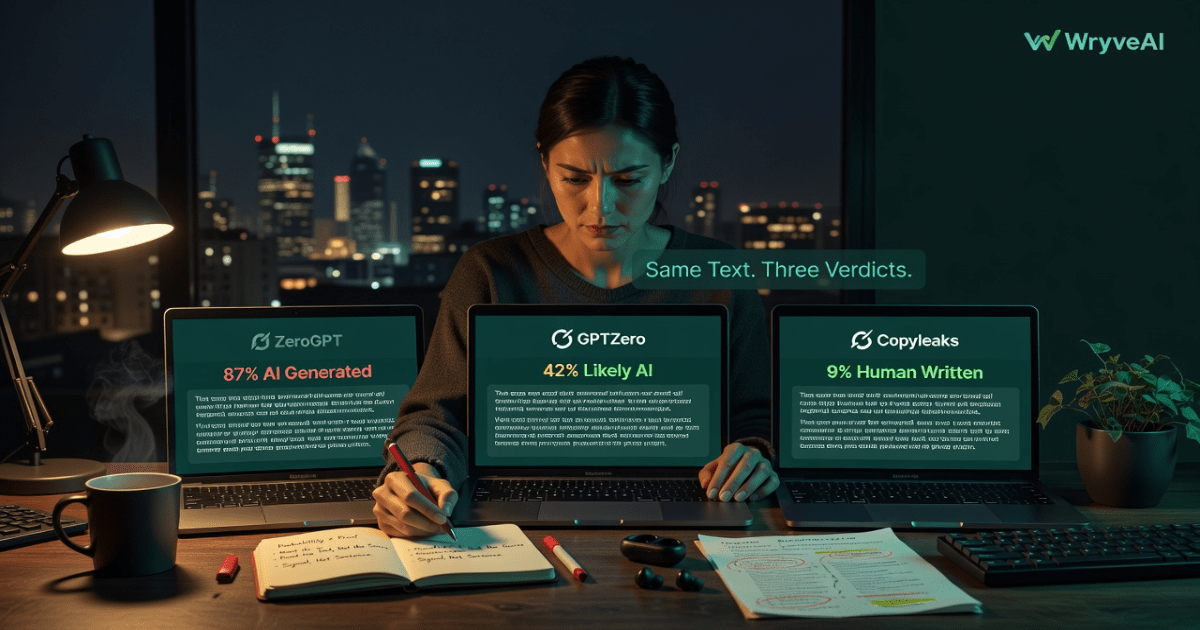
Run the same paragraph through three different AI checkers and you will get three different scores. That is not a bug. It is the predictable result of each tool using its own training data, thresholds, and pattern definitions.
Take ZeroGPT as one example. It flags text based on burstiness and perplexity, how varied the sentence lengths are and how predictable the word choices feel. It works well on formulaic AI output. But it struggles with human writing that is direct and structured. A clear, well-edited email can trigger it.
GPTZero approaches the same text differently. It was trained heavily on academic writing, so it recognizes the cadence of student essays and research papers. That makes it more sensitive to certain types of human prose and less sensitive to conversational AI content.
Copyleaks takes a third path. It compares text against a broader corpus of known AI-generated content and uses a different statistical model to evaluate randomness. It catches more edge cases but also produces more false flags on technical writing, where jargon and repetition are normal.
The disagreement between tools is not a sign that one is broken. It is a sign that each model sees a different version of the same text. The reader who understands this variability stops looking for the “right” score and starts looking for the pattern across scores. That is where the real signal lives.
This is why a single tool score should never determine a decision. A student submitting an essay flagged by one detector can run it through a second and third tool before drawing any conclusion.
The same applies to content teams reviewing drafts. A flagged paragraph from one checker that passes clean in two others is not a problem. It is noise. The signal lives in the convergence, not the individual result.
What the Score Actually Means for Your Writing
A high AI probability score does not mean the text is bad. It means the text shares statistical patterns with AI-generated content: predictability, consistent sentence structure, and common transitional phrasing. That is a different claim entirely.
An AI checker and detector tool cannot evaluate quality, originality, or intent. It evaluates pattern match probability. A well-structured academic paragraph written by a human can score higher than a sloppy AI-generated paragraph, because the detector rewards clarity and consistency. The tool has no concept of what “good writing” means.
This is why “is using AI considered cheating?” misses the point. The tool does not know if AI was used. It knows if the text looks like AI wrote it. Those are two separate questions. The score is a signal about form, not about process.
Editors and educators who treat the score as a sentence make a category error. The score tells you something about the text’s statistical profile. It does not tell you whether the author used AI, whether the content is accurate, or whether the argument holds. Those judgments require reading the text.
The real skill is separating what the tool measures from what you need to decide. A high score warrants a closer look. It does not warrant a verdict. The GPTZero documentation makes this distinction explicitly: the score is a probability, not a proof.
What the score actually means is simple: the text is statistically similar to AI-generated text. What it does not mean is anything about the writer, the effort, or the value of the work. Treating the score as anything more than that is where the tool stops being useful and starts being dangerous.
When to Trust a Detector and When to Walk Away
Every scenario involving an AI checker and detector tool carries different stakes. The tool’s value shifts dramatically depending on what you are trying to prove and to whom.
Academic submissions: a flag, not a verdict
Professors and students both misuse detection scores in academic settings. A flagged paper should prompt a conversation, not an accusation. Treating the score as evidence bypasses the human judgment that the process requires. The human input rule is a useful heuristic here, if the student can explain their work, the score loses its power.
Content publishing: useful for obvious cases only
Publishing teams can spot clearly machine-written content with a detector. The tool catches the obvious stuff, repetitive phrasing, unnatural transitions, generic examples. But it fails on edited AI text that reads naturally. A clean score does not mean the content is good. It only means the text passed one narrow test.
SEO content: detectors are poor judges of quality
Search engines reward usefulness, not human authorship scores. A detector cannot tell you whether a page answers a query or provides unique value. Writers who optimize for detector scores produce sterile content that ranks poorly. The tool is irrelevant to search performance.
Personal curiosity: fine, but do not over interpret
Running your own writing through a detector out of curiosity is harmless. The problem starts when that single score changes how you feel about your work. A high probability on a draft you wrote yourself tells you nothing about the draft’s quality. It tells you your writing style overlaps with common AI patterns. That is all.
Take a paper flagged at probability. A professor who treats that as cheating has made an error before speaking to the student. A professor who uses the flag to start a conversation has used the tool correctly.
The Real Cost of Over-Reliance on Detection
The most damaging effect of an AI checker and detector tool is not a false flag. It is the way writers start writing for the detector instead of for the reader. The tool becomes the audience.
This shift is subtle at first. A writer sees a high AI probability on a draft that took hours to compose. The instinct is not to question the tool. The instinct is to sand down the prose until it passes the test. Remove the transition. Shorten the sentence. Kill the natural rhythm. The result is writing that is technically undetectable and emotionally dead.
Content teams waste time rewriting text that was fine. A blog post scores high on one detector. The team rewrites it to lower the score. The post scores low on a different detector.
The team rewrites it again. The cycle produces generic SEO articles that satisfy no reader and rank for nothing. The tool dictated the workflow, and the workflow produced nothing worth reading.
The real cost is not a mistaken flag. It is the slow erosion of confidence in your own judgment. A tool that should inform a decision starts making the decision. The writer stops trusting their ear. The editor stops trusting their eye. The student stops trusting their voice. That is a price that no probability score can justify.
Using a Detector as Part of a Smarter Workflow
Most people run text through one detector, see a score, and act on it. That single step misses the entire point of what an AI content writing tool can actually offer. A smarter workflow treats the detector as one input among several, not the final authority.
Step 1. Run the text through at least three different detectors. Each tool uses its own training data and thresholds, so a single score tells you almost nothing. Skipping this step means you are making a decision based on one statistical model’s opinion, not the broader picture.
Step 2. Compare the scores side by side. If they cluster tightly, the text is likely in a clear category. If they disagree widely, you are looking at a gray area where no tool is confident. The consequence of ignoring disagreement is acting on a false sense of certainty.
Step 3. Read the flagged sections yourself. Do the sentences actually sound unnatural? AI detectors flag predictable patterns, but good human writing can be predictable too. The cost of skipping this step is rewriting prose that was perfectly fine for a human audience.
Step 4. Make a judgment call based on context, not the score alone. An academic submission and a blog post demand different standards. The same score that warrants a second look in one setting means nothing in another. Without context, the percentage is just noise.
Completing this process turns a detector from a black box into a diagnostic tool. You stop reacting to numbers and start making informed decisions about the text in front of you.
This workflow works because it replaces faith with triangulation. No single detector earns trust. Three detectors with aligned scores earn more. Write this process down and keep it visible. The moment a score feels urgent is exactly when the process matters most.
Treat the Score as a Signal, Not a Sentence
An AI checker and detector tool is useful only when you understand its limits. The percentage it returns is a probability, not a verdict, and treating it as anything more is a misuse of the tool.
Every time you paste text into a detector, you face a choice. You can let the score override your own reading of the text, or you can use it as one input among many. The second path protects you from false accusations, wasted rewrites, and the slow erosion of trust in your own judgment. Run the text through a detector. Note the score. Then read the flagged sections yourself. Make the final call based on context, not confidence intervals.
Every claim in this article was checked against a real source before it was published.
WryveAI researches live search results, writes source-verified content, and publishes straight to WordPress, all in one platform.
Try WryveAI Free →No credit card required.
Frequently Asked Questions About AI Detection Accuracy
Can an AI checker and detector tool be wrong?
Yes, false positives and false negatives are common because the tool returns a probability, not a definitive verdict. A piece of human-written text that is clear and structured can easily trigger a high AI score.
Why do different detectors give different results?
Each tool trains on a different dataset and uses its own threshold for what counts as AI-generated. That is why the same paragraph can score 10% on one AI checker and detector tool and 80% on another.
Should I rewrite text that gets flagged as AI?
Only if the flagged sections actually sound unnatural when you read them aloud. Rewriting text just to lower a detector score often makes the prose worse, not better.
Is using AI detection considered cheating?
No, running text through a detector is not cheating. The problem arises when educators or editors treat the score as proof of misconduct without considering the tool’s known error rate.
Which AI detector is the most accurate?
No single tool is the most accurate for every type of text. Accuracy shifts depending on whether the text is academic, creative, or technical, so cross-referencing multiple detectors gives a clearer picture than relying on one.