
The Best Grammar Checker Tool Isn’t the One You Already Know
ℹ️ TL;DR
- The best grammar checker tool is not the one with the biggest brand, it is the one that survives a test against your real writing.
- Most “top grammar checker” lists rank by affiliate commission, not by accuracy on actual documents with real errors.
- A great grammar checker catches structural, tonal, and readability issues, not just spelling and punctuation.
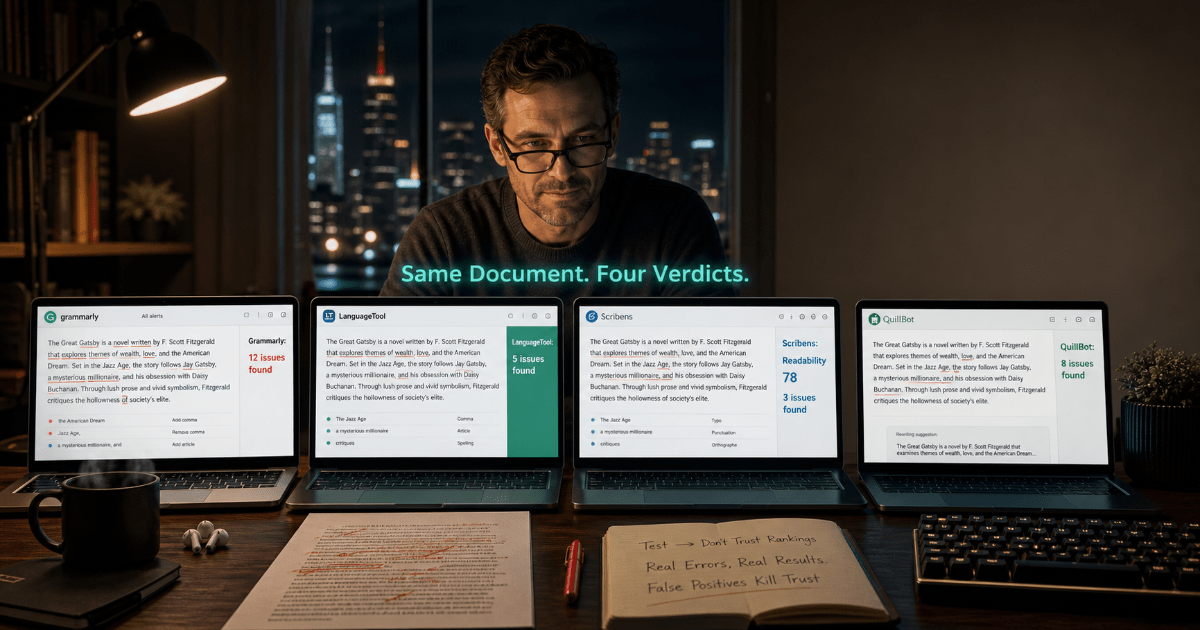
- Grammarly wins on tone, LanguageTool on accuracy, Scribens on readability, and Quillbot on rewriting help. Pick based on your workflow.
- A grammar checker fixes what is on the page. It cannot fix what is missing, that requires SERP analysis and human strategic judgment.
Every writer knows the feeling. You paste a draft into a grammar checker tool, fix every red underline, and hit send. Then someone points out a comma splice the tool missed entirely. The problem is not the tool. The problem is trusting lists that rank by commission, not by accuracy. Most comparison articles exist to push affiliate links.
This article is different. Here you will find a tested, non-affiliate comparison of the best grammar checker tools available right now. No commissions. No rankings based on who pays the most. Just honest results from real documents with real errors.
The difference shows up fast when you run a page through Grammarly and then through ProWritingAid. The same sentence gets flagged by one and ignored by the other. That gap is where the affiliate list fails you. You need a second opinion you can trust. Not a referral fee disguised as a recommendation.
Why Most Grammar Checker Lists Mislead You
The best grammar checker tool in an affiliate post is rarely the best one in your document. Those lists rank by commission, not by how well a tool catches a dangling modifier or a tense shift. Affiliate revenue shapes the rankings. The reader loses. They pay for a subscription based on a recommendation built on a payout percentage, not a test run against actual prose.
The testing gap is the real problem. No affiliate site runs the same paragraph of error-ridden text through ten tools and publishes the raw results. They test one tool, write a description, and move on. The comparison is a fiction built from feature lists and marketing pages.
These affiliate-driven content lists do not tell you which tool misses a comma splice or flags a correctly used passive voice. They tell you which tool has the best affiliate program. Those are not the same metric. A genuine comparison requires a controlled test. Same document. Same errors. Same conditions.
The affiliate model creates a specific kind of blindness. The reader never sees that tradeoff. A controlled test flips the incentive. It rewards the tool that actually works. That is the only metric that matters when a deadline is approaching and the document needs a real second pass.
What a Grammar Checker Actually Checks
Grammar checker tool is a label that undersells what these applications do. Most writers assume it catches subject-verb agreement and comma splices. That is the floor, not the ceiling.
A good grammar checker tool scans for syntax, punctuation, style, tone, and readability. It flags passive voice where it weakens a sentence. It spots jargon that alienates a reader. It measures how hard a paragraph is to process. Tools like Scribens go further by detecting wordiness and suggesting concise alternatives. Language Tool identifies regional spelling differences and offers context-aware corrections. These are not spellcheckers with a better dictionary.
The distinction matters because most errors are not grammatical in the textbook sense. They are structural. A sentence can be grammatically perfect and still bad. A grammar checker tool that only checks rules misses the real problem.
Readability scoring is the hidden layer. It tells you whether a sentence needs to be split. It reveals when a paragraph has too many clauses. That is the difference between a tool that edits and a tool that improves writing.
The implication is direct. A tool that only catches typos is a waste of time. The right one catches what a human editor would flag on a second pass. That is the standard to hold it to.
Take a sentence like “The report was completed by the team.” Grammatically flawless. But the passive construction buries the actor and adds two unnecessary words. A tool that flags this is doing work a spellchecker cannot touch. That is where the real value lies. Not in catching what is wrong. In catching what is weak.
The Wrong Way to Pick a Grammar Tool
Choosing a grammar checker tool based on brand recognition alone is a shortcut that costs more time than it saves. The biggest name in the space has the biggest marketing budget, not necessarily the best engine for your specific writing. A tool that catches every comma splice but misses a garbled sentence structure is a tool that failed its primary job.
The logic behind this mistake feels safe. A familiar brand means less risk. The free tier is easy to download, and the interface is polished. The reasoning breaks down the moment you paste in a document with a real problem, a tangled clause, a misplaced modifier, a tone mismatch that a simple red underline cannot flag. The tool that looks good in a screenshot often performs poorly under actual pressure.
Before: A freelance writer opens a blank document in the most popular grammar checker tool. They paste in a draft with a known structural issue: a paragraph where the subject shifts mid-sentence. The tool flags zero errors. The writer assumes the draft is clean.
They send it to the client. The client returns it with a note about the confusing sentence. The writer spends 20 minutes untangling what the tool should have caught.
After: The same writer runs the same draft through a tool that tests syntax, not just spelling. The tool highlights the sentence and suggests a restructure. The writer fixes it in two minutes. The client receives a clean draft. The writer keeps the relationship intact and saves the rework time for the next project.
The difference is not about which brand has the most users. It is about which tool actually tests the writing the way an editor would. A brand name guarantees visibility, not accuracy. The only way to know is to run your own test with a real document. Trust a tool that passes your worst draft, not one that looks good on a website.
How We Tested Each Grammar Checker Tool
Testing a grammar checker tool against real writing reveals which ones actually catch errors and which ones just look busy. The method is straightforward: feed every tool the same document and compare what each one finds.
Step 1. Build a test document with known errors. The text must contain real mistakes a writer would make, not just missing commas but subject-verb disagreements, dangling modifiers, and inconsistent tense. A document with no errors tells you nothing. A document with only obvious typos tells you even less.
Step 2. Run the same text through each tool without adjusting settings. Default configurations matter because that is what most users encounter first. Change nothing. Accept every suggestion the tool flags. The goal is to see what the tool catches on its own, not what it finds after you tune it.
Step 3. Compare the catches against a master list. Every flagged error gets logged. Every missed error gets logged. The pattern that emerges is more revealing than any single catch, a tool that catches three out of four structural errors but misses every punctuation issue tells a specific story about its strengths.
Step 4. Count the false positives separately. A tool that flags correct writing as wrong is worse than a tool that misses errors. False positives waste time, erode trust, and train writers to ignore real suggestions. LanguageTool’s open-source approach makes its false-positive rate easier to audit than proprietary alternatives.
Step 5. Test the same document in different formats. A tool that works well in a browser extension may fail when pasted into its web editor. Run the test in both environments. The difference in results is often the deciding factor for which tool fits a real workflow.
This process strips away marketing claims and reveals what each tool actually does. The winner is not the tool with the most features. It is the tool that finds the most real errors while wasting the least time on false alarms.
What the Top Tools Get Right and Wrong
A good grammar checker tool catches what you missed. A great one does it without drowning you in false positives. The difference between them is where most comparisons fail.
Grammarly catches more surface errors than any other option. Its tone detection and style suggestions are genuinely useful for professional emails and client-facing documents. But the premium version flags so many optional style choices as errors that experienced writers spend more time dismissing suggestions than editing.
LanguageTool handles technical and academic writing better than Grammarly. Its open-source engine catches nuanced syntax errors that proprietary models miss. The free tier is generous, but the interface feels dated, and the browser extension occasionally misses errors that the web editor catches.
Scribens delivers the best readability analysis of any option tested. It flags passive voice, adverb overuse, and sentence length variation in ways that actually improve writing structure. The catch is a smaller error database, it misses some common comma errors that cheaper tools catch easily.
Quillbot pairs its grammar check with a paraphraser that rephrases flagged sentences. This is useful for non-native speakers who know something is wrong but not how to fix it. The grammar engine itself is less thorough than the others, and the Quillbot grammar checker generates more false positives on standard punctuation than any competitor.
For daily editing across varied document types, LanguageTool offers the best balance of accuracy and false positive rate. For polished client-facing copy where tone matters as much as correctness, Grammarly still wins. Scribens earns its place for writers who prioritize readability scores over raw error count. Pick the one that matches the work you actually do.
The Hidden Feature That Changes Everything
Most writers treat a grammar checker tool as a proofreading utility. They run it, accept the suggestions, and move on. This misses the entire point of what these tools can do.
The features that separate a useful editor from a transformative one are readability scoring, keyword density analysis, and AI detection features. These three capabilities shift the tool from catching typos to improving how the writing actually performs.
Readability scoring tells you something no spellcheck can. It measures whether your sentences flow well enough for a reader to follow without re-reading. A tool like GrammarCheck.net’s readability analysis surfaces this directly. A paragraph that passes every grammar rule can still be unreadable. The score reveals that.
Keyword density analysis matters for anyone writing content that needs to rank. A grammar checker that tracks how often a term appears helps avoid accidental overuse. It also catches the opposite problem. A writer might mention a key concept once in 2,000 words and never return to it. The tool flags that gap.
AI detection is the newest frontier. Some checkers now identify whether a passage reads like machine-generated text. For editors reviewing outsourced work or student submissions, this is not a nice-to-have. It is the difference between catching a problem and publishing a problem.
These features do not replace human judgment. They surface what the eye misses during a fifth read-through. A writer who ignores them is still editing by hand in a world where the tools have moved on.
Consider a content team publishing 12 posts per month. Without keyword density tracking, the same term might appear 18 times in one article and zero in the next. A grammar checker with this feature standardizes that inconsistency before the editor ever sees the draft. That is not a proofreading task. That is a content strategy decision surfaced by a tool most writers never use for strategy at all.
When a Grammar Checker Tool Isn’t Enough
A grammar checker tool catches what is on the page. It cannot catch what is missing from the page. That gap is where most content fails.
Surface errors are easy to fix. A missing comma or a subject-verb disagreement takes seconds. The harder problem is invisible: did you answer the question the reader actually asked? Did you cover the subtopic your competitor covered? Did you structure the argument so a scanner finds the answer in five seconds?
The Content Gap No Tool Sees
A document can be grammatically perfect and strategically useless. Perfect prose wrapped around the wrong message still fails. The reader leaves because the answer they needed was never written, not because it was written poorly. This is where the limits of a grammar checker tool become clear. It validates execution. It cannot validate direction.
What SERP Analysis Reveals That Grammar Misses
SERP analysis tools look at what searchers actually want. They surface the questions, the subtopics, and the intent behind a query. A grammar checker sees a sentence. A SERP analysis tool sees whether that sentence belongs in the document at all. One catches typos. The other catches blind spots. Both are necessary, but only one fixes the strategic gap.
Editing the Wrong Thing
Most writers spend time polishing sentences that should not exist. A paragraph that does not serve the reader’s intent is not improved by better grammar. It is improved by deletion. A grammar checker cannot tell you which paragraph to cut. That decision requires understanding what the reader came to find. No algorithm on the market makes that call for you.
The Workflow That Works
Run a draft through a grammar checker tool for surface errors. Then step back. Ask what the document is missing. Use SERP analysis tools to validate the structure, the coverage, and the angle. Fix the strategy first. Polish the prose second.
Pick the Tool That Matches Your Workflow
The best grammar checker tool is not the one an affiliate link pushes you toward. It is the one that survives a test against your actual writing. That is the only filter that matters.
Affiliate lists will still rank by commission next month. Your next document will not wait. A tool that misses structural errors in a real draft costs more than a subscription ever will. Pick one tool. Run your own test. Use a real document with errors you know are there. The right choice will be obvious after that.
Every claim in this article was checked against a real source before it was published.
WryveAI researches live search results, writes source-verified content, and publishes straight to WordPress, all in one platform.
Try WryveAI Free →No credit card required.
Frequently Asked Questions About Grammar Checker Tools
What is the best free grammar checker tool?
LanguageTool offers the strongest free tier, catching syntax and punctuation errors that most competitors miss without a subscription. Its open-source foundation means the free version updates regularly with new language rules and style checks.
Can a grammar checker tool catch all errors?
No tool catches everything, because grammar checkers operate on rules and patterns, not intent. A sentence can be grammatically perfect and still say the wrong thing, no algorithm reads for meaning the way a human editor does.
Do grammar checker tools work for academic writing?
Most grammar checkers flag academic conventions like passive voice and long sentences as errors, which creates noise for scholarly writers. Scribens handles academic text better than most, offering citation-aware checks that reduce false positives on formal constructions.
How accurate are AI grammar checkers?
AI-powered checkers catch more nuanced errors than rule-based systems, but they also introduce more false positives by overcorrecting conversational phrasing. The trade-off is worth it for most writers, as a missed error costs more than a rejected suggestion.
Is a grammar checker tool worth paying for?
A paid subscription matters most for writers who produce long documents daily, where the time saved on manual proofreading exceeds the annual cost. For occasional editing, the best free grammar checker tool handles surface errors well enough to skip the upgrade.


