
How Long Does It Take to Rank in Google? And How Old Are Top Ranking Pages?

ⓘ TL;DR
- How long does it take to rank in Google? Longer than anyone will tell you. For new domains on competitive keywords, six months is not pessimistic. It is optimistic.
- Google’s algorithm was not built for new brands. It was built to reward age, historical click data, and backlink profiles that take years to build. A new URL starts at zero on every signal that matters.
- Content quality alone will not save you. A perfectly written article on a new domain still loses to mediocre content on a ten-year-old domain. Quality without trust signals is a resume with no work history.
- The structural bias is not a bug. It is a feature. Stop fighting it. Start finding the gaps established brands are too big to care about.
- The only fair fight for a new domain is the keywords nobody else wants. Own those first. Let the accumulated trust lift the harder keywords later.
This article will not give you a six-month ranking timeline and call it realistic. It will tell you why that timeline is wrong for most new domains and what actually determines how long it takes to rank in Google.
The standard advice, publish great content and wait, works fine for established brands with years of backlinks and click data. For a new domain, that advice is a slow path to nowhere. Google’s algorithm was built to reward age and authority, not freshness.
Here you’ll learn the real age of top-ranking pages, why content quality alone fails new sites, and the specific strategy that exploits the gaps established competitors are too big to fill. The timeline changes when you stop fighting the algorithm’s bias and start working with it.
The Timeline Nobody Wants to Admit
The standard advice to publish great content and wait is a lie for new domains. It assumes the playing field is level. It is not.
Google’s automated ranking systems sort through hundreds of billions of pages. They prioritize signals a new URL simply does not have. Domain age, historical click data, and a backlink profile built over years are the real gatekeepers. A fresh article on a brand-new site enters this system with zero trust signals. It is not ignored. It is deprioritized until it proves itself.
This is not a bug. It is how the system is designed. Google’s ranking systems guide explains that many factors and signals are evaluated to present the most relevant results. For a new domain, every one of those factors is a deficit. The system is structurally biased toward what already exists.
Ranking in the top ten within six months for a competitive keyword is an outlier. It is not a baseline. It is not something to plan around. The advice that works for a ten-year-old domain with thousands of backlinks will fail a new brand that follows it blindly.
The timeline is longer than most guides admit. The strategy must change accordingly. Waiting is not a strategy.
How Old Are the Pages That Rank First?
The pages at the top of Google’s search results are not recent publications. They are often years old, sitting on domains that have been accumulating trust signals long before the current content was written.
Google’s automated ranking systems are designed to sort through hundreds of billions of webpages to present the most relevant, useful results. Relevance is not measured in isolation. It is filtered through historical data, how long a page has existed, how many clicks it has earned, how many other sites have linked to it over time.
A new page on a new domain enters this system with none of that history. It is competing against pages that have been building authority for years. The playing field is not level. It was never designed to be.
This is not a flaw in the algorithm. It is the feature that makes search work. Without this structural memory, every query would return a random mix of old and new content with no reliable signal of quality. The system rewards persistence because persistence correlates with trust.
For a new domain, the implication is uncomfortable but unavoidable. The page published today will not rank tomorrow. It will not rank next month. It will rank only after it has survived long enough to earn the signals Google’s ranking systems actually reward.
Why Content Quality Alone Won’t Get You There
Content quality alone is a commodity. Every brand publishes well-researched articles with proper grammar and original insights. That is the baseline, not the edge.
Google’s ranking systems sort through hundreds of billions of webpages to present the most relevant, useful results. Relevance and usefulness are measured through signals a new domain does not have. A perfectly written article on a site that launched last month is a stranger at a party where everyone already knows each other. The algorithm trusts the stranger less, regardless of what they have to say.
Consider two articles on the same topic. One lives on a domain that has published consistently for a decade, accumulated backlinks from reputable sources, and built a history of satisfied searchers clicking through. The other lives on a new domain with zero history. The newer article might be better written, more thoroughly researched, and more. It will still rank below the older domain’s article because Google’s ranking systems weigh domain-level trust signals more heavily than page-level quality for new sites.
This is not a flaw in the algorithm. It is a design choice. Google prioritizes results that have been validated by real user behavior over time. A new domain has no behavioral data to offer. Quality without trust signals is like a resume with no work history. It might be impressive, but it will not get the interview.
The implication is uncomfortable but unavoidable. New brands cannot win by out-writing established competitors. They must find the angles those competitors are too big to exploit. Niche topics. Underserved subtopics. Questions the big sites answered poorly or ignored entirely. Quality matters, but only after the algorithm lets you through the door.
The Structural Bias Toward Aged Domains
Structural bias is the built-in advantage Google’s algorithm grants to domains that have existed longer, accumulated more backlinks, and generated historical click-through data. It is not a bug in the system. It is a feature of how Google’s automated ranking systems work, they rely on historical signals to determine relevance and trust.
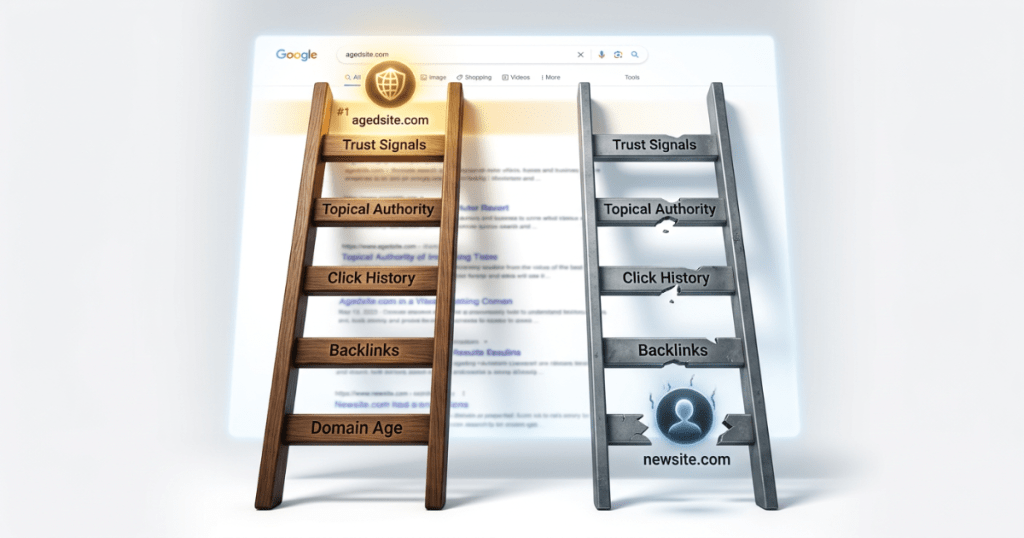
Most SEO advice treats this bias as something to overcome through sheer content volume. That framing is wrong. The bias is baked into the architecture of how Google sorts through hundreds of billions of webpages to present the most relevant, useful results. Fighting it head-on is like trying to outrun a headwind by running harder. The smarter move is to change direction.
New domains must accept this bias and work around it, not against it. The goal is not to match an aged domain’s history. The goal is to find the gaps where history matters less, niches the established players have ignored, queries they have not optimized for, and angles they are too big to pursue. That is where the structural bias stops being a wall and starts being a map.
What Established Brands Won’t Tell You
The advantages established brands hold are not secrets. They are structural realities that compound daily. New domains cannot replicate them quickly, and pretending otherwise wastes months.
- Historical click data that trains Google’s systems
- Backlink profiles built over years, not weeks
- Domain authority that amplifies every new page
- Brand recognition driving direct traffic and trust signals
- Internal link equity distributed across thousands of pages
- Content archives that create topical depth automatically
- User engagement signals from repeat visitors
Each advantage feeds the next. A backlink profile earns trust, which amplifies domain authority, which makes every new page rank faster, which generates more click data, which signals relevance again. New domains start at zero on every loop of this cycle.
Stop trying to replicate what took years to build. Find the specific queries these brands ignore because the traffic is too small, the topic too narrow, or the effort too high relative to their scale. That gap is the only fair fight.
The Strategy That Works for New Domains
Most new domain strategies fail because they try to compete on the wrong battlefield. The goal is not to outrank a 10-year-old domain on a broad keyword. The goal is to find the keywords that domain has no reason to care about.
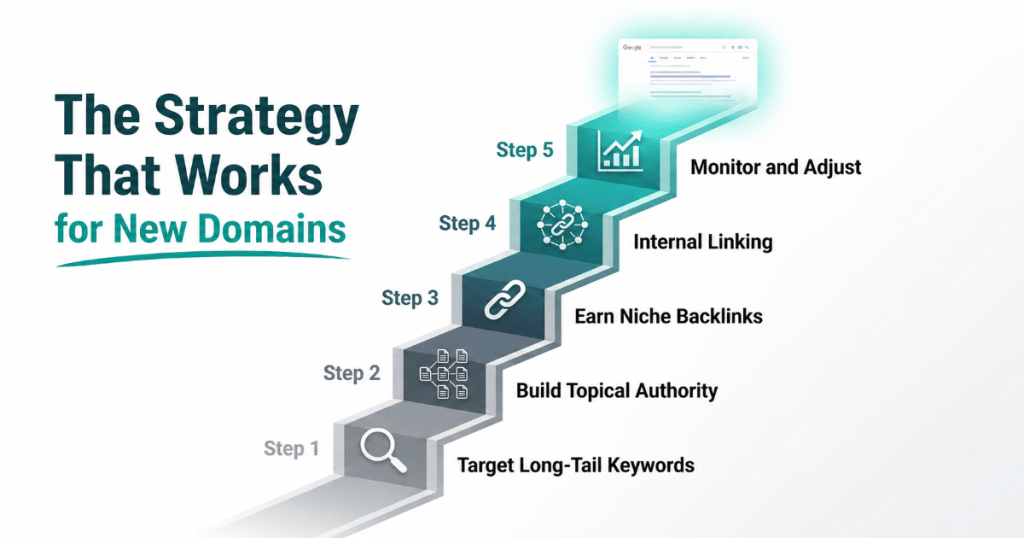
Step 1. Target low-competition, long-tail keywords where established brands have not optimized. A major brand will not rewrite its entire site for a three-word query that drives 50 visits a month. That is your opening.
Step 2. Build topical authority by publishing a cluster of related content, not isolated articles. A single article on a new domain carries no weight. Ten articles that cover every angle of one topic signal depth. Google notices depth before it notices individual pages.
Step 3. Earn backlinks from niche-relevant sites through guest posting or original research. A link from a respected industry blog carries more weight than ten links from generic directories. One strong link changes the trajectory of a new domain.
Step 4. internal linking to distribute authority across your site. Every new page you publish should link to your cornerstone content. This tells Google which pages matter most and spreads whatever link equity you have earned.
Step 5. Monitor rankings with a rank checker tool and adjust strategy based on real data. Guessing which keywords are moving wastes months. Data tells you exactly where to double down and where to abandon.
Completing this process shifts the domain from invisible to competitive on the keywords that matter most. The gap is not in content quality. The gap is in strategy.
When to Expect Your First Real Rankings
The most honest answer about ranking timelines is the one most guides avoid: nobody knows for sure, and anyone who promises a specific month is guessing. Google’s automated ranking systems sort through hundreds of billions of webpages to present the most relevant, useful results, and a new domain has no place in that sorting yet. The timeline depends entirely on what you are competing against and how aggressively you build trust signals.
Low-competition keywords are the only realistic expectations for a new domain in the first year. These are searches where established brands have not bothered to optimize, niche queries with clear intent but low search volume. A well-structured article on one of these terms can surface within months, not because the content is brilliant, but because the competition is asleep.
Medium-competition keywords require a different patience. These are the terms where multiple domains have invested in content, backlinks, and topical authority. Ranking here takes consistent publishing over many months, combined with deliberate backlink building from niche-relevant sites. The domain needs to prove it belongs in the conversation before Google’s systems will surface it.
High-competition keywords are the trap. These are the terms every competitor targets, where the top results are years old and backed by thousands of backlinks. A new domain chasing these terms directly is wasting time. The smarter play is to build authority on adjacent low-competition terms first, then let that accumulated trust lift the page for the harder keyword later.
The timeline is not a countdown. It is a function of how quickly a domain can accumulate the signals Google’s systems use to rank pages. Strategic action, targeting the right keywords, building topical depth, earning backlinks, accelerates that process. Patience without strategy is just waiting.
Ranking Is a Marathon, Not a Sprint
Google’s algorithm was never designed to be fair to new domains. It was built to reward persistence, age, and accumulated trust.
Understanding that bias is not a reason to give up. It is the only way to compete. The right strategy does not fight the algorithm, it exploits the gaps the algorithm leaves open.
Every week spent waiting for content quality alone to work is a week the competition gains more ground. Established brands are not slowing down. They are not leaving easy openings. But they are too big to care about the narrow, specific, low-competition angles that a new domain can own completely.
That is the only real advantage a new domain has. Speed. Focus. The ability to care about a topic no one else will touch.
Stop publishing and hoping. Start finding the gaps. Target the keywords established brands ignore. Build the topical authority they cannot be bothered to build. Earn the backlinks from the niche sites they overlook.
The algorithm will not change. But the course you choose can.
Every claim in this article was checked against a real source before it was published.
WryveAI researches live search results, writes source-verified content, and publishes straight to WordPress, all in one platform.
Try WryveAI Free →No credit card required.
Frequently Asked Questions About Ranking in Google
What does it mean to rank on Google?
Ranking on Google means your web page appears in the organic search results when someone searches for a specific keyword or phrase. The position of your page among the list of results determines its visibility, with the first page capturing the vast majority of clicks.
Where do I rank in Google?
You can check your current ranking by searching for your target keyword in an incognito browser window or using a dedicated rank checker tool. Most rank checkers show your exact position on the search results page, along with the URLs of the pages currently ranking above and below yours.
How to rank #1 on Google in 2026?
Ranking first on Google requires a combination of technical SEO, high-quality content, and a strong backlink profile that signals authority to the algorithm. For a new domain, targeting low-competition keywords with specific user intent is the most realistic path, as competing for high-volume terms against established sites is unlikely within a short timeframe.
How can a new domain compete with established brands?
A new domain can compete by targeting the specific gaps established brands are too large to exploit, such as low-competition long-tail keywords and niche topics with clear user intent. Building topical authority through a cluster of related content and earning backlinks from relevant niche sites creates the trust signals Google needs to rank a new site.


