AI Blog Writer: How to Turn SERP Data Into Articles That Rank

ℹ️ TL;DR
- Most AI blog writer tools generate in a vacuum, ignoring the SERP data that determines whether content ranks or vanishes.
- The research-first workflow analyzes top-ranking pages, maps content gaps, then generates, in that order. Reversing it produces generic filler.
- A complete output is a system, not a draft. Metadata, FAQs, tables, internal links, and structured data are what separate ranking content from published noise.
- Long-form articles break when generated in one pass. Section-by-section generation with SERP context maintains coherence and depth.
- Human oversight is not optional. The draft is the starting point. The edit is where credibility, accuracy, and voice enter the page.
Every content team hits a wall where articles get published and then vanish into the search results. The tool they trusted was an AI blog writer, and it delivered exactly what it was asked for: text. Not context, not competitive insight, just words arranged in a plausible order.
The gap is that most AI blog writer tools generate content without ever looking at the search results they need to beat. They draft in a vacuum, producing generic articles that sound professional but offer nothing Google hasn’t already ranked. The speed is real. The ranking power is not.
This article walks through a research-first workflow that turns SERP data into structured, publish-ready content. You’ll learn how to analyze what ranks, build outlines that cover gaps competitors miss, and use an AI blog writer to produce articles that actually compete. The tool matters less than the intelligence you feed it. By the end, you’ll know exactly how to close that gap.
Why Most AI Blog Writers Produce Generic Content
The core failure of most AI blog writer tools is not the writing. It is the absence of research. They generate text without ever looking at the search results they are supposed to beat. ChatGPT and Jasper promise speed, and they deliver it. What they deliver is prose that reads fine and says nothing. No depth. No structure that mirrors what Google already rewards.
The gap is always the same. A tool that ignores the SERP cannot know which subtopics competitors covered, which questions searchers actually ask, or where the content gap sits. Text without SERP intelligence is just a guess with good grammar. That is why so much AI output ends up as generic SEO articles that get published and then disappear.
Tools like WryveAI take the opposite path. They analyze top-ranking pages first, map the subtopics those pages cover, and identify what they miss. The writing starts after the research, not before it. The result is content built to fill a real gap rather than repeat a familiar pattern.
The distinction matters because the cost of generic output is not just a wasted draft. It is the credibility of the entire content program. Search engines do not reward effort. They reward answers that beat what already ranks.
An AI blog writer that skips the SERP will keep producing articles that sound professional and rank nowhere. The fix is not a better prompt. It is a tool that treats research as the first step of writing.
Watch what happens when the same prompt runs through two tools. One drafts from a blank page. The other drafts from a SERP analysis that names the exact subtopics missing from the top ten results. The second article has a reason to exist.
That reason is what editors feel when they read it. The content answers questions the competitors skipped, which changes the calculus from “is this good enough to publish” to “why has nobody covered this yet.”
The Research-First Workflow for an AI Blog Writer
The gap between a draft that ranks and a draft that disappears is decided before a single word is generated. A research-first workflow forces the AI blog writer to build on competitive intelligence rather than guesswork.
Step 1. Analyze the SERP for your target keyword. Study the top-ranking pages and note the subtopics they cover, the questions they answer, and the angles they ignore. Skipping this step produces content that mirrors the competition instead of beating it.
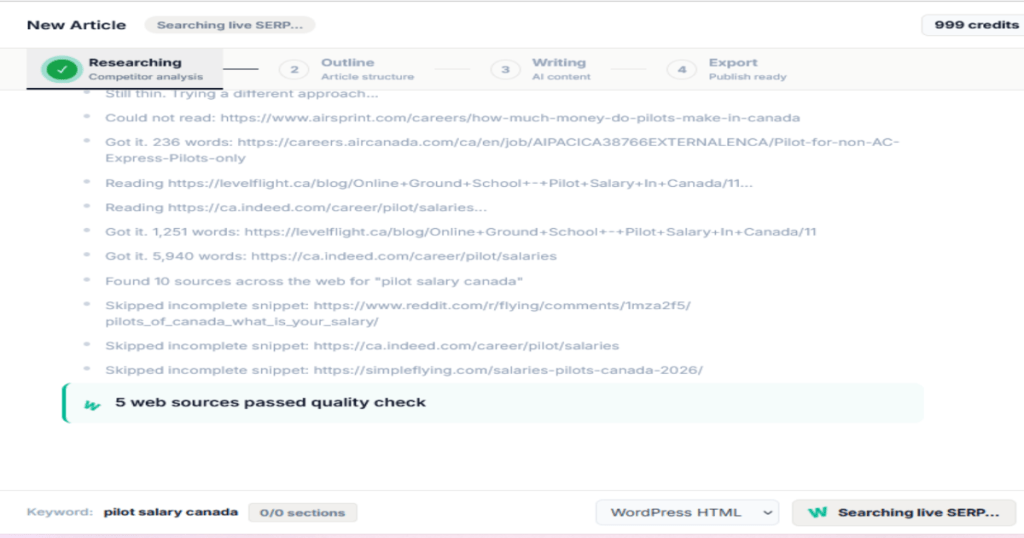
Step 2. Build a content outline that covers the gaps competitors miss. The outline is where ranking potential is won or lost, so treat it as the blueprint. Community discussions on using AI for outlines consistently highlight that structured planning beats raw generation speed.
Step 3. Generate the first draft with your AI blog writer, feeding it the outline and the SERP insights directly. Tools like WryveAI that analyze top-ranking pages can surface content gaps automatically, turning research into structure without manual effort.
Step 4. Edit for accuracy, tone, and E-E-A-T signals. Verify every factual claim, tighten the voice, and ensure the author expertise comes through clearly. Skipping this step trades ranking potential for factual errors that destroy credibility.
Step 5. Optimize metadata and internal links before publishing. The title tag and description determine click-through rate, while internal links distribute authority to the pages that need it most.
Completing this sequence turns a generic draft into a publish-ready package built on search intent. The tool that researches before it writes will always outperform the one that simply generates.
Most teams stop at Step 3 and call it done. That is where the ranking potential leaks away, because search engines reward the page that answers intent most completely, not the one generated fastest.
The practical takeaway is simple: treat the SERP analysis as the deliverable, not the draft. When the research is locked in before generation, the AI blog writer becomes a formatting engine for a strategy that already exists.
What a Real AI Blog Writer Package Includes
A complete AI blog writer output is a system, not a single document. Most tools hand you a draft and call it done. That draft is the smallest piece of what actually ranks.
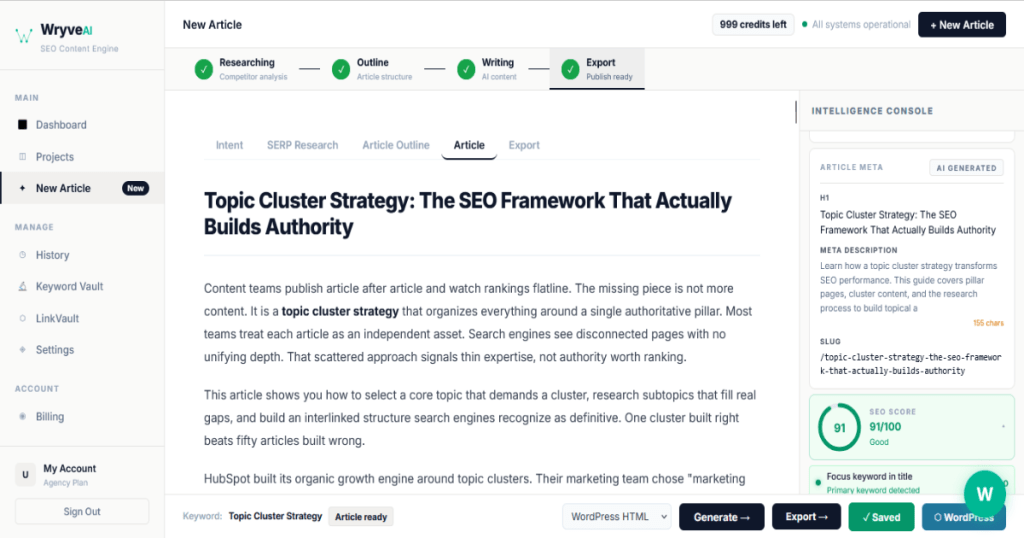
The full package starts with an SEO blog brief that defines the target keyword, search intent, and the specific angles competitors have already covered. From that brief, the outline emerges with subtopics that fill the gaps the SERP analysis exposed. A first draft follows, but it is only the middle layer of the stack.
Metadata That Earns the Click
Title tags and meta descriptions are where rankings convert into traffic. An AI blog writer that generates these alongside the draft saves hours of manual work. The metadata must reflect the content’s actual structure, not a keyword-stuffed afterthought.
FAQs That Capture Featured Snippets
Question-based formatting targets the search features that traditional articles miss. A well-placed FAQ block answers the queries users type when they are close to converting. This is where the SERP intelligence becomes visible.
Tables and Structured Data for Readability
Google rewards content that is easy to parse. Comparison tables, data tables, and clean HTML formatting signal that the page answers the query directly. Readers scan before they read, and tables give their eyes a place to land.
Supporting Assets That Close the Loop
Internal link suggestions, image alt text, and related query prompts complete the package. Each element reinforces the others, creating a page that satisfies both the reader and the ranking algorithm. Tools like Manus’s AI blog writer build this entire editorial package in one pass, which is why the output outperforms a bare draft. The difference between a tool and a system is whether the components work together. A package that includes research, structure, and metadata outranks a draft every time.
How to Use an AI Blog Writer for Long-Form Articles
Long-form articles expose the weakness in most AI blog writer tools faster than any other format. A two-thousand-word draft generated in one pass reads like it was written by someone who forgot the beginning by the time they reached the end.
Step 1. Break the article into distinct sections before generating anything. Each section gets its own SERP-informed angle, pulled from what already ranks for that subtopic. Skipping this produces a draft that meanders without ever answering the query fully.
Step 2. Feed the AI blog writer one section at a time, not the whole outline. This keeps the voice consistent and forces the tool to focus on depth rather than breadth. Tools like ChatGPT and Jasper drift badly when asked to hold an entire long-form structure in one prompt.
Step 3. Use the SERP data to dictate what each section must cover, including the gaps competitors left open. That is the difference between content that fills a page and content that fills a need. The strategic framework for this process starts with the search results, not the topic.
Step 4. Review each generated section against the one before it. Check for repeated phrases, contradictory claims, and shifts in tone that break the reading flow. Coherence is the first thing readers notice and the last thing most tools deliver.
Step 5. Assemble the sections, then run a full read-through for factual consistency and E-E-A-T signals. WryveAI structures its output as publish-ready articles, which shortens this review window considerably. The tool handles the structural load so the editor focuses on substance.
Completing this process turns a tool that writes paragraphs into a system that builds authority. The article reads like one author wrote it with a clear argument, because the structure forced that outcome.
The Human Oversight That Keeps AI Content Honest
Publishing an AI blog writer draft without review is the fastest way to destroy a brand’s credibility. The draft reads fine on the surface, but surface is where the value ends.
Generic phrasing slips through. Facts go unchecked. The tone drifts into something no human on the team would sign their name to. The reasoning that makes this feel safe is simple: the tool produced words, so the work is done. That reasoning breaks the moment a reader spots an error and questions everything else on the page.
Before: A content manager generates a post, skims the first paragraph, and hits publish. The article ranks for nothing, reads like every other AI output on the topic, and contains a claim about industry regulations that is subtly wrong. The reader who catches it never returns. The team saves drafting time and loses the trust that time was meant to buy.
After: The same draft goes through a structured review. Facts get verified against primary sources. The tone gets adjusted to match the brand voice guide. E-E-A-T signals get checked: is the author named, is the expertise demonstrated, is the content actually useful?
The published piece ranks because it offers something the raw draft did not. The editing pass takes time. It is not wasted time.
HubSpot’s AI blog writer is built on this assumption. It generates the draft, but the platform expects a human to shape it into something publishable. The tool is a starting point, not a finish line.
Human oversight is the quality gate that separates content that ranks from content that embarrasses. The teams that treat editing as a cost to minimise are the teams that publish the most forgettable content. The teams that treat it as a feature produce articles that hold up under scrutiny. That scrutiny is the entire game. An AI blog writer gets the first draft done. The human gets the draft right.
How to Choose the Right AI Blog Writer for Your Team
The right choice hinges on one question: do you need speed, or do you need ranking power? Most teams pick a tool because it generates text quickly, then wonder why the content never earns traffic. That ordering is backwards.
Step 1. Map your workflow before you compare tools. Write down where content currently stalls: research, drafting, editing, or optimization. A tool that solves the wrong bottleneck adds cost without fixing the problem.
Step 2. Evaluate general-purpose chatbots like ChatGPT for their true strength: brainstorming and ideation. These tools handle outlines and rough angles well, but they lack search context. Drafts arrive generic because no SERP analysis informed them.
Step 3. Test dedicated SEO tools that build research into the writing process. WryveAI analyzes top-ranking pages and identifies content gaps before generating, which means the draft arrives with structure already aligned to what Google rewards. Compare that directly against SEO Writing AI to see which workflow produces publish-ready output.
Step 4. Consider content platforms like HubSpot when integration matters more than raw generation. These systems manage the full editorial lifecycle, but they lock you into their ecosystem. The trade-off is flexibility for convenience.
Step 5. Run the same test brief through every shortlisted tool. Generate one article on the same topic, then compare research depth, structural quality, and editing required. The draft that needs the least revision is the one that understood the search landscape.
Step 6. Check how each option handles the long tail of publishing: metadata, internal links, and FAQ generation. A tool that produces a complete package beats one that produces only paragraphs, because the missing pieces become your workload.
The tool that wins is the one that removes the research gap, not the one that types fastest. A general-purpose chatbot gets you a draft. A research-first AI blog writer gets you a ranking asset. Choose accordingly.
What Most AI Blog Writer Guides Get Wrong
The advice circulating in most AI blog writer guides is organized around the wrong question. They ask which tool has the best interface or which prompt produces the most polished prose. The question that actually matters is whether the tool builds on competitive intelligence before it writes a single sentence.
Prompt tricks are a distraction. A cleverly engineered prompt fed into a tool with no SERP awareness still produces content that ignores what already ranks. The result is an article that reads competently and then fails in the search results because it covers the same ground as every other page, with nothing new to offer the algorithm or the reader.
This is why the strategic foundation matters more than the generator. The best AI blog writer is not a standalone text engine. It is a system that analyzes top-ranking pages, identifies the subtopics competitors missed, and builds the outline from that gap analysis. Research integrated into the writing process beats research bolted on afterward.
WryveAI approaches the problem this way. Its SERP intelligence layer examines what ranks for a given query, then structures the article around the content gaps it finds. The writing is the final step, not the first one. That ordering is what separates content that competes from content that merely exists.
Guides that skip this layer send teams straight to the prompt box. Those teams then wonder why their output needs heavy rewriting and still does not move rankings. The tool was never the bottleneck. The missing research was. Teams producing 20 blog posts a month with an AI blog writer discover this quickly when volume rises and traffic does not follow.
Build a Content Engine That Ranks
The best AI blog writer is not the one that types fastest. It is the one that researches first. That distinction separates content that earns rankings from content that merely fills a publishing calendar.
Every article published without SERP intelligence is a bet against competitors who already hold the top positions. The gap between your draft and theirs is not writing quality. It is the research layer that tells you what to cover, how to structure it, and where the openings are. That layer is the entire game.
Evaluate your current tool against the research-first workflow. If it cannot analyze the search results before generating, it is a typing assistant, not a content engine. Try WryveAI to see the difference.
Every claim in this article was checked against a real source before it was published.
WryveAI researches live search results, writes source-verified content, and publishes straight to WordPress, all in one platform.
Try WryveAI Free →No credit card required.
AI Blog Writer Questions, Answered
What is an AI blog writer?
An AI blog writer is software that generates article drafts from prompts, outlines, or source material. The difference between tools comes down to whether they research the search results first or simply produce text from training data.
Can AI blog writers produce content that ranks?
Yes, but only when the tool feeds SERP intelligence into the drafting process. An AI blog writer that analyzes top-ranking pages and fills content gaps will outperform one generating from a bare prompt every time.
How much human editing does AI blog content need?
Raw output needs substantial editing for factual accuracy, tone, and E-E-A-T signals. Teams that skip this gate publish content that damages credibility, while those applying structured review turn drafts into ranking assets.
What should I look for in an AI blog writer?
Look for built-in SERP analysis, content gap detection, and structured output like metadata and FAQs. A tool that assembles the full editorial package saves more time than one that only produces a draft you must rebuild.
Is an AI blog writer better than ChatGPT for SEO content?
A dedicated AI blog writer with SERP analysis built in will consistently outperform ChatGPT for SEO content, because ChatGPT generates from training data without analyzing what currently ranks for your target keyword.