AI Content Strategy for Insurance Companies: In-House Team vs Agency vs AI Platform

Picking the fastest AI writer is the wrong first move. A carrier marketing team can draft a quarter of educational articles in an afternoon, then watch every piece stall in compliance for weeks because nobody built the review path into the workflow.
That failure is not a tool problem. It is an operating model problem, and it sits underneath every serious content program in a regulated industry.
This article compares the three models directly: an in-house team, an agency, and an AI content platform. You’ll see which criteria decide the fit, and why compliance review capacity, not drafting speed, separates a working program from a stalled one.
Why Insurance Content Fails Before It Ranks
Insurance content gets graded twice, and the second grader can kill a page that already won the first. A draft can hit every on-page target and still never publish. The reason is rarely the writing.
Search rewards clarity about coverage. Compliance rewards restraint about coverage. Those two forces pull in opposite directions, and a strategy that only optimizes for the search engine is building for half the audience.
Generic AI output defaults to confident coverage language. It writes that a policy “covers water damage” without knowing which form, which state, or which endorsement applies. A compliance officer then rewrites the sentence from scratch, and the efficiency gain evaporates at review.
Regulators are paying attention. The NAIC’s model bulletin on insurer AI systems expects insurers to govern AI across the whole insurance life cycle, marketing included. New York has gone further on the underwriting side with its circular letter on AI in underwriting and pricing.

The failure mode is not bad prose. It is unapproved claims dressed as good prose. A carrier-specific promise the insurer cannot legally make stalls the whole batch. Teams chasing speed hit AI strategies that backfire precisely here, because faster drafting just means more drafts stuck in the same queue.
In-house team, agency and AI platform are three answers to one question: who owns the review path? Pick the model before the tool, or the tool picks your bottleneck.
The In-House Team Model and Its Real Ceiling
The comparison that matters is not speed. It is which model keeps a draft inside the approved claim set before a reviewer ever touches it. In-house teams win that contest outright, then lose the next one.
In-house teams already hold the carrier relationships, the approved claim language and the state-specific rules. A writer who knows which product features cannot be described as guaranteed in a given state writes the compliant version the first time. Review becomes a check, not a rewrite. Brand voice holds because the person writing it has sat in the same meetings as the person approving it.
The ceiling arrives with volume. A small team cannot produce the educational depth search visibility demands, and the same people who write are often the people who review. Lose one writer to a leave of absence and the publishing calendar stops. That single point of failure is structural.
In-house is the strongest model for accuracy and the weakest for throughput. Choose it when the bottleneck is regulatory risk, not output.
Where the Agency Model Breaks on Carrier Rules
Four failure points sink agency-produced insurance content, each tracing to a different cause. Treat them as separate problems, because fixing one does nothing for the others.
The admitted versus surplus lines blind spot
An agency writer who doesn’t know admitted from surplus lines will produce copy that reads beautifully and cannot publish. Admitted carriers file rates and forms with state regulators; in most states, surplus lines carriers operate outside that filing system. That distinction changes what a sentence is legally allowed to promise.
The approval chain that recreates the bottleneck
Outsourcing drafting doesn’t outsource approval. Agency drafts still route through the insurer’s compliance team, so the queue the agency was hired to shorten reappears intact.
Voice flattening across a multi-client roster
An agency serving six carriers tends to write all six in one voice. Templates, shared prompt libraries and deadline pressure push every client toward the same generic tone. A Medicare supplement brand and a commercial property carrier end up sounding interchangeable.
Retainers that never get cheaper per article
Agency retainers are predictable, but cost scales with volume, so the per-article price stays flat no matter how many pieces you commission. There’s no efficiency curve, only a bigger invoice.
The agency model works when the insurer hands over a detailed claims and language guide before the first draft. Without that document, you’re paying for polished copy the compliance desk sends straight back. The same pattern shows up in other detail-heavy sectors, as our AI content strategy for logistics companies shows.
What an AI Content Platform Adds to the Mix
A platform model is a structured pipeline that forces research, drafting and review into a fixed order, so a draft cannot skip a stage on its way to publication. Each layer below stops a specific failure that generic SEO articles walk straight into.
- Live SERP research. Drafts start from what currently ranks for the query, not from a prompt typed into a blank box.
- Brand profile management. Each carrier or product line keeps its own approved voice and vocabulary, so a Medicare supplement article and a commercial auto article stop sounding like the same person wrote both.
- Internal linking automation. Educational pieces connect to the right product page without a manual audit.
- A quality check before export. Every draft is scored before anyone exports it, so weak drafts get caught before they reach your reviewer.
Regulatory attention is moving toward how insurers govern AI output, not whether they use it. Colorado’s Division of Insurance keeps a dedicated AI guidance page for carriers, and the U.S. Treasury has held a roundtable on AI in the insurance sector.
WryveAI builds every article from live SERP research, with separate brand profiles for each client and a Quality Score on every draft. If a claim can’t be verified, it is left out instead of guessed. That structure keeps review from restarting on every draft, but only if the compliance team sits inside the workflow rather than after it.
The Review Path That Decides Which Model Wins
Sequence is the whole game. Run these five steps in order and drafts arrive at review already inside the guardrails.
Step 1. Lock the approved claim set before anyone drafts. Write down the coverage statements a writer is allowed to make, product line by product line. Skip this and every draft becomes a negotiation.
Step 2. Load the brand and compliance profile into the tool or the agency brief. Constraints have to travel with the work, not sit in a shared drive nobody opens. A profile that names prohibited language and required disclosures keeps the first draft closer to publishable.
Step 3. Route every draft through one reviewer who owns the state rules. A committee multiplies turnaround time without improving accuracy. One owner who tracks the bulletins in every state you write in, such as Colorado’s statutes and bulletins, signs off once and moves on. This is the human input rule in practice: judgment stays with a named person, not a queue.
Step 4. Log every published claim. Each approved statement becomes the baseline for the next draft. Without the log, the same coverage question gets re-argued on every article.
Step 5. Refresh published content on a schedule. Insurance rules shift, and a stale article quietly becomes a compliance liability. Treat refresh as production work, not cleanup.
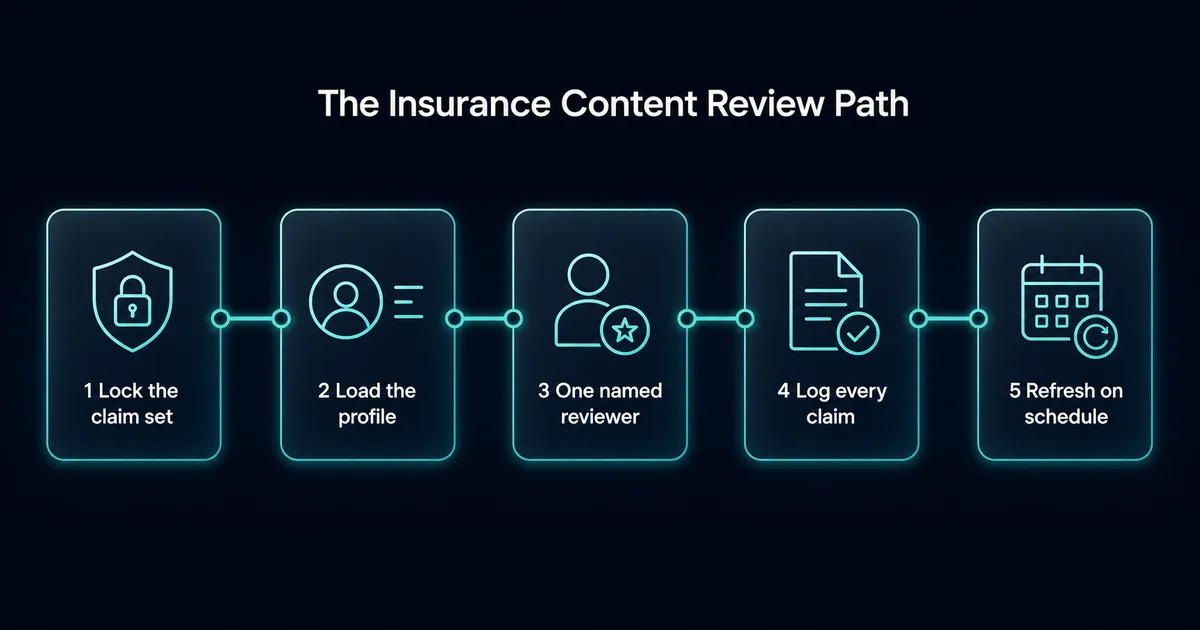
Finish all five and review becomes a checkpoint a draft can pass quickly.
What Most Guides Get Wrong About AI in Insurance
The guides keep answering a question insurers never asked. Tool selection decides little. What decides everything is whether the operating model around that tool survives a compliance reviewer with veto power over every word.
Tool-first thinking feels safe because it’s concrete. You can compare interfaces and pricing. You can’t compare operating models in a trial account, so teams buy the software instead.
Before: A marketing lead buys a general-purpose writing tool and prompts it for a batch of articles on auto coverage. The drafts read clean and confident, which is exactly the problem. They promise things about liability limits and claims handling that no underwriter signed off on, and the compliance reviewer rejects the whole batch. The team walks away convinced AI can’t work in insurance.
After: The same team writes the approved claim set first, then loads it into a brand profile before drafting anything. Articles target a named product line, use language the carrier already cleared, and arrive at review already inside the guardrails. One reviewer signs off instead of rewriting from scratch.
The contrast exposes the real variable. Regulators already scrutinize how insurers use technology, as the GAO’s report on insurance technology shows, and a marketing claim carries liability the moment it’s published. The tool was never the failure. The missing operating model was.
Choosing Between In-House, Agency, and Platform
The table below scores each model against the constraints that decide whether insurance content reaches publication. Read the accuracy row first, because it overrides everything beneath it.
| Dimension | In-House Team | Agency | AI Platform |
|---|---|---|---|
| Accuracy on carrier rules | Strong, holds filings knowledge | Weak, learns rules per brief | Depends on profile setup |
| Throughput at scale | Low, capped by headcount | High, scales with retainer | High, scales with plan |
| Cost predictability | Fixed salaries, variable output | Fixed retainer, linear cost | Fixed monthly plan |
| Compliance review speed | Fast, reviewer knows claims | Slow, reintroduces bottleneck | Fast if the claim set is loaded |
| Brand voice control | Tight, one voice | Drifts across clients | Per-profile, stays consistent |
Your bottleneck decides the winner. Knowledge-heavy insurers should keep review in-house and add a platform for volume. Volume-heavy insurers should adopt a platform and hire one reviewer who owns the claim set.
Hybrids often work best: an in-house reviewer, a platform producing research-backed drafts, and an agency reserved for campaign creative. That split explains why most plans fail when they pick a single model and expect it to cover all three jobs.
Build the Review Path Before You Pick the Tool
A working AI content strategy for insurance companies starts with a claim set and a named reviewer. Everything else, including the tool, is downstream of that decision. Get the order wrong and the fastest drafting engine in the market still produces drafts nobody can publish.
Insurers that lock the claim set first stop paying for rewrites. Their reviewers read for accuracy instead of rebuilding coverage language, and the marketing team ships educational content on a predictable rhythm. Write the approved claim set this week. Name the one person who owns state-specific rules. Then evaluate vendors and agencies against that constraint, not against a demo.
WryveAI builds insurance articles from live SERP research and verified sources, with a separate brand profile for every carrier or product line. Try it free and run one article through your own review path.
FAQ
Questions Insurers Ask About AI Content Strategy
How to use AI in insurance industry?
Use AI where it removes repetitive work and keep a human gate on anything that touches a coverage promise. The useful split is research, drafting and internal linking on the machine side, with claim approval and state-rule checks staying with a named reviewer.
Which AI is best for content strategy?
The best system starts from live search research and checks quality before anything exports, not the one with the slickest editor. A tool that drafts from a blank prompt produces confident copy with no grounding, which is exactly the output a compliance officer rejects first. Judge platforms on their research inputs and review checks, not their word count per minute.
What is the best AI tool for insurance agencies?
Agencies get the most from a platform that keeps a separate brand profile for every carrier client, so voice and approved language never bleed between accounts. Generic writing assistants push the same prompt across every client, and that sameness is what clients notice first when they compare drafts.
Every claim in this article was checked against a real source before it was published.
WryveAI researches live search results, writes source-verified content, and publishes straight to WordPress, all in one platform.
Try WryveAI Free →No credit card required.