AI Content Strategy for Logistics Companies: Why Generic AI Fails

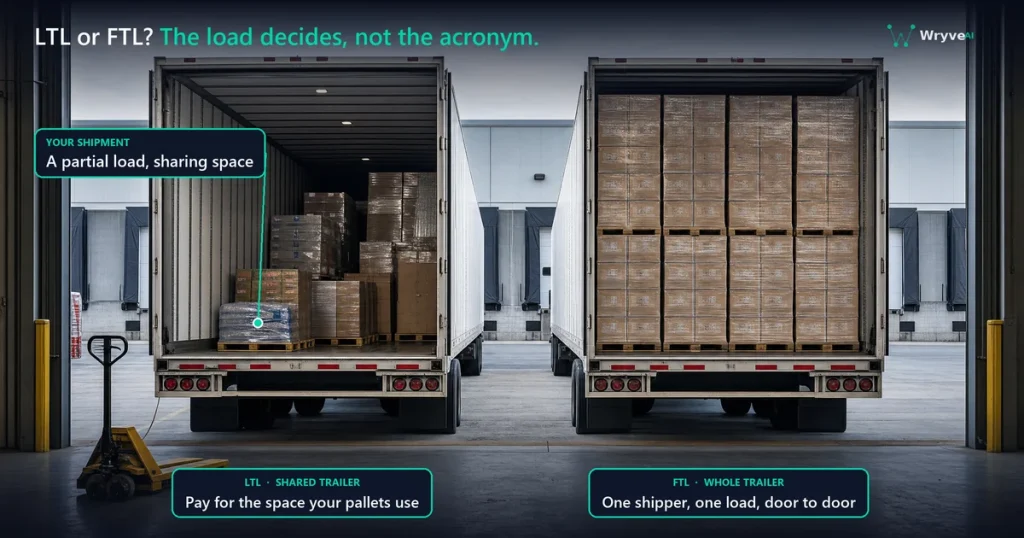
Search “LTL vs FTL” and you’ll get a dozen articles that explain the acronyms and none that tell a shipper which mode fits a partial load moving from Columbus to Memphis. That gap is where an AI content strategy for logistics companies either earns trust or burns it.
The prompt-first habit makes it worse. A team types a keyword into a chatbot, publishes the draft, and ships content that cannot name a real customs rule or cite a verifiable transit time. Buyers who live inside those details spot the filler in one paragraph.
This article explains why the prompt-first approach collapses in freight and what a research-led strategy looks like instead. Live SERP research, verified sources, and a compliance layer turn generic drafts into content a fleet manager actually finishes reading.
The Prompt-First Approach Is Why Generic AI Fails
The default workflow in logistics marketing: open ChatGPT, type a keyword, publish the draft. It produces content that reads fluently and says nothing a freight buyer can use.
The model isn’t the problem. Starting from a prompt instead of live SERP research and verified sources is the problem. A prompt gives the model a topic, no lane data, no regulation text, no competitive context.
Ask a prompt-only tool to explain shipping options and it blurs LTL freight and full truckload into one vague paragraph. It cannot tell a shipper when a partial load justifies LTL rates versus when a dedicated trailer wins on cost and handling. A buyer who books freight daily spots that gap in the first sentence.
The same failure hits customs content. Generic output gestures at “import regulations” without naming a single rule, form, or agency. That’s not useful to an operations manager clearing a shipment through a port. Transit times expose the flaw fastest. A prompt-first draft offers “varies by carrier and route” and calls it an answer. Every logistics buyer already knows that.
Teams reach for AI content writing tools expecting the model to supply domain knowledge. It supplies language instead. The knowledge has to come from somewhere the draft can cite, and a blank prompt is not that source.
Swap the starting point and the output changes. Feed the model a live SERP map and primary sources, and the draft has something concrete to work from. Leave the prompt blank and you get filler dressed as expertise.
What Logistics Buyers Search For That AI Misses
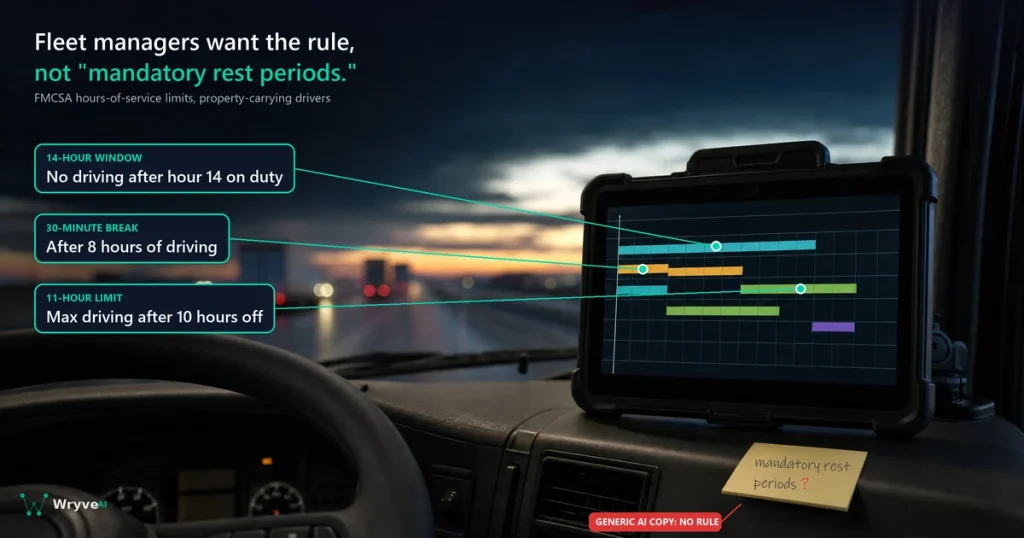
A fleet manager typing a query about driver rest rules wants the regulation, not a paragraph about the importance of safety culture. Generic drafts answer the topic. Buyers need the answer.
Prompt-first drafting feels safe because the output reads clean and professional. The reasoning breaks the moment a reader who lives inside those rules spots a vague claim where a specific one belongs.
Before: A carrier’s marketing team opens a chat tool, types “why supply chain visibility matters,” and publishes the result. The draft names no lanes, cites no regulation, and describes visibility as a competitive advantage. A shipper reading it learns nothing they could act on, and the page earns a bounce instead of a call.
After: That same team pulls the live SERP first and sees fleet managers asking precise questions about rest breaks and on-duty limits. The article names the FMCSA hours-of-service rules and links to the federal driver hours-of-service rules so a dispatcher can verify the claim directly. It answers the question that was actually typed.
The contrast exposes the real gap. Models are fluent about logistics in the abstract and silent on the operational detail that decides whether a buyer trusts the page. Specificity is the trust signal, and no prompt manufactures it. The research has to come before the draft.
Build the Strategy From Live SERP Research, Not Prompts
A research-led workflow produces briefs that already know what ranks, what competitors skipped, and which claims can be sourced. Prompting feels faster, but the draft stalls for hours in review.
Step 1. Pull the live SERP for every target query and map what already ranks, page by page. Skip this and you brief the model on a topic instead of the competitive picture, so the draft duplicates page one.
Step 2. Identify what the top pages leave out: the named regulation, the real transit window, the lane-specific example, the form a shipper actually has to file. Skipping this produces the article every shipper has read and none has bookmarked.
Step 3. Attach a verified source to every specific claim before drafting begins. Skip it and the model fills gaps with plausible-sounding rules and invented transit details an editor must catch later.
Step 4. Build the brief from those sources, then draft against the brief. Skipping the brief is where prompt-first teams lose the work from steps one through three.
WryveAI runs this exact sequence on every article, building from live SERP research and verified sources instead of a marketer’s memory. The same discipline carries over to an AI content strategy for agencies managing several logistics clients at once.
Finish the sequence and the draft arrives with a competitive position, a sourced claim set, and a brief an editor can check against. That is the difference between a draft that needs rewriting and one that needs tightening.
The Compliance Layer Generic AI Cannot Handle
A carrier’s blog post about driver rest rules is a legal document wearing a marketing costume. Get the hours wrong and you’ve published bad guidance under your own logo, to an audience that screenshots everything.
Generic AI drafts treat regulation as decoration. The model produces a confident paragraph about “mandatory rest periods” without naming the actual duty limits. A fleet manager spots the vagueness and files your brand next to every other content farm.
Worse is the invented rule. Ask a prompt-only tool about customs documentation for cross-border freight and it will assemble something plausible. Plausible is the danger. A shipper who acts on a fabricated requirement can have a load held at the border.
Grounding every regulatory claim in the primary source is the only defense. A research-led strategy treats the regulation text as truth and the model as a summarizer. The model never gets to remember a rule. It gets to quote one.
NIST’s AI Risk Management Framework treats validity and reliability as core requirements for trustworthy AI, and logistics content sits squarely inside that risk. The human editing requirement isn’t overhead here. It’s the control that keeps a misstated rule off your site. Skip it and the liability compounds quietly: the post ranks, gets shared, and a compliance officer finds it months later.
Where Machine Learning Fits in the Content Pipeline
Two machine learning deployments sit on opposite ends of a logistics content operation. One generates drafts. The other generates intelligence. The difference decides whether your content program compounds in value or burns budget on cleanup.
Drafting shortcuts treat machine learning as a faster keyboard. A writer types a lane, a mode, and a service into a prompt and gets a post in seconds. That works for a top-of-funnel explainer nobody fact-checks closely. It collapses the moment a claim needs a source, because the model has no idea which tariff schedule changed last quarter.
Analytical machine learning treats the model as a research assistant. It reads the live SERP for a query like “cross-border customs broker requirements,” clusters related keywords by intent, and flags which competitor pages hold position. That intelligence shapes the brief before drafting starts. In WryveAI, the Keyword Vault banks and clusters target terms, and SERP analysis runs before every brief, so the writer opens a brief that already knows the competitive picture.
The value sits in the analysis, not the draft. A competitor page ranking for a high-intent freight query tells you what structure and depth the market rewards. A generated paragraph tells you nothing you did not already prompt. Feed the writer intelligence and the AI SEO content writing that follows has a target.
Choose analytical machine learning when your content has to win against informed buyers. Drafting shortcuts only make sense for low-stakes internal notes or first-pass outlines a senior writer will rebuild anyway.
Preparing Content for Supply Chain Shifts Ahead
Logistics content goes stale faster than content in almost any other industry. A tariff schedule changes, a lane’s economics flip, a carrier exits a market, and yesterday’s accurate article becomes today’s bad advice. That decay is invisible to a static AI-generated library, which keeps serving the same confident paragraphs long after the ground beneath them has moved.
Annual date swaps are the reflex fix, and they solve nothing. Bumping a publish date without re-checking the underlying claim leaves a stale tariff figure or a retired routing rule under a fresh timestamp. The reader trusts the new date and gets burned by the old substance.
Real maintenance runs on signals, not calendars. Search Console data shows which logistics pages are losing impressions or slipping in position, the earliest honest warning that a query’s intent shifted. Pair that with a live SERP check on the same keyword and you see whether competitors have published something fresher.
A content refresh strategy that never reads Search Console is guessing. WryveAI’s Search Console Refresh Loop uses real performance data to find stalled articles and fix them, so decay becomes a signal to act on, not a date to bump.
Watch a page on cross-border customs once a duty threshold changes. Without a refresh trigger, it keeps answering the old question with total confidence. Stale logistics content doesn’t just underperform. It misinforms the buyer who acted on it.
What a Working AI Content Strategy Looks Like
A working AI content strategy for logistics companies is defined by its inputs, not its tools. Swap the model and the output barely changes. Swap the inputs and everything does.
- Live SERP research first. Pull the ranking pages for every target query before a brief exists. The draft inherits the competitive picture instead of guessing at it.
- A verified source per claim. Every transit window, customs rule, and compliance detail traces to primary text. Unsourced specifics get cut, not softened.
- A brand voice profile. Logistics terminology stays consistent across writers and campaigns. One article says LTL, another says less-than-truckload, and the buyer notices the seam.
- A human regulatory pass. An editor checks every compliance claim against the source before publishing. The model drafts; a person signs off on liability.
- A refresh schedule tied to Search Console data. Pages losing impressions get rewritten, not date-stamped. The same discipline powers an AI content strategy for B2B manufacturing.
Each component looks optional in isolation. Together they form a chain where the weakest input sets the ceiling. Remove the source layer and the compliance pass has nothing to check. Remove the SERP research and the voice profile polishes filler. Fix the input your team skips most often before the next brief. That change moves output further than any tool upgrade.
Stop Prompting and Start Researching
The model was never the weak link. The starting point was. A blank prompt asks a language model to remember the freight world, and it answers with the average of everything it has read. An AI content strategy for logistics companies begins with what is already ranking, not with what the model recalls.
Act on this and the next article you publish answers a real query with a real regulation behind it. Skip it and you keep shipping fluent paragraphs that a fleet manager closes in seconds, while a competitor who cited the actual rule earns the click and the call. That gap grows with every post you publish.
Before the next logistics article, pull the live SERP. Attach a verified source to every specific claim. Then draft. Run that sequence once and the difference in the output will end the debate.
FAQ
AI Content Strategy for Logistics: Common Questions
Why does generic AI content fail for logistics companies?
Prompt-only drafts can’t tell an LTL shipment from a full truckload, so they default to vague statements about “streamlining operations” that a freight buyer sees through instantly. The failure is structural: a model working from memory has no access to the specific tariff code, lane rate, or regulation clause that makes an answer useful.
What should a logistics content strategy start with?
Live SERP research and a verified source attached to every specific claim, not a blank prompt. That sequence forces the writer to see what already ranks and where the gaps sit before a single word gets drafted, which is the opposite of typing a keyword into a chat window and hoping for the best.
How do you keep AI-written logistics content compliant with regulations?
Ground every regulatory claim in the primary source text and route the draft through a human reviewer who knows the rules. A model that paraphrases hours-of-service limits from memory will eventually state a rest requirement that doesn’t exist, and that error publishes under the carrier’s name.
Can AI content rank for competitive logistics keywords?
Yes, when the draft is built from SERP intelligence rather than a generic prompt, because ranking depends on matching the intent behind the query, not on word count. The advantage comes from answering what competitors skipped, such as a named customs procedure or a specific lane constraint.
How often should logistics content be refreshed?
Refresh on a schedule driven by Search Console data and live SERP checks, not a fixed annual calendar. Tariffs, lane economics, and carrier availability shift faster than that, and an article citing a rate or rule that changed six months ago starts misinforming the buyer who trusts it.
Every claim in this article was checked against a real source before it was published.
WryveAI researches live search results, writes source-verified content, and publishes straight to WordPress, all in one platform.
Try WryveAI Free →No credit card required.