
Content Refresh Strategy: Reclaim Rankings and Capture AI Search Traffic

ℹ️ TL;DR
- A content refresh strategy now has to fight two decay curves at once: traditional ranking loss and invisibility in AI Overviews and ChatGPT, which favor recency and clean extraction over keyword position.
- Three decay drivers operate independently and need different fixes: rising competition needs structural depth, intent shifts need format changes, and freshness bias needs a recurring update calendar.
- Audit before you refresh. Pull six months of traffic and ranking data, flag sustained drops, check the SERP for new competitors, and confirm whether AI Overviews have replaced your snippet.
- Prioritize by revenue, not traffic. A high-converting pricing or product page deserves a refresh before a high-traffic article that never converts.
- The five-step refresh workflow (re-research the SERP, rewrite the opening for current intent, update data, restructure for AI extraction, refresh links and metadata) turns a one-time fix into a repeatable, scalable process.
The standard advice for refreshing content has not changed in years. Update the date. Add a paragraph. Swap a few links. That approach worked when Google was the only search engine that mattered.
Those days are gone. AI search models like Google AI Overviews and ChatGPT have introduced a second decay curve that traditional refreshes cannot touch. They favor recency and structured extraction. Content that still ranks in organic results can be invisible to AI.
A real content refresh strategy must defend against both forms of decay. It must reclaim rankings in traditional SERPs while restructuring content for AI extraction. Here you will find the framework that does both, built around the three decay drivers most competitors ignore and a workflow that scales without drowning your editorial calendar.
Why Your Old Content Is Losing to AI Search
The standard content refresh strategy assumes your biggest threat is a competitor who updated their post last week. That assumption is now dangerous.. AI search models like Google AI Overviews and ChatGPT introduce a second decay curve that traditional SEO advice never accounted for.
These models have a recency bias that goes beyond Google’s freshness algorithm. They favor content structured for extraction, clear definitions, concise answers, predictable formatting. A page that ranks well in traditional SERPs can be completely invisible to an AI model that needs a single, authoritative sentence to cite.
Consider what happens when a user asks an AI assistant a question your old content answers perfectly. The AI model does not scan your page for nuance. It extracts from the content that is most recently updated, most cleanly structured, and most directly aligned with the query’s current intent. Your page can hold position one in Google and still never appear in an AI-generated answer.
The problem compounds as AI search adoption grows. More users bypass traditional SERPs entirely, getting answers from AI overviews and chat interfaces. Your content is not just losing rankings. It is losing the audience that never sees a search results page at all.
This is the hidden decay most content audits miss. Traffic drops are blamed on competition or algorithm updates. The real cause is often simpler: the content was written for a search engine that no longer represents how people find information. The content refresh strategy that works today must defend against both traditional ranking loss and this new form of AI invisibility.
Take a SaaS company publishing weekly API documentation updates. Their competitors who update quarterly still rank in traditional SERPs. But AI models consistently cite the most recent documentation, even from lower-authority domains. The content refresh strategy must now account for this extraction bias, not just keyword positions.
The Three Decay Drivers Competitors Ignore
A content refresh strategy that only updates dates misses the real threats. Three distinct decay drivers operate beneath the surface, and most guides treat them as one problem. Each requires a different response.
Increased Competition Steals Your Clicks
Every day, new pages target the same keywords you hold. A post that ranked third six months ago may now sit on page two because ten new competitors published fresher, more comprehensive versions. The ranking loss has nothing to do with your content quality. It is a volume problem.
Search Intent Shifts Change What Users Want
The query that once meant “compare tools” now means “how to implement.” User expectations evolve as markets mature. A page optimized for early-stage research fails when searchers want step-by-step guidance. Intent drift is invisible in your analytics until traffic collapses. The only fix is re-researching the SERP to see what format now dominates.
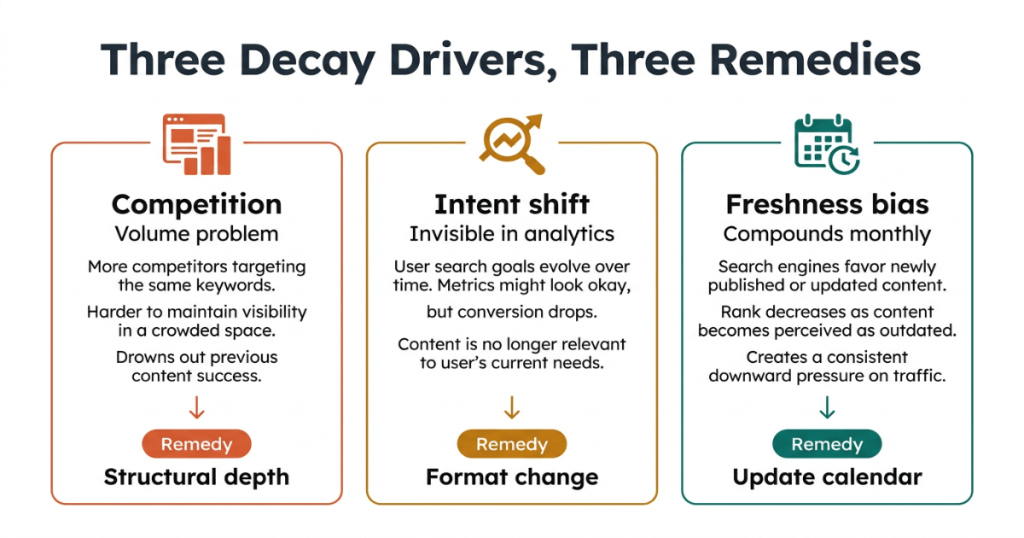
Freshness Bias Accelerates Decay
Google weights recency heavily for topics with rapid change. An article from last year with no updates signals staleness regardless of accuracy. This is where content decay is a slow leak that compounds monthly. Competitors who refresh quarterly pull ahead while your page sinks one position at a time. Each driver demands a different remedy. Competition requires structural depth. Intent shifts demand format changes. Freshness needs a calendar.
Consider how HubSpot refreshes its pillar pages. The team adds new sections for emerging subtopics, restructures headings to match current SERP formats, and replaces outdated examples. That triple response hits all three decay drivers in one pass.
Most teams do one of those three things. That is why their refresh fails. A content refresh strategy that picks one driver and ignores the other two leaves the page exposed.
Audit Your Library for Decay Signals
Most content audits fail before they start. The reason is not a lack of data but a lack of a structured process that connects each decay signal to a specific action. A content refresh strategy built on guesswork is worse than no strategy at all.
Step 1. Pull traffic and ranking data for the last six months. Export from Google Search Console or your analytics platform. This creates a baseline, without it, every decision is a gamble.
Step 2. Identify pages with a traffic drop that exceeds normal fluctuation. A sustained decline signals deeper decay. Pages that lose ground consistently are bleeding authority to fresher competitors or shifting intent.
Step 3. Check the SERP for new competitors. Open the search results for each declining page and look for domains that did not rank six months ago. If a competitor with stronger structure or fresher content has taken your spot, your page is not just decaying, it is being actively displaced.
Step 4. Check for AI Overviews replacing your snippet. Search your target query and see whether Google now surfaces an AI-generated answer above your result. If your content is no longer cited, it has lost its extraction value. This is the hidden decay that traditional audits miss entirely.
Completing this process reveals exactly which pages need attention and why. It turns a vague feeling of decline into a ranked list of priorities. The faster, cheaper ROI argument for refreshes only holds when you target the right pages first. A SERP intelligence tool can automate the competitor and AI Overview checks, cutting the audit from hours to minutes.
Take a B2B SaaS page that once ranked in position three for a high-intent query. A competitor published a comparison table six months later, and that page now sits at position nine. The audit catches this displacement only when you check the SERP directly.
Refresh for Both Google and AI Overviews
The standard content refresh strategy treats Google as the only audience worth optimizing for. That assumption is now a liability. A modern refresh must serve two distinct systems: traditional search rankings and AI-generated answers. A traditional SEO refresh updates statistics, adds internal links, and fixes broken redirects. It does nothing for visibility in AI Overviews or ChatGPT responses.
An AI-ready refresh adds structured data, writes clear definitions at the top of the page, and formats concise answers that extraction models can pull directly. This improves the chance of being cited in AI-generated summaries. But it can feel mechanical without regard for the human reader.
The winning approach does both, but in the right order. Start with the AI-ready structure: clear H2s that answer specific questions, definition blocks, and list formats that extraction models prefer. Then layer in traditional SEO elements: updated internal links, fresh meta descriptions, and current statistics. The AI structure creates the foundation. The SEO polish ensures Google trusts the page.
This dual approach reduces the human editing requirement on future refreshes because content is already structured for extraction and ranking. The dual decay defense is not about doing twice the work. It is about building content that survives both forms of loss with a single, intentional structure.
A page refreshed only for Google might hold position 3 for months while generating zero AI citations. The same page restructured for extraction appears in both search results and AI summaries, capturing traffic from two sources.
This is not theoretical. Search Engine Journal documented pages that lost 60% of organic traffic after AI Overviews launched, then recovered it by adding structured definitions and concise answer blocks. The recovery did not require new content. It required restructuring existing content for a second audience.
Prioritize Pages That Drive Revenue, Not Traffic
The standard advice to refresh your best-performing pages is a trap. A page with high traffic but zero conversions is a page that costs money to maintain and generates nothing in return. The real priority list starts with revenue data, not pageview counts.
Most content libraries have a handful of pages that quietly carry the business. These are the product pages, the pricing comparisons, the bottom-of-funnel content that turns research into decisions. A 10% traffic gain on a high-converting page is worth more than a 50% gain on a top-of-funnel article that no one acts on.
The fix is a simple data merge. Pull your traffic report for the last six months. Then pull your conversion report for the same period. Where those two lists overlap is where your content refresh strategy should begin. Any page that ranks well but converts poorly needs a different kind of refresh, one focused on messaging and trust signals, not keyword density.
This approach mirrors the data-driven methodology outlined in the Surfer SEO content refresh guide, which argues that refresh decisions should be based on performance metrics, not intuition. The same logic applies here, but with a sharper filter: conversion rate is the metric that pays the bills.
Pages that drive revenue deserve the first slot in your refresh queue. Traffic without conversion is a vanity number. A content library full of high-traffic, low-conversion pages is a library that looks impressive in a dashboard but fails in the only metric that matters.
Run this report for a client like Optimizely, and the pattern is immediate. Their highest-traffic blog post on A/B testing drives 40,000 monthly visits but converts at 0.3%. A pricing comparison page with 8,000 visits converts at 4.2%. The traffic page gets all the attention. The revenue page gets the refresh.
The Refresh Workflow That Scales
A content refresh strategy that works once but fails the next time is not a strategy. This workflow turns every refresh into a repeatable process that defends against both traditional ranking loss and AI invisibility.
Re-research the keyword and SERP: The SERP you optimized for six months ago is not the SERP you face today. New competitors have published. Search intent may have shifted. AI Overviews may now occupy space your snippet once held. Run a fresh SERP analysis before touching a single word. Tools like WryveAI automate this step by pulling current competitor structures and content gaps directly into your workflow, letting you scale content production without repeating manual research.
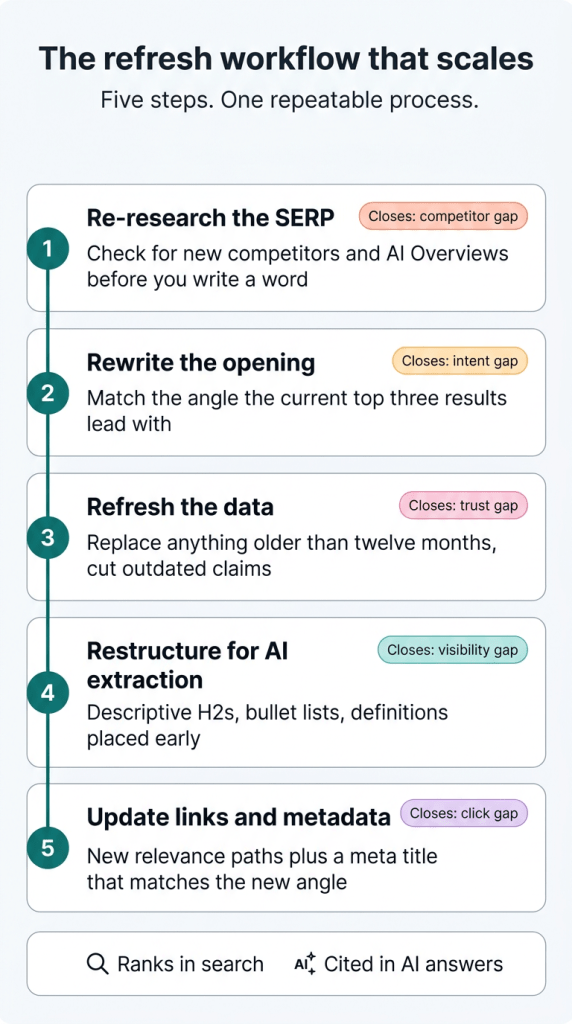
Rewrite the opening to match current intent: The old opening answered a question readers no longer ask. Read the top three ranking pages. Identify the angle they lead with. If every competitor now opens with a comparison table and your page opens with a definition, your intent match is broken. Fix the opening first.
Add new data and remove outdated claims: Stale data signals neglect to both readers and search models. Replace any statistic older than twelve months. Remove claims that no longer hold. A single outdated reference can undermine the credibility of an entire page. Treat data hygiene as a non-negotiable step.
Restructure for AI extraction: AI search models pull answers from clearly structured content. Add descriptive H2s that mirror query language. Use bullet lists for multi-point explanations. Place concise definitions early in the section they belong to. This structure serves human readers too, making the page scannable and authoritative.
Update internal links and meta data: Every refresh creates new relevance paths. Link from the refreshed page to newer supporting content. Update the meta title and description to reflect the current angle. A page that ranks but gets no clicks is a page with a metadata problem.
Completing these five steps turns a decaying page into a dual-purpose asset. It earns visibility in traditional search results and becomes extractable for AI-generated answers. The process takes focus, but the alternative, letting decay compound, costs far more in lost rankings and missed revenue.
Track What a Successful Refresh Looks Like
A content refresh strategy that cannot be measured is a gamble, not a strategy. The metrics that matter after a refresh are not the ones most teams track. Traffic volume alone tells you nothing about whether the refresh actually worked. Every refresh must be judged against four specific signals. If none of them move, the page may be beyond saving.
- Ranking position recovery. This is the most obvious signal, but it comes with a trap. A page that climbs two positions but still sits below the fold has not recovered. Track keyword ranking recovery against the position it held before decay began, not against a generic target.
- Organic traffic trend. Look at the 30-day window after the refresh, then compare it to the 90-day window. A spike in the first month that fades by the third is a sign the refresh addressed symptoms, not causes. Sustained growth across both windows means the page regained its footing.
- AI Overview citation appearance. This is the new frontier most refreshes ignore. Check whether the refreshed content appears as a cited source in Google AI Overviews or ChatGPT responses. If it does not, the page is invisible to the fastest-growing search channel.
- Conversion rate change. A page that recovers traffic but converts worse than before is a liability. Traffic without conversion is noise. If the refresh changed the page structure or messaging, verify that the conversion rate held steady or improved.
These four metrics form a content refresh pyramid where each layer depends on the one below it. Ranking recovery means nothing without traffic. Traffic means nothing without AI visibility. AI visibility means nothing without conversion. If a refresh fails to move any of these, the page may be structurally unsound, rewrite it from scratch or let it die.
Build a Refresh Cadence That Defends Your Rankings
A content refresh strategy that treats decay as a one-time problem guarantees the next traffic drop. The real work is building a cadence that catches decay before it compounds.
A quarterly review of your top-performing pages is the minimum viable defense. Pages that drive revenue get priority. Pages that once ranked but now sit on page two get a decision, refresh or retire. The cost of ignoring a decaying page is not just lost traffic. It is the opportunity cost of letting a competitor claim that search real estate permanently.
Set the review cycle now. Block the time. Run the audit. The pages that survive this process are the ones that defend your rankings through every algorithm update and every AI shift. The ones that do not, they were never worth keeping.
Every claim in this article was checked against a real source before it was published.
WryveAI researches live search results, writes source-verified content, and publishes straight to WordPress, all in one platform.
Try WryveAI Free →No credit card required.
Frequently Asked Questions About Content Refresh Strategy
How often should I refresh content?
Refresh content on a quarterly cycle for your top-performing pages and annually for the rest of your library. Pages targeting competitive keywords or rapidly evolving topics may need more frequent attention to maintain visibility against new entrants.
What’s the difference between a refresh and a rewrite?
A refresh updates existing content with new data, improved structure, and current examples while keeping the core argument intact. A rewrite replaces the entire page with new content, often targeting a different angle or keyword entirely.
Does refreshing content help with AI search?
Yes, when you structure your refreshed content for AI extraction by adding clear definitions, concise answers, and well-organized sections. AI search models favor content that can be easily parsed and cited in generated responses, making structure as important as substance.
How do I decide which pages to refresh first?
Start with pages that have the highest conversion potential combined with a recent traffic drop of twenty percent or more. Pages generating revenue or leads but losing visibility are the highest-value candidates for a content refresh strategy.
Can I refresh content without losing rankings?
Yes, if you preserve the URL, maintain the original keyword focus, and avoid changing the page’s core topic or structure dramatically. Significant rewrites or keyword shifts can confuse search engines and temporarily drop rankings until the new version is re-evaluated.


