
AI Content Strategy for B2B Manufacturing: Where Generic Copy Loses Deals

A spec sheet with one wrong tolerance number kills a deal faster than any competitor’s sales pitch. That is the risk every AI content strategy for B2B manufacturing has to answer for.
Generic AI copy fails here because it smooths over the details engineers use to disqualify vendors. It writes “high-strength alloy” where the buyer needs the grade, and “fast turnaround” where the buyer needs the lead time.
This article covers the technical accuracy standard manufacturing content has to clear, the content types that move a buying committee, and the workflow that keeps AI output from getting a vendor struck from the shortlist.
The counter-argument is that buyers skim, so precision is wasted effort. Wrong audience. Engineers skim the fluff and slow down on the numbers. Get the grade, the tolerance, and the lead time right, and the spec sheet becomes your best salesperson.
Why Generic AI Copy Fails the Spec Check
Engineers do not read your product page. They interrogate it. They arrive with a tolerance range in mind, a material spec they already trust, and a certification they need to see before a sample request moves forward. Thomas’s research on industrial buyer habits shows how much of that checking happens online before a buyer ever contacts a supplier. Content is a verification tool, not a persuasion surface.
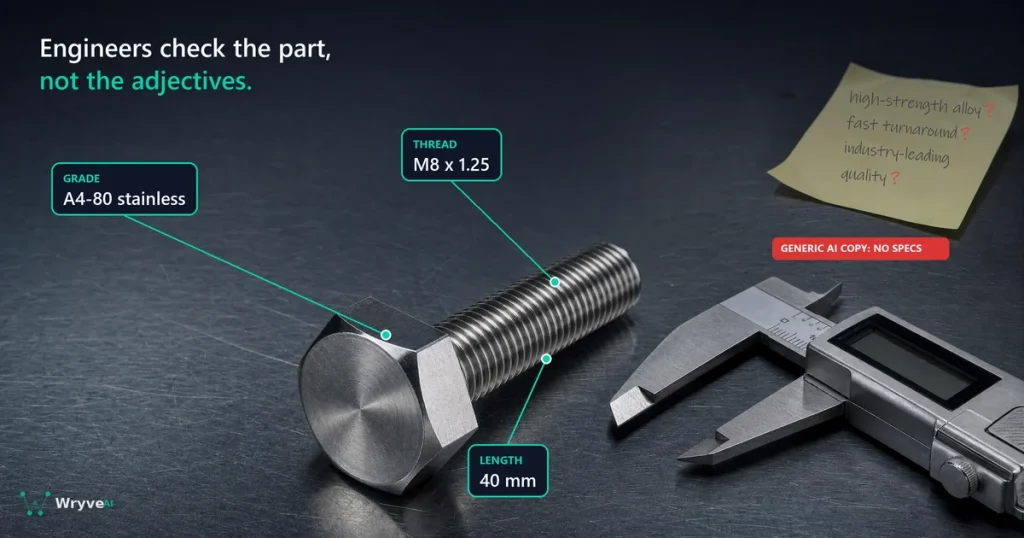
Generic AI output fails here because it does the opposite of verifying. Ask a model to write about a stainless fastener and it produces confident prose about durability, precision, and quality. It omits the grade, the thread pitch, the load rating.
The smoothing is the problem. A model trained on marketing copy learns that specifics are optional and adjectives are safe. So it replaces the load rating with “high-performance” and the certification with “industry-leading standards.”
The failure is a sourcing problem, not a writing problem. The model was never handed the spec sheet, so it filled the gap with plausible language. Plausible language is exactly what gets a vendor struck from a shortlist.
This is where generic SEO articles and spec-checked content part ways. A buyer who catches one wrong figure does not flag it for correction. They close the tab and call the next supplier.
What AI Content Strategy Means for Manufacturers
An AI content strategy for manufacturers is a documented system for producing technical marketing content at scale without losing spec accuracy, brand voice, or distributor relevance. It is a governance structure, not a prompt library. A content marketing strategy built on prompts produces words; one built on governance produces assets an engineer will actually cite.
Manufacturers misread the term constantly. They buy a seat on a generic writing tool, feed it a keyword list, and call the output a program. What they get is a library that reads exactly like the competitor two states over.
The system needs three layers, and skipping any one collapses the others. A verified source layer holds spec sheets, certifications, and material data that every claim traces back to. A brand and voice layer locks technical vocabulary so a tolerance is described the same way in Ohio and in a distributor’s German-language catalog.
The review layer is where manufacturers cut corners most often. An engineer or product specialist signs off on technical claims before publication, not after a prospect disputes them. When the source layer comes from live research instead of a bare prompt, which is how WryveAI builds every article, the reviewer checks accuracy rather than rewriting filler.
Get these three layers documented and your team stops arguing about which tool to buy. The argument shifts to whether the output survives a spec check.
How AI Fits the Manufacturing Buying Journey
Four people touch a manufacturing purchase, and each needs a different document to move forward. Feed a model one generic brief and it writes for none of them. Giving it the right source material for each seat is the only way AI content serves the whole buying committee.

The design engineer wants tolerance and material data first
An engineer opens a product page to rule you out, not in. Give them a generic overview and they bounce to a competitor’s datasheet. Spec-backed comparison pages earn the sample request; vague feature lists kill it.
The procurement lead is pricing risk, not features
Procurement asks about lead times, minimum order quantities, and total landed cost. AI copy about quality craftsmanship answers a question nobody in that seat asked. Lead-time and cost-framing content earns the next conversation.
The plant manager needs compatibility and replacement guidance
A maintenance lead is usually replacing a part that failed, under time pressure. They need to know what fits, what supersedes what, and what changed in the current revision. Generic AI output skips the cross-reference table and loses the order.
The distributor resells your content, not just your product
Distributors hand your spec sheets and comparison content to their own customers. If your AI-generated collateral is thin on verified specs, they stop using it and stop pushing your line. Distributor-ready enablement content keeps them selling.
One system can serve all four seats, but only when you map the buying committee first and attach the right verified sources to each brief. A brand profile that holds your terminology, audience, and product facts keeps the engineer’s datasheet and the distributor’s comparison page saying the same thing.
The Content Types That Actually Move Deals
Blog posts get produced because they’re easy to brief and easy to count. The assets that actually shorten a manufacturing sales cycle are the ones an engineer forwards to a colleague or a distributor hands to their own customer.
- Spec-backed comparison pages. Side-by-side tables with tolerances, materials, and load ratings let an engineer rule a competitor in or out without a call. A comparison page missing the deciding spec forces the reader to email sales, which stalls the deal.
- Application and use-case guides. Content tied to a named process or industry, like washdown environments in food processing, proves you understand the operating conditions. Generic “industries we serve” pages prove nothing.
- Tolerance and material explainers. These answer the selection question before it becomes a support ticket. They also match the long-tail questions engineers type at the bench.
- Distributor-ready sales enablement. Spec sheets, objection-handling one-pagers, and comparison decks your channel partners can rebrand and send. Distributors sell what they can explain without calling you.
- Refresh programs for stale pages. Product lines change and published specs don’t. Treat content lifecycle management as a maintenance schedule, not a one-time launch task.
Notice what’s absent: thought leadership, company news, culture posts. A manufacturing content program should be judged by how many of these five assets it ships per quarter, not by article count.
Where Most Manufacturing AI Programs Go Wrong
Two programs get funded under the same name, and only one survives contact with a buyer who checks. The split is not tooling or budget. It is what each program hands the model before drafting starts.
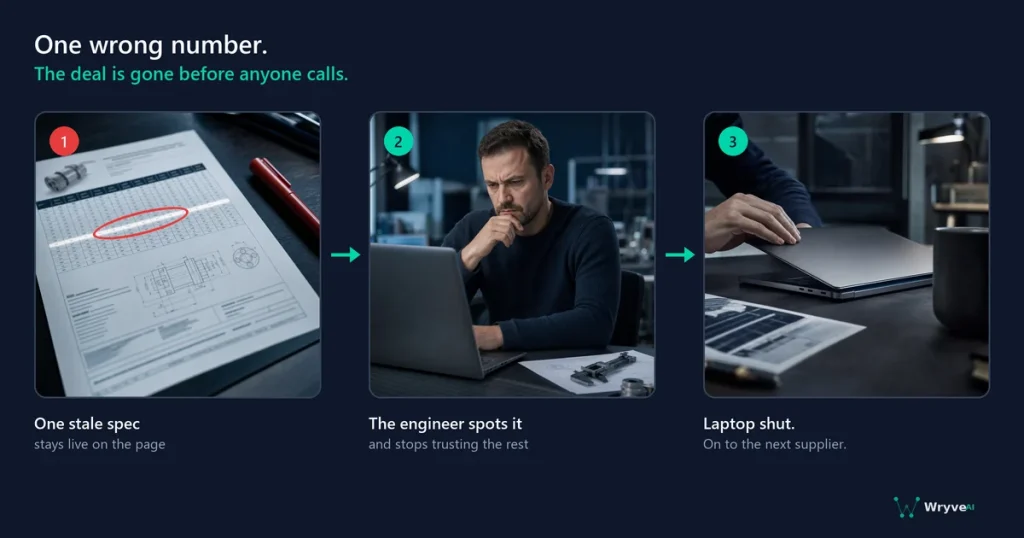
The volume-first program hands the model a keyword list and a target article count. It ships fast, fills a monthly report with published URLs, and looks like momentum to a marketing director. Then a distributor forwards a comparison page to a plant engineer, the engineer spots a tolerance that does not match the current revision, and the vendor is out.
The accuracy-first program hands the model verified spec sheets, certification records, brand rules, and a review gate. Output slows down, and the cost per article climbs. That cost is the honest price of a claim you can defend in a technical meeting.
Here is the trade-off nobody states plainly: the volume approach pays back immediately and fails later, while the accuracy approach costs now and compounds. A wrong spec gets published, gets indexed, and gets quoted back by a prospect who then disqualifies you. That disqualification is invisible in analytics and permanent in the account record.
The way to keep the accuracy-first model affordable at volume is to automate everything except the judgment: research, drafting against sources, scoring, and publishing, with the human review reserved for the technical claims. Choose volume only if your catalog never changes and no buyer verifies anything. Choose accuracy if your product lines revise, because AI content strategies that backfire in manufacturing almost always backfire on a stale number.
Building the Workflow: From Spec Data to Publish
A reliable AI content workflow runs in a fixed order. Reverse any two steps and you get copy that reads well and fails technical review. Manufacturers already apply this discipline on the factory floor, where AI adoption in U.S. manufacturing is growing, and the same rigor now applies to marketing.
Step 1. Assemble the verified source layer before drafting. Pull spec sheets, certifications, and product data into one place first. Every later claim traces back to this file, so skipping it causes the most rework.
Step 2. Run live SERP analysis to find the spec gaps. See what the top-ranking pages cover, then note where tolerances, materials, or certifications are missing. That gap is your opening.
Step 3. Lock a brand profile across product lines and regions. Technical vocabulary drifts between divisions and territories. A fixed profile keeps terminology consistent.
Step 4. Draft with the source layer attached. Keep the data visible so no sentence floats free of a verified fact.
Step 5. Route to an engineer or product specialist for sign-off. A human gate on technical claims catches what no model will flag.
Step 6. Publish with internal links that connect the library. Tie product pages, application guides, and comparison content together so a buyer can move from spec to proof without leaving your site.
WryveAI covers steps 2, 3, 4, and 6 in one platform, from SERP research to brand profiles to direct WordPress publishing, which leaves your team free to own the source layer and the sign-off. Finish the sequence and you have a content library where every page survives a spec check. That is the asset a distributor forwards and an engineer trusts.
Measuring Whether the Strategy Earns Its Budget
Manufacturing content programs get defunded over a dashboard nobody in the plant trusts. Pageviews and article counts read fine to a marketing manager. They read as noise to the person who signs the budget.
Replace the volume report with distributor requests for spec sheets and comparison pages. Those requests come from people actively selling your product. A distributor asking for updated tolerance data is a buying signal, not a vanity metric.
Track sample and quote requests attributed to content, then compare sales cycle length for deals that touched content against deals that did not. A shorter cycle on content-touched deals survives a budget review.
The measure that matters most is spec accuracy after a product change. Stale technical content is worse than no content, because buyers verify everything and a wrong revision number reads as negligence. A content program that cannot report this number is reporting theater.
Put that figure in front of the budget holder. The question that follows is uncomfortable: how many of your published pages would fail that check today?
Make the Next Article One an Engineer Would Trust
Spec accuracy has stopped being a quality checkbox and become the strategy itself. Manufacturers who win with AI content treat every tolerance, material grade, and certification as the product, not the supporting detail.
Skip that shift and the cost compounds quietly. A single unverified claim sits on your site, gets indexed, and surfaces in an engineer’s search at the worst possible moment. One wrong spec can undo a year of content investment. Pull the last ten pieces you published. Check each for a verifiable spec, a named source, and a human sign-off. Fix the ones that fail before drafting anything new.
FAQ
Questions Manufacturers Ask About AI Content
How can AI be used in B2B marketing?
AI handles research synthesis, first-draft production, and internal linking at a volume no team can match manually. The catch is that B2B buyers verify claims, so the model has to be given source documents before drafting starts, and a human has to sign off on technical claims.
How can AI be used in the manufacturing industry?
Beyond marketing, plants use AI for predictive maintenance, quality inspection on production lines, and demand forecasting tied to supplier lead times. Marketing applications lag those operational wins because spec accuracy is harder to automate than a visual defect check.
What is AI content strategy?
AI content strategy is a documented system covering what gets produced, which sources feed the model, who reviews output, and how performance gets measured. A prompt library is not a strategy, because it has no source layer and no sign-off gate.
What is the rule of 7 in B2B?
The rule of 7 is an old marketing rule of thumb that a buyer needs roughly seven touchpoints before committing to a purchase. Manufacturing committees stretch that count across several people, so a spec sheet, an application guide, and a distributor email each count as a separate touch.
Every claim in this article was checked against a real source before it was published.
WryveAI researches live search results, writes source-verified content, and publishes straight to WordPress, all in one platform.
Try WryveAI Free →No credit card required.


