
Claude vs ChatGPT: Which AI Model Actually Delivers for Your Workflow?

ⓘ TL;DR
- There is no single winner. The Claude vs ChatGPT debate is the wrong question. The right question is which model handles your specific task without friction.
- Claude wins on depth. Long documents, complex coding, professional writing, and nuanced analysis are where it consistently outperforms. Patience is its competitive advantage.
- ChatGPT wins on breadth. Speed, multimodal inputs, image generation, and ecosystem integrations make it the default for teams juggling varied tasks under deadline pressure.
- Pricing follows the same split. ChatGPT Plus bundles more tools for generalist teams. Claude Pro goes deeper for specialists who need sustained reasoning over feature count.
- Smart teams run both and route by task. Standardizing on one model means leaving quality or speed on the table depending on which one you picked.
You have been asking the wrong question.
Every comparison you have read tries to crown a single winner. The debate frames itself as a choice between two models, as if one must be better across every task. That framing is the problem.
The Claude vs ChatGPT question does not have a universal answer because the answer depends entirely on what you need the model to do. A tool that excels at long-form analysis will not be the same tool that handles quick brainstorming or multimodal tasks. The real separation is task-specific, not model-versus-model.
This article gives you a framework for choosing based on your actual workflow. You will learn where each model delivers its strongest results, where the trade-offs live, and how to stop picking sides in a debate that should never have been a single contest.
Why a Single Winner Misses the Point
The Claude vs ChatGPT debate is a trap. Everyone wants a definitive answer, a single model to crown as the superior tool. That framing is the problem, not the solution.
General benchmarks like the Chatbot Arena often produce a dead heat. Both models land in the same statistical tier when tested across broad, mixed tasks. This tells you nothing useful. A tie in a general test does not mean they are interchangeable for your specific work.
The real separation is task-specific. One model handles long, nuanced documents with a thoughtful, conversational tone. The other moves fast, integrates with a wider ecosystem, and handles multimodal inputs. They are built for different jobs.
Picking a winner without defining the task is like asking whether a chef’s knife or a serrated bread knife is better. The answer depends entirely on what you are cutting. The same logic applies here.
This is why the Claude vs ChatGPT comparison needs a different framework. Stop asking which model is better. Start asking which model is better for the specific problem you are solving right now. The answer changes with every task.
Where Claude Excels: Depth and Nuance
The Claude vs ChatGPT debate gets interesting when the task stops being simple and starts demanding patience. Most users discover this the hard way, they ask both models the same complex question and get two completely different kinds of answers.
Claude handles long-context work with a composure that ChatGPT often rushes past. Drop a 50-page research report into the prompt window. Claude reads it like a careful editor, tracking arguments across chapters, catching contradictions, and summarizing with genuine structure. This is not a speed game. It is a comprehension game, and Claude plays it differently.
The difference shows in the response quality. ChatGPT tends to bullet-point everything into submission. Claude builds thoughtful, structured responses that feel like someone actually considered the question before typing. The tone lands closer to human conversation than machine output. Reddit threads on this are telling, users consistently describe Claude’s voice as natural, patient, and less robotic than the competition.
This matters most for professional writing and analysis. A legal brief, a strategic memo, a creative brief for a campaign, these are not tasks that benefit from speed alone. They benefit from depth. Claude is known for its strong long-context handling and the ability to maintain coherence across thousands of words without losing the thread.
The catch is that depth comes with trade-offs. Claude’s slower pace frustrates users who need rapid iteration. Its refusal to generate images or handle multimodal inputs limits its utility in workflows that demand versatility. The question is not whether Claude is better. The question is whether your work rewards patience or punishes it.
Where ChatGPT Dominates: Speed and Ecosystem
The fastest tool in the room wins when the room is full of deadlines. ChatGPT earns that speed not through raw output alone but through a breadth of capabilities that makes it the default choice for teams who need one tool to do many things. The all-in-one AI toolkit claim holds because ChatGPT delivers image generation, code execution, multimodal analysis, and plugin integrations from a single interface.
Versatility is the real differentiator. ChatGPT handles a brainstorming session at 9 AM, generates a Python script at 10, drafts a social post at 11, and analyzes an uploaded PDF by noon. No context switching. No second tool. That workflow density matters more than any single feature advantage when the clock is running.
The ecosystem compounds this speed. Plugins connect ChatGPT to real-time data sources, web browsing, and third-party applications without leaving the chat window. Multimodal input means a photo of a whiteboard becomes a project plan. A screenshot of a bug becomes a fix. The friction of moving between tools disappears.
Speed without breadth is a narrow advantage. ChatGPT’s versatility, speed, and broader tool ecosystem mean it wins on volume and variety. The trade-off is depth. Fast answers are not always nuanced answers. Quick drafts are not always publishable drafts.
The question is not whether ChatGPT can do everything. It is whether doing everything at once dilutes the quality of anything specific. That tension is where the choice lives.
Pricing Plans: What You Actually Get for Your Money
The Claude vs ChatGPT pricing debate is less about who charges less and more about what each plan actually unlocks. Free tiers tell you nothing about real workflow value. The table below strips away the marketing and shows what each tier delivers for the money.
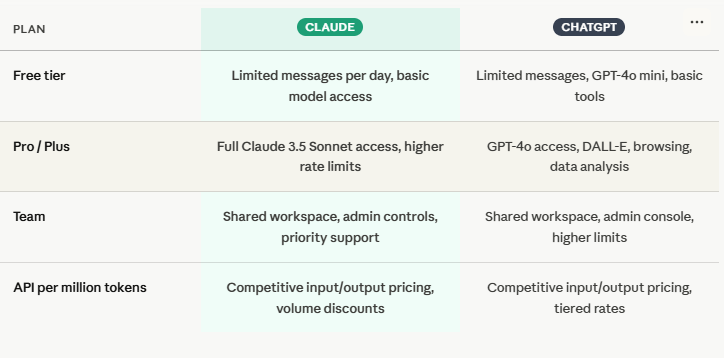
ChatGPT wins on raw value for most users because its Plus tier bundles image generation, browsing, and multimodal features into one subscription. Claude’s Pro tier gives you deeper reasoning and longer context windows but fewer integrated tools.
The smart money goes to ChatGPT for generalist teams and Claude for specialists who need depth over breadth. Pick the plan that matches your primary task, not the one with the flashiest feature list.
Coding and Developer Workflows Compared
The developer workflow comparison between these models reveals a split that mirrors the broader debate, but with sharper edges. Claude Code operates as a full coding agent, it reads repositories, plans multi-file changes, and executes them with minimal hand-holding. ChatGPT offers a broader toolkit but requires more manual orchestration to achieve the same depth.
Claude leads on hard prompts and coding because its architecture rewards precision. A developer who writes a complex refactoring instruction with multiple constraints gets a response that respects every constraint. The model tracks context across hundreds of lines of code without losing thread. This matters most for legacy codebases where a single misstep breaks the build.
ChatGPT wins on multimodal tasks and ecosystem breadth. A developer debugging a frontend issue can upload a screenshot of the broken UI, paste the error log, and ask for both the fix and the explanation. The same session can generate an SVG icon, write a unit test, and suggest a deployment script. The versatility saves time when the task list is long and varied.
The real separation shows in daily workflow. A developer spending eight hours on a single complex feature benefits from Claude’s sustained focus. A developer context-switching between five different tickets across the afternoon benefits from ChatGPT’s speed and breadth. Neither approach is wrong. The wrong choice is using the wrong model for the wrong kind of work.
Most teams end up running both. The question is not which one to standardize on. The question is which one to reach for first when the terminal is open and the problem is not yet fully understood.
Creative Work and Long-Form Writing
Creative writing exposes the real difference between these models faster than any benchmark. The task demands voice, structure, and sustained coherence, qualities that separate a draft from something worth publishing.
Claude is a better partner for creative work, and the reason shows up in how it handles long-form structure. Give it a complex narrative brief with multiple constraints, and it builds arguments that hold together across thousands of words. The output reads like someone thought through the arc, not like a machine predicting the next token.
One real-world test makes this concrete. A writer asked both models to produce a recipe in the voice of Gordon Ramsay, aggressive, precise, theatrical. ChatGPT delivered a competent parody. Claude produced something that felt like the actual person wrote it, with pacing and vocabulary that matched the source material. The difference was not subtle.
This matters for anyone producing long-form content that needs to sound human. Blog posts, white papers, case studies, the kind of writing that builds authority and trust. Claude handles the structural demands of these formats without collapsing into repetition or losing the thread. ChatGPT produces faster drafts, but those drafts often require significant rewriting to develop a consistent voice.
The trade-off is speed. Claude takes longer to generate thoughtful responses. For teams producing long-form content reviews, that extra time pays for itself in reduced editing cycles. For teams churning out generic SEO articles, the speed of ChatGPT makes more sense. The question is what kind of writing the work actually demands.
How to Choose Based on Your Actual Tasks
Task-specific selection beats model loyalty every time. The framework is simple: match the model’s structural strength to the work’s core demand.
Long document analysis belongs to Claude. Brainstorming and quick drafts belong to ChatGPT. Coding with complex instructions favors Claude. Multimodal tasks favor ChatGPT. Professional writing leans Claude. Agentic automation leans ChatGPT.
- Long document analysis, Claude
- Brainstorming and quick drafts, ChatGPT
- Coding with complex instructions, Claude
- Multimodal tasks, ChatGPT
- Professional writing, Claude
- Agentic automation, ChatGPT
The pattern is not about which model is better. It is about which cognitive load each model handles without friction. Claude rewards depth and patience. ChatGPT rewards speed and breadth.
Most teams eventually run both. The smart ones do not standardize on a single model. They route each task to the tool that handles it best, then use an AI content writing tool like WryveAI to produce content that ranks regardless of which model powered the draft. The framework is not about picking a winner. It is about knowing when to switch.
Stop Picking Sides and Start Picking the Right Tool for the Job
The Claude vs ChatGPT debate resolves the moment you stop asking which model is better and start asking which model is better for what you are doing right now. That shift changes everything. It turns a frustrating choice into a simple routing decision.
Teams that standardize on one model leave results on the table. The writer who forces ChatGPT to produce a nuanced long-form analysis fights the tool’s nature. The developer who uses Claude for a quick multimodal prototype wastes its depth. The cost is not just time. It is the quality of the work itself.
Test both models with your actual tasks this week. Route each task to the model that handles it best. Then use a tool like WryveAI to turn that draft into content that ranks, regardless of which model powered it. Check the WryveAI Content Writing Tool Pricing page to see how production scales when the model choice stops being the bottleneck.
Every claim in this article was checked against a real source before it was published.
WryveAI researches live search results, writes source-verified content, and publishes straight to WordPress, all in one platform.
Try WryveAI Free →No credit card required.
Frequently Asked Questions About Claude and ChatGPT
Why do people prefer Claude AI?
People prefer Claude AI when their work demands depth, nuance, and long-form reasoning over speed and breadth. The model’s conversational tone and structured responses make it feel more like a thoughtful collaborator than a fast answer machine.
When did Claude become better than ChatGPT?
There is no single moment when one model surpassed the other because the answer depends entirely on the task. Claude pulled ahead for complex coding and long document analysis, while ChatGPT retained the lead for multimodal tasks and rapid iteration across diverse workflows.
Is Claude AI free?
Claude offers a free tier that provides access to the base model with usage limits on message volume and context length. The free version works well for occasional queries and short document analysis, but heavy users will hit the cap quickly and need the Pro subscription for sustained work.
Is Claude Pro better than ChatGPT Pro 2026?
Neither subscription is universally better because each serves a different primary use case. Claude Pro rewards specialists who need deep reasoning and long-context handling, while ChatGPT Pro delivers more value for generalists who want a bundled ecosystem of tools and integrations.


