What are AI Overviews and How to Optimize for Them (2026 Guide)

ⓘ TL;DR
- AI Overviews do not replace organic rankings. They synthesize answers from multiple sources and cite them. The goal shifts from ranking first to earning the citation inside the summary.
- Ranking high does not guarantee placement. A page ranking third with a cleaner structure and a more direct answer will be cited over the first result every time.
- The first paragraph is everything. If the answer is not stated clearly and completely before the second paragraph, Google will skip the page for one that leads with it.
- Headings must mirror the query verbatim. “How to Optimize for AI Overviews” signals relevance. “Optimization Strategies” does not. The match has to be exact.
- Click-through rates will drop for cited queries. That is the trade-off. Brand visibility in the summary builds trust before the user clicks anything, and that trust compounds over time.
This guide will not explain what AI Overviews are and then leave you guessing about what to do next. Too many articles stop at definition when the real question is how to earn placement in them. The gap between understanding a search feature and systematically optimizing for it is where most content strategies fail.
The problem is not a lack of information about AI Overviews. It is a lack of process. Most site owners know the feature exists but have no repeatable method for structuring content that Google’s AI will pull from. They write for ranking and hope for citation, which is not a strategy.
Here you will find a framework that moves from understanding to execution. You will learn what AI Overviews actually reward in content structure, how to identify the queries where they appear, and the exact steps to optimize your pages for selection. No theory. No guesswork. A repeatable system.
What AI Overviews Actually Do in Search
AI Overviews are AI-generated summaries that appear at the top of Google Search results for certain queries, providing a snapshot of key information with links to explore further. They are designed to help users get the gist of complex topics quickly, acting as a jumping-off point rather than a final destination. This is a fundamental shift from how search results have traditionally worked.
The standard assumption is that AI Overviews replace traditional organic results. They do not. A featured snippet pulls a single block of text from one page. An AI Overview synthesizes information from multiple sources, then presents a condensed answer with attribution links. The page still ranks. The difference is that the user now gets a synthesized answer before clicking anything.
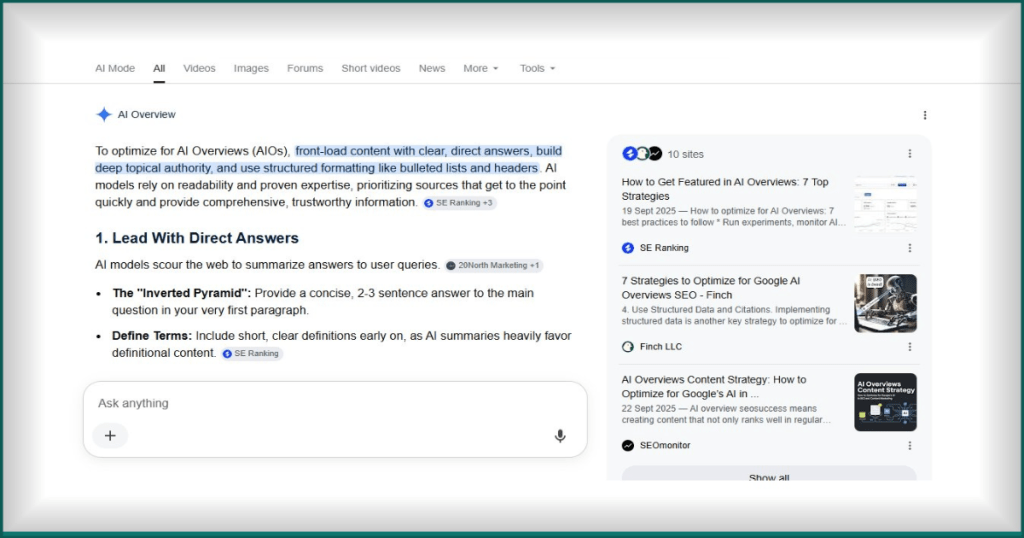
This distinction matters because it changes what “winning” looks like. Ranking first is no longer the only goal. Being cited as a source within the overview carries its own visibility. Google has been transparent about how these AI-powered search features work, but most site owners still optimize for a world that no longer exists.
The feature has drawn criticism for occasional inaccuracy and for reducing click-through rates. Those are real concerns. But the practical response is not to ignore the feature. It is to understand how content gets selected and to build pages that earn that selection.
That understanding starts with one fact: AI Overviews do not guess. They extract from content that is structured, authoritative, and directly answer-oriented. Content that meets those criteria gets cited. Content that does not gets skipped.
Why AI Overviews Demand a New Content Strategy
The SEO playbook built on keyword density and backlink volume is not just outdated for AI Overviews, it is actively counterproductive. This feature does not rank pages the way traditional search does. It synthesizes answers from multiple sources, which means the goal shifts from ranking a URL to being cited as a source of truth.
Content structured for extraction wins here. A page that buries its answer in the third paragraph, surrounded by fluff and keyword repetition, will never get pulled into an AI Overview. The feature needs a clear, direct, and authoritative answer it can extract and repurpose. Write the way a reference book writes, not the way a sales page writes.
This shift demands a different research process. Instead of optimizing for a single keyword, content must anticipate the full question the user is asking and answer it completely in the first section. The Google AI Overviews update rewards pages that act as definitive resources on a narrow topic, not pages that try to rank for everything vaguely related.
Tools that analyze what Google is already surfacing become essential here. A SERP intelligence approach reveals the exact structure and depth Google favors for a given query. Platforms like WryveAI use this data to align content with the format AI Overviews extract from, removing the guesswork from optimization.
The old strategy was about beating competitors in a ranking list. The new one is about earning a citation in a synthesized answer. That is a fundamentally different game, and it requires a fundamentally different content architecture.
How Google Selects Content for AI Overviews
Google does not guess which content to pull for AI Overviews. The selection follows a set of structural and authority-based criteria that determine whether a page gets cited or ignored.
Understanding these criteria is the difference between hoping for placement and engineering for it. Here is what Google looks for:
- Crawlability and indexability
- Clear, authoritative content structure
- Structured data markup
- Topical relevance and depth
- Trust signals like E-E-A-T
- Direct answer formatting
- Mobile-first design
Crawlability is the gate. If Google cannot reach and parse a page, nothing else matters. A clean site architecture and a well-maintained sitemap ensure the page is discoverable in the first place.
Content structure determines whether Google extracts your answer or skips it. A page that buries its key point under three paragraphs of introduction will lose to a page that states the answer in the first sentence under a matching heading. Headings that mirror the user’s question signal relevance directly.
Structured data helps Google understand what a page contains. Schema markup for articles, FAQs, and how-tos gives the algorithm explicit signals about content type and hierarchy. Pages with structured data are more likely to be treated as authoritative sources.
Topical depth matters more than keyword count. A page that covers a subject comprehensively, with sub-topics and related questions addressed, signals expertise. Thin content that only scratches the surface rarely earns a citation.
Trust signals like E-E-A-T requirements separate credible sources from the rest. Author bios, citations from reputable domains, and a clear editorial process all contribute. Google prioritizes content it can trust to be accurate, especially for queries where the AI Overview will be the first thing a user sees.
The list reveals something counterintuitive: ranking high in organic results does not guarantee AI Overview placement. The feature selects based on extractability and authority, not just position. A page ranking third can be cited over the first result if its structure is cleaner and its answer more direct.
Audit your top pages against these criteria. If a page ranks well but never appears in AI Overviews, the problem is likely structural, not topical. Fix the structure first, then measure again. Understanding AI Overviews starts with understanding what Google values in a source.
Optimize Your Content for AI Overview Placement
Most optimization guides skip the single step that determines whether content gets cited or ignored. They focus on writing quality while overlooking the structural conditions that make extraction possible. The process below closes that gap.
Step 1. Identify queries where AI Overviews appear using SERP analysis tools. Run a manual check on your target keywords to see which ones trigger the feature. This tells you where to focus optimization effort instead of guessing.
Step 2. Structure the opening paragraph to answer the query directly. The first paragraph must state the answer clearly and completely before adding any context or nuance. AI Overviews extract from the top of the page, so burying the answer deeper guarantees exclusion.
Step 3. Use headings that mirror the question verbatim. A heading like “How to Optimize for AI Overviews” signals relevance more clearly than “Optimization Strategies.” Google matches heading text against query language when selecting sources.
Step 4. Include authoritative citations and data from recognized sources. Reference established industry standards, official documentation, or widely accepted methodologies. The feature favors content that demonstrates verifiable authority over opinion-based claims.
Step 5. Ensure technical SEO basics are solid before publishing. Crawlability, page speed, and mobile responsiveness determine whether Google can access and process the content at all. A perfectly written page that fails technical checks will never be considered.
Completing this process transforms content from a general resource into a structured answer source. The result is content that earns placement because it was built for extraction from the first sentence.
Track Whether Your Content Appears in AI Overviews
Optimizing for AI Overviews without tracking is guesswork. A systematic monitoring process reveals which queries trigger the feature and whether your pages are being cited. This feedback loop turns optimization from a hope into a measurable strategy.
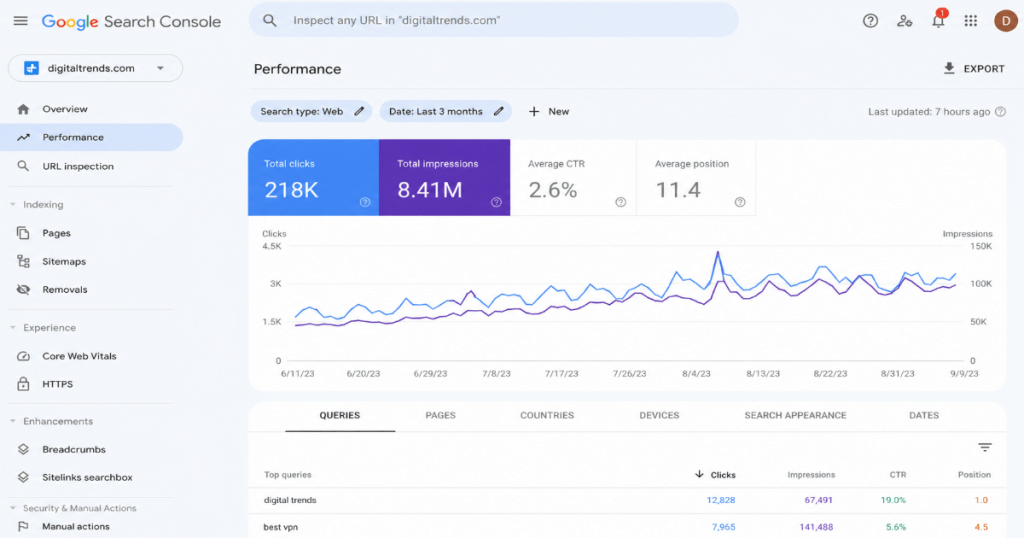
Audit Google Search Console for ranking queries
Pull the queries where your pages already appear in search results. Focus on informational and question-based queries, as these are the types most likely to trigger an AI Overview. This list becomes your starting point for deeper investigation.
Manually inspect high-traffic queries in incognito mode
Open a private browser window and search for each query from your list. Look for the AI-generated summary block at the top of the results. Note whether your page is cited as a source within the summary or appears in the linked results below it.
Use SERP tracking tools that flag AI Overviews
Several third-party platforms now identify when an AI Overview appears for a given query. These tools log changes over time, showing when the feature appears, disappears, or shifts its cited sources. This data removes the manual burden of constant checking.
Analyze click-through rate changes when an AI Overview appears
Compare your page’s CTR for queries with and without an AI Overview present. A significant drop suggests the summary is satisfying the user intent before they reach your page. This signals a need to adjust your content strategy or target different query types.
Tracking reveals what works and what does not. Without this process, optimization efforts operate in the dark. The data from monitoring directly informs which content to revise and which queries to prioritize next.
Common Missteps That Block AI Overview Inclusion
Most site owners block their own content from AI Overviews without realizing it. The mistake is not a lack of effort but a misunderstanding of what the feature actually extracts. Avoiding generic content pitfalls means recognizing that thin, unfocused pages get passed over regardless of how many keywords they contain.
Before: Thin content that barely answers a query. Keyword stuffing that prioritizes repetition over clarity. Pages built for search engines rather than people, with headings that describe the site structure instead of the question. A site that loads slowly on mobile and buries its best information under layers of navigation. This approach signals to Google that the page is not a reliable source worth citing.
After: Comprehensive answers that address the query from multiple angles. Clear, descriptive headings that mirror the exact phrasing of the question. Authority signals like author bios, cited sources, and a logical content hierarchy. A fast, mobile-optimized site that lets Google crawl and extract content without friction. This approach signals that the page is a trustworthy, extractable source.
The difference is not subtle. One set of pages gets ignored. The other gets cited. The choice is structural, not strategic, and most site owners never audit for it.
The Future of AI Overviews and What It Means for SEO
The most dangerous assumption about AI Overviews is that they are a finished product. Google will expand them to more query types, more languages, and more verticals. The selection criteria will tighten as the system learns which sources actually satisfy users and which ones just game the format.
This trajectory forces a hard choice. Site owners can treat AI Overviews as a traffic threat and optimize defensively. Or they can accept that the AI Overviews feature is becoming a permanent layer of search and build content specifically to be cited within it. The second path leads to brand visibility that survives even when click-through rates drop. The first path leads to irrelevance.
Click-through rates will decline for queries where an AI Overview appears. That is the trade-off. But brand visibility increases for the sites that get cited. A user who sees a brand name in an AI Overview gains trust before clicking anything. The strategy shifts from fighting for the first organic position to fighting for the citation itself.
Content teams that prepare for this shift now will have a structural advantage. The future of AI content belongs to writers who treat every page as a potential source document rather than a ranking target. Tools like WryveAI are already evolving to help teams identify which query patterns Google is surfacing in AI Overviews and structure content to match those patterns before the competition does.
The window for early optimization is closing. Google will keep refining how it selects sources, and the sites that wait for stability will arrive after the criteria have hardened. The question is not whether AI Overviews will change search. The question is whether your content will be part of that change or invisible within it.
Build Your AI Overview Strategy Now
AI Overviews are not a feature to fear but a format to master. The sites that earn placement now will hold that advantage as the feature expands to more queries and languages.
Every week of delay is a week competitors claim the citations your content could have earned. The difference between being cited and being ignored comes down to structure, authority, and directness, all of which are within your control.
Audit your top ten content pieces against the criteria in this guide. Rewrite the ones that bury the answer. Add the headings that mirror the query. The window for early advantage is open. It will not stay open forever.
Every claim in this article was checked against a real source before it was published.
WryveAI researches live search results, writes source-verified content, and publishes straight to WordPress, all in one platform.
Try WryveAI Free →No credit card required.
Frequently Asked Questions About AI Overviews
How to get AI Overview?
Earning placement in an AI Overview requires content structured for direct extraction, with clear answers positioned early in the page and supported by authoritative signals. The most effective approach is to identify queries where the feature already appears, then build content that mirrors the question verbatim in headings and answers it completely in the opening paragraph.
Why am I getting AI Overviews?
AI Overviews appear when Google determines a query benefits from a synthesized summary pulling information from multiple authoritative sources. This typically happens for complex or comparative questions where a single answer is insufficient, and the feature surfaces content that demonstrates clear topical depth and structured formatting.
Can AI Overviews be trusted?
AI Overviews are generated from indexed web content and reflect the quality of the sources they cite, not independent verification by Google. The accuracy of any given overview depends entirely on whether the source pages it draws from are factually correct and well-maintained.
How do I turn off AI Overview Google?
Individual users cannot permanently disable AI Overviews through standard browser settings, as the feature is controlled server-side by Google. The only workaround is to append &udm=14 to the search URL, which forces a web-only results view without the AI-generated summary.