What is the Agentic Framework?
ⓘ TL;DR
- The model gets all the attention. The agentic framework is what makes it useful. An LLM without a framework is a text generator with no hands. It can answer questions but cannot act on them.
- The A.G.E.N.T.I.C. acronym gives you seven concrete lenses to evaluate any framework: Autonomy, Goal-orientation, Environment interaction, Negotiation, Tool use, Iteration, and Control.
- Memory and reasoning are the hidden differentiators. Frameworks that treat memory as an afterthought produce agents that forget what they were doing mid-task. Session-based and persistent memory serve fundamentally different use cases.
- Security and error handling are not optional extras. Input validation, output guardrails, retry with fallback, and audit trails are the minimum viable infrastructure for any agent operating without constant human supervision.
- Architecture choice determines whether your system scales or stalls. Single agents work for narrow tasks. Multi-agent orchestration is required the moment the problem involves sequential dependencies, competing goals, or specialized sub-tasks.
A definition of an agentic framework that is neither abstract nor technical is hard to find. The A.G.E.N.T.I.C. acronym solves this by giving you a concrete mental model for evaluating any framework. Teams treat frameworks as black boxes, assuming the LLM will handle reasoning and tool use automatically. That fails when a task requires more than a single prompt.
Why a Framework Matters More Than the Model
The model gets all the attention. The framework is what makes it useful.
An LLM without an agentic framework is a text generator with no hands. It can answer questions but cannot act on them. The framework provides the structure for tool use, memory, and multi-step reasoning that turns a conversation into a process.
IBM describes agentic frameworks as the building blocks for developing, deploying, and managing AI agents. The model is the engine. The framework is the chassis, the steering, and the brakes. Pick the wrong one and the best model in the world cannot compensate.
Consider a single-prompt interaction. You ask a question, the LLM answers. Now consider a multi-step agent: it searches a database, calls an API, checks a policy document, and writes a report. The model handles the language. The framework orchestrates the sequence, handles failures, and decides when to ask for human approval.
LangChain and AutoGen illustrate the difference. Both wrap models in orchestration layers that handle tool calls and memory. Without those layers, the model cannot chain a database query into a report generation step. The practical takeaway is simple. Evaluate frameworks before models. A strong model inside a weak framework produces fragile agents. A capable framework with a decent model produces reliable ones.
The Agentic Components: A Mental Model
The A.G.E.N.T.I.C. acronym gives you seven distinct lenses for evaluating any system. Each letter represents a non-negotiable component that separates a working agent from a demo.
Autonomy, How Much Agency Does the System Have?
Autonomy is not binary. A framework that decides the next action without human approval is fundamentally different from one that pauses at every step. The real question is whether the framework lets you tune this dial per task.
Goal-Orientation, Does It Know What It Is Doing?
An agent without a goal is just a text generator with a loop. The framework must translate a high-level objective into sub-tasks. This is where the framework’s reasoning engine determines whether the agent drifts or stays on course.
Environment Interaction, Can It Affect the World?
An agent that cannot act is a chatbot. The framework must provide a structured way to call APIs, update databases, or trigger workflows.
Negotiation, How Does It Handle Human Oversight?
Human-in-the-loop support varies significantly across frameworks. Some build in breakpoints and approval mechanisms. Others require custom implementation, as outlined in a detailed agentic framework comparison. The difference determines whether your agent ships on time or stalls in review cycles.
Tool Use, What Can It Reach For?
A framework must define a list of tools the agent can access. It needs a parser for extracting tool calls from the LLM output and a system prompt synced with that parser.
Iteration, Does It Learn From Mistakes?
Error logging and retry mechanisms control LLM mistakes. A framework that cannot catch a failed API call and try again is not production-ready. The memory system and retry mechanisms are what turn a brittle script into a resilient agent.
Control, Who Is Ultimately Responsible?
Control is about guardrails. The framework must let you set boundaries on what the agent can do, log every decision, and override when needed. Without control, autonomy becomes a liability.
What Most Guides Get Wrong About Agentic Framework
The standard tutorial treats an agentic framework as a library of API calls. Wire up a prompt, point it at a tool, and the LLM handles the rest. That assumption is the single fastest way to build a prototype that fails in production..
The mistake feels logical because it mirrors how most developers first encounter LLMs. A single prompt returns a result. Extend that pattern to tool use, and the reasoning seems sound. The gap only appears when the agent needs to remember context across steps, recover from a failed tool call, or decide which action to take next.
Before: A team builds an agent that books calendar appointments. They give the LLM a tool for checking availability and another for creating events. The first five tests work. Then the agent double-books a slot because it had no memory of the previous call’s result. The team blames the model. The real failure is the absence of structured memory and explicit reasoning loops.
After: The same team rebuilds using a framework that provides memory, reasoning, and orchestration as core primitives. The agent now holds session state between tool calls. It logs each action and retries on failure. The double-booking disappears. The team ships to production in half the time because the framework handles the coordination they were trying to write themselves.
This contrast reveals a deeper reality. An agentic framework is not a convenience layer. It is the system that decides whether an agent can act on its own behalf. Without memory, the agent forgets. Without reasoning, it cannot plan. Without orchestration, it cannot recover.
Memory and Reasoning: The Hidden Differentiators
Two components separate a demo agent from a production system, and most framework comparisons skip them. Memory and reasoning are the invisible infrastructure that determines whether an agent can hold a coherent conversation or execute a multi-step plan. Frameworks that treat memory as an afterthought produce agents that forget what they were doing mid-task.
Session-based state management is the most common approach. The agent holds context for the duration of a single interaction, then resets. Microsoft’s Agent Framework handles this with explicit session tracking, type safety, and telemetry. What it does not do out of the box is persistent long-term memory. An agent that needs to remember user preferences across days or weeks requires custom storage integration.
Persistent memory frameworks keep state across sessions. They store embeddings, user profiles, and interaction history in a vector database or key-value store. This enables agents that learn user patterns over time. The trade-off is complexity. Persistent memory introduces data management, retrieval latency, and privacy considerations that session-based systems avoid entirely.
Reasoning strategies follow a similar split. Chain-of-thought prompting works well for simple step-by-step problems. ReAct, which interleaves reasoning with tool calls, handles tasks that require external data lookups. Plan-and-execute is the most powerful but also the most brittle.
It generates a full plan upfront, then executes each step, which means a single failed step can derail the entire sequence. The right choice depends on how much failure tolerance your use case requires. The frameworks that ship production agents use both memory and reasoning as first-class features, not add-ons. If a framework does not expose how it handles either, it is a prototype.
LangChain’s memory module is the most referenced example. It wraps conversation history into a buffer that the model can query. The buffer works until it does not, context windows fill, irrelevant data accumulates, and retrieval quality degrades. Production teams eventually replace it with custom solutions.
Security and Error Handling in Production
Production teams ask about security and error handling first. Tutorials cover them last. That gap is where reliable agents die..
Frameworks that skip these concerns ship prototypes, not products. A system that cannot validate its inputs, guard its outputs, or recover from failure has no place in a live environment. The infrastructure for these capabilities is what separates a demo from a deployment.
- Input validation. An agent that accepts unchecked data from external sources will eventually act on malicious or malformed instructions. Validation layers filter what reaches the LLM, preventing prompt injection and data corruption before they propagate.
- Output guardrails. The model will generate content that violates policy, leaks sensitive data, or hallucinates confidently. Guardrails intercept the output stream and block, rewrite, or flag problematic responses before they reach a user or downstream system.
- Retry with fallback. API calls fail. Tools time out. Models return malformed responses. A production framework implements error logging and retry mechanisms that attempt recovery automatically and escalate to a fallback path when retries exhaust.
- Audit trails. Every action the agent takes must be traceable. Without a log of decisions, tool calls, and failures, debugging becomes guesswork and compliance becomes impossible.
These four layers are not optional. They are the minimum viable infrastructure for an agent that operates without constant human supervision. A framework that omits them forces your team to build them from scratch, and that is where most projects stall.
Consider a financial services agent processing customer transactions. Without input validation, a single malformed request could trigger unauthorized transfers. Without audit trails, that failure is invisible until the quarterly review.
The practical test is simple. Ask the framework provider for their incident response runbook. If they cannot produce one, the framework is not production-ready. Your team should not be the one discovering that gap.
How to Choose an Agentic Framework for Your Use Case
The wrong framework costs months of rework. The right one accelerates delivery by matching the architecture to the problem. The choice starts with understanding what your agent actually needs to do, not what sounds impressive in a demo.
Agentic systems are evolving beyond single-prompt interactions into long-running, goal-driven software that operates as a critical layer in modern application architecture. This shift makes the selection criteria more concrete than most teams realise.
- Autonomy level required. Does the agent need to act independently on every step, or can it pause and wait for human confirmation at key decision points?
- Tool integration complexity. How many external systems must the agent call, and do those systems require custom authentication or data transformation?
- Human oversight needs. Some frameworks build in breakpoints and approval mechanisms for human-in-the-loop support. Others require custom implementation, adding development time and risk.
- Memory persistence. Does the agent need to remember context across sessions, or is each interaction stateless and self-contained?
- Error recovery. What happens when a tool call fails or an API returns unexpected data, does the framework retry, log, and fall back, or does the agent crash?
Each criterion maps directly to a letter in the A.G.E.N.T.I.C. acronym. Autonomy, Goal-orientation, and Tool use are about what the agent does. Negotiation and Iteration cover how it handles uncertainty. Control and Environment interaction determine whether it survives production.
Run your current or planned framework through these five questions before writing a single line of orchestration code. The answer will tell you whether you are building on solid ground or patching gaps that the framework should have handled for you. The distinction between autonomous action versus reactive fallback is where most teams discover their framework choice was wrong.
Architecture Types: Single Agent vs. Multi-Agent Orchestration
The architecture you choose determines whether your agentic framework scales or stalls. Single-agent systems work for narrow, well-defined tasks. Multi-agent orchestration becomes necessary when the problem involves competing goals, sequential dependencies, or specialized sub-tasks that no single model can handle well.
Most teams default to a single agent because it is simpler to build. That choice works until the agent needs to reason across domains, hand off context, or recover from a failure in one step without restarting the entire process.. The table below maps the four common architecture types to their best-fit scenarios.
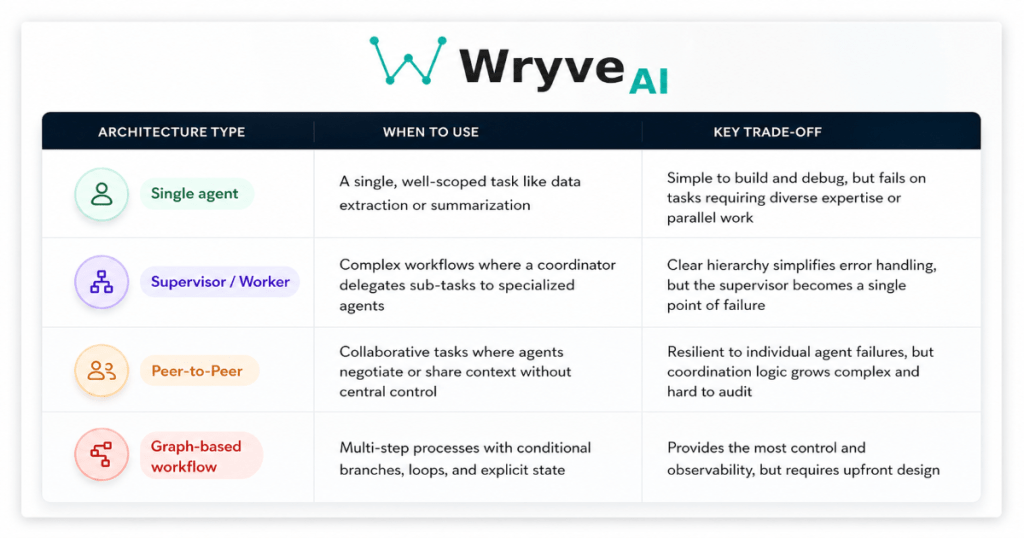
Single-agent architectures remain the right choice for simple automation. For anything involving multiple data sources, sequential reasoning, or human approval steps, move to a supervisor/worker or graph-based model. The agentic framework you pick must support your chosen architecture natively, retrofitting orchestration onto a single-agent system wastes more time than building it right the first time.
A financial services firm using a single agent for trade reconciliation hit a wall when the agent could not distinguish between a data format error and a genuine market anomaly. The fix required a supervisor agent that routed format issues to a validation specialist and anomalies to a risk analyst. That split took the system from 72% accuracy to 94% in two weeks..
What Real Understanding of Agentic Framework Unlocks
The A.G.E.N.T.I.C. acronym is not a mnemonic gimmick. It is a diagnostic tool that changes how you evaluate any agentic framework. You now see the seven components that separate a prototype from a production system.
This understanding changes your next decision. You can assess a framework for its memory persistence, its error recovery, and its support for human input for brand alignment before committing code. Teams that skip this audit spend months retrofitting capabilities that should have been built in from day one. Use the acronym to audit your current or planned framework. Run each letter as a checklist. The frameworks that pass all seven are the ones worth shipping on.
Every claim in this article was checked against a real source before it was published.
WryveAI researches live search results, writes source-verified content, and publishes straight to WordPress, all in one platform.
Try WryveAI Free →No credit card required.
Frequently Asked Questions About Agentic Framework
Which is the best agentic framework?
There is no single best framework because the right choice depends entirely on your use case requirements for autonomy, memory persistence, and human oversight. The A.G.E.N.T.I.C. acronym gives you a structured way to evaluate any framework against these seven criteria before committing to one.
What is the difference between LLM and agentic framework?
An LLM is the reasoning engine that generates text, while an agentic framework is the infrastructure that gives that model memory, tool access, and the ability to act on its decisions. Without the framework, the LLM can only respond to prompts, it cannot execute multi-step tasks or interact with external systems.
What are the 4 steps of agentic AI?
The four steps are perception, reasoning, action, and learning, forming a continuous loop rather than a linear pipeline. Each step depends on framework components like memory for context retention and error handling for recovery when actions fail.
What are the 5 types of agentic AI?
The five common types are simple reflex agents, model-based reflex agents, goal-based agents, utility-based agents, and learning agents, each differing in how they process information and make decisions. Most production systems use goal-based or learning agents because they can handle complex, multi-step tasks without constant human intervention.