
What Is AI SEO Content Writing and Why Agencies Are Switching Fast in 2026

ℹ️ TL;DR
- The real flaw in most AI SEO content writing tools isn’t the model, it’s the missing input. Tools that write before analyzing the SERP produce generic drafts that need heavy rewriting to rank.
- SERP intelligence means analyzing top-ranking pages for content gaps, structural patterns, and search intent before generating a single word. That’s different from keyword research, which only tells you what people search for, not why certain pages win.
- Agencies are switching because of three pressures: margin compression from manual editing, clients demanding data-backed content over just good writing, and competitors winning proposals with faster, ranking-ready pipelines.
- Human editors stay essential. Their job shifts from rebuilding AI drafts to verifying facts, checking brand voice, and confirming E-E-A-T signals the model cannot generate on its own.
- A repeatable workflow front-loads strategy: map search intent, analyze competitor gaps, generate from a structured outline, then edit for voice and accuracy. Skipping the SERP analysis step is what makes AI drafts expensive to fix.
Adding writers to a broken workflow produces more broken content. The promise of AI SEO content writing is speed, but the output lands generic because the tool has no idea what actually ranks. The common fix is better prompts. That misses the real problem. The AI model is not the differentiator, the data feeding it is.
This article traces the flaw from tool choice to editorial review. You will see why SERP intelligence changes the economics of agency content production.
The gap between a generic draft and a rankable article is not prompt length. It is whether the tool knows that the top three results for this query all include a comparison table and a specific data point from a government report.
The Core Flaw in Most AI SEO Content Writing Tools
The foundational problem with most AI SEO content writing tools is not what they generate, but what they ignore. They produce grammatically flawless text based on language patterns, not on what actually ranks in search.
This creates a dangerous gap. A tool trained on the entire internet produces content that sounds professional but says nothing competitors have not already published. It fills space without claiming territory.
Practitioners already understand this intuitively. The most effective approach treats SEO content as a staged process. Experienced teams use ChatGPT or Claude for ideation and rough drafting, then switch to Semrush for keyword research, search intent analysis, and competitor page evaluation. The missing stage is SERP intelligence before generation.
Most AI writing tools skip this entirely. They write first and optimize later. The result requires heavy editing to align with what Google rewards. The editing cost eats the speed gain.
WryveAI solves this by analyzing top-ranking pages before generating a single word. It identifies content gaps, structural patterns, and search intent signals from live SERP data. The AI writes from competitive intelligence, not generic training data. The difference is between content that ranks and content that produces generic SEO articles that nobody reads.
Consider a team using Claude for drafting and Ahrefs for research. They spend 20 minutes writing a prompt, 10 minutes reviewing SERP data, and 3 hours rewriting to match competitor depth. The tool never warned them about the content gap.
That gap is where rankings die. An AI that writes without reading the SERP first is an AI that writes blind. The fix is a tool that treats the SERP as its primary input, not its afterthought.
What SERP Intelligence Adds to AI Content Writing
SERP intelligence is the process of analyzing top-ranking pages for a keyword to identify content gaps, structural patterns, and search intent signals before generating a single word. This is not keyword research. Keyword research tells you what terms people search for. SERP intelligence tells you why the pages that rank for those terms actually rank.
Most AI tools skip this entirely. They generate text from a language model trained on the whole internet, not from the specific competitive landscape of a single query. The result is content that reads well but competes against nothing. It answers a question the searcher already saw answered on the first result.
SERP intelligence feeds the AI with real competitive data. It tells the model which subtopics the top pages cover, which structural patterns they use, and which search intent they satisfy. The AI then generates content that fills a gap rather than repeating what already exists. This is the difference between content that ranks and content that fills a folder.
WryveAI is built on this principle. It analyzes top-ranking pages before generating a single sentence. The output is not a generic draft. It is a structured response to a specific competitive environment. That is what makes the difference between content an editor can publish and content an editor must rewrite..
Take a SaaS company targeting the keyword “project management software for agencies.” A standard AI tool generates a generic feature list. SERP intelligence reveals the top three results all include a pricing comparison table and a section on client collaboration workflows. The AI then prioritizes those gaps instead of repeating the same feature list. That single shift changes the content from a commodity to a competitive asset.. The editor spends time polishing, not restructuring.
Why Agencies Are Switching to AI SEO Content Writing in 2026
The shift happening now is not driven by technology hype. It is driven by three economic and strategic pressures that make the old model unsustainable. Each one pulls agencies toward AI SEO content writing that is backed by real competitive data, not just faster drafts.
Margin Pressure That Kills the Old Production Model
Agencies face a brutal math problem. Clients want more content every quarter, but editorial headcount cannot scale at the same rate. Adding writers to a broken workflow just compounds the cost problem.
The only escape is a tool that reduces the editing burden. Generic AI tools fail here because their output needs heavy rewriting. Tools that feed the model competitive data before generation produce drafts that survive editorial review with far less surgery, protecting the agency’s ability to offer high-margin services without hiring three more editors per account.
Client Expectations Have Moved Past Good Writing
Clients no longer accept articles that read well but rank poorly. They want data-backed content strategies tied directly to search performance. A well-written piece without competitive positioning is now a deliverable that gets questioned in the monthly review.
This expectation forces agencies to build SERP intelligence into every workflow. Established players like AIOSEO are already integrating AI deeply into their platforms, offering features like an AI image generator that creates visuals directly inside the editor. The market is moving toward tools that embed strategy into the creation process, not just the editing phase.
Competitive Necessity in a Fast-Moving Market
The agencies that adopt SERP-intelligent AI are winning contracts. The ones that stick with manual workflows or generic AI tools are losing them. The gap is not in writing ability, it is in how fast an agency can produce content that actually ranks.
This is not a future problem. Proposals are being won and lost today based on whether an agency can demonstrate a repeatable, data-driven content pipeline. The cost of not switching is not stagnation. It is irrelevance.
The Human Editing Requirement That Most Guides Ignore
Two approaches dominate how agencies handle AI-generated content, and they produce radically different outcomes. The first treats the tool as a finished product. The second treats it as a starting point requiring strategic refinement.
The publish-and-pray method sends AI output live with a quick proofread and a headline tweak. It works when speed is the only metric and content targets low-competition queries. The problem is that Google evaluates content on expertise, authoritativeness, and trustworthiness, signals no AI model can generate on its own. Content that passes a grammar check but fails an E-E-A-T review does not hold rankings.
The strategic editing approach treats the AI draft as raw material. Humans focus on three things the model cannot handle: brand voice consistency, factual accuracy against current data, and structural coherence that matches search intent. This is where the human editing requirement becomes non-negotiable. The editor does not rewrite the entire piece. They verify claims, tighten arguments, and inject the perspective that makes content defensible against competitors.
Neither approach wins universally. Publish-and-pray works for thin content in low-stakes niches. Strategic editing wins everywhere else, which is most work agencies actually get paid for. The decision comes down to one question: does this content need to rank for more than three months? If yes, the editing requirement is not optional.
Take a client in the legal sector. Google’s E-E-A-T guidelines demand citations from current case law and regulatory bodies. An AI model trained on data from 2023 cannot cite a ruling from 2025. The editor who catches that gap saves the client from a ranking collapse and a credibility crisis.
This is the practical test. If the editor cannot name the specific data source, the competitor angle, or the brand’s unique framing within 60 seconds of reading the AI draft, the draft is not ready. The editing requirement is not about fixing typos. It is about making content defensible.
How AI SEO Content Writing Changes Agency Economics
The standard economic model of content production treats volume and headcount as locked variables. AI SEO content writing breaks that lock, but only for agencies that understand where the real costs live. A tool that generates a draft in thirty seconds but requires ninety minutes of rewriting has not changed the economics at all.
Generic AI tools increase editing costs because they produce content without competitive context. The editor becomes a strategist, a researcher, and a fact-checker rolled into one, performing work the tool should have done. That hidden labor erases the margin gain the agency expected from automation.
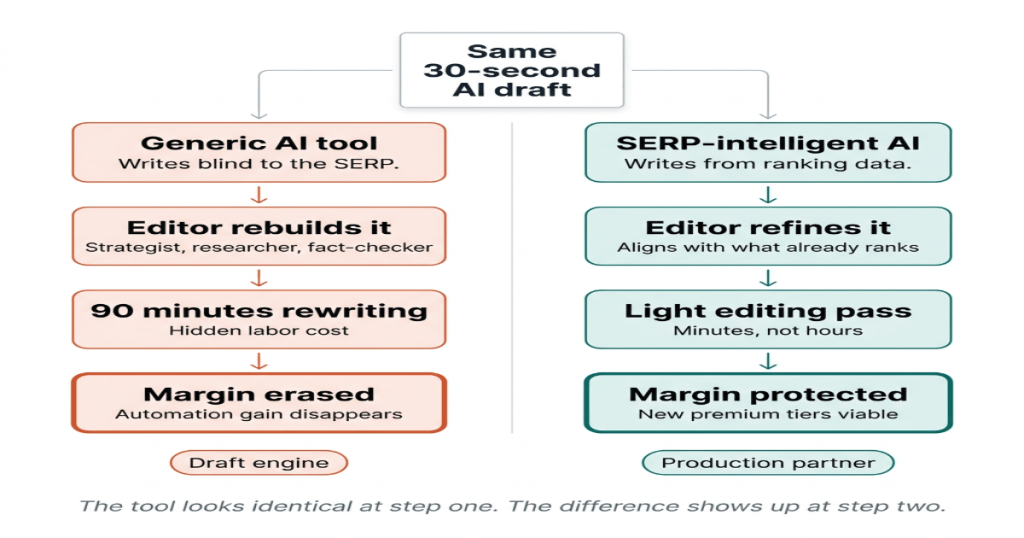
SERP-intelligent tools flip this equation. When the AI receives real ranking data before it writes, the output aligns with what search engines already reward. The editor’s job shifts from rebuilding content to refining it. That difference in editing effort is the difference between a profitable AI content workflow and a costly one..
This shift allows agencies to decouple content volume from headcount in a way that actually works. New service tiers become viable: AI-optimized content packages that combine speed with data-driven strategy. These command premium rates because they deliver what clients actually want, content that ranks, not just content that reads well. The market already evaluates tools on this price-to-value axis, as seen in recent SEO content optimization comparisons that rank platforms by strategic output rather than feature lists.
The agency that treats AI as a draft engine will see margins compress. The agency that treats AI as a data-driven production partner will find new pricing models and new revenue streams. The difference is not the tool. It is knowing which costs to eliminate and which to protect.
What Most Guides Get Wrong About AI SEO Content Writing
The dominant narrative is wrong. Most guides treat AI SEO content writing as a prompt engineering problem. Get the right prompt, get the right article. That misses the entire strategic layer. The real skill is what data you feed it before a single word gets generated.
Prompt Engineering Is a Distraction
Guides that test tools against each other almost never compare data inputs. They compare word count, templates, and integration lists. A tool trained on billions of marketing data points, like Anyword’s custom AI model, still produces generic output without competitive context for the specific keyword. The prompt is a lever. The data is the load. Most guides obsess over the lever and ignore whether the load is worth lifting.
Keyword Clustering Is the Real First Step
Before any AI generation, someone must group keywords by search intent. A tool writing about “content marketing” without knowing whether the user wants a definition, strategy guide, or tool comparison satisfies no one. This clustering is invisible in comparison tables. But it determines whether AI-generated content survives editorial review or gets rewritten.
Content Gap Analysis Separates Strategy From Output
The best prompts cannot compensate for missing competitive intelligence. A guide testing AI tools on the same keyword reveals which produces cleaner prose. It will not reveal whether any addresses the content angle top-ranking pages missed. That gap analysis is what separates content that ranks from content that fills a blog. It happens before the AI writes anything.
Search Intent Mapping Is Non-Negotiable
Every keyword carries an intent signal: informational, commercial, navigational, transactional. An AI tool ignoring this signal produces content matching the query syntactically but failing the searcher’s actual goal.
Most guides skip this entirely. They evaluate tools on output quality without checking whether the output matches the intent behind the query.
Building a Repeatable AI SEO Content Writing Workflow
A repeatable workflow is the difference between a tool that saves time and one that burns it. Most teams skip the strategic layer and jump straight to generation. The process below works because it front-loads the competitive intelligence that determines whether content ranks.
Step 1. Map keywords by search intent before any writing begins. Group terms by whether the searcher wants to buy, learn, or compare. Skip this step and the AI will target the wrong stage of the buyer’s journey.
Step 2. Analyze the top-ranking pages for each keyword cluster. Identify the content gaps: what questions do competitors leave unanswered, what formats do they avoid, what angles do they miss. A tool that skips this step generates text that mirrors the competition instead of beating it.
Step 3. Generate content using structured outlines based on the SERP analysis. Feed the AI with the specific headings, data points, and structural patterns that top pages use. A one-click approach like SEO Writing AI promises speed, but without competitive data, the output still requires heavy rewriting.
Step 4. Edit for brand voice and E-E-A-T signals. The human editor’s job is not to rewrite the structure but to verify factual claims, adjust tone, and add original insights. Skip this step and the content reads like every other piece in the SERP.
Completing this workflow means the AI content writing tool produces drafts that survive editorial review with minimal changes. The result is content that ranks faster, requires less rewriting, and scales without adding headcount.
One agency using this workflow cut editorial revision time from three rounds to one across a 40-article campaign. The difference was the SERP analysis step that told the AI exactly which competitor angles to avoid and which gaps to fill.
The Future of Agency Content Production
The real shift in AI SEO content writing is not about replacing writers. It is about equipping them with data that actually predicts what will rank. A tool that generates text without knowing why the top ten results look the way they do is just a faster way to produce content that will not survive editorial review.
An agency that adopts a SERP-intelligent workflow changes its economics at a fundamental level. The editor stops fixing strategic gaps and starts polishing arguments that already work. The client receives content that targets real search behaviors instead of generic language patterns.
The next action is simple. Evaluate your current AI tool by one metric alone. Count how much of its output survives editorial review without structural rewrites. If the answer is less than half, the tool is costing you more than it saves.
Every claim in this article was checked against a real source before it was published.
WryveAI researches live search results, writes source-verified content, and publishes straight to WordPress, all in one platform.
Try WryveAI Free →No credit card required.
Frequently Asked Questions About AI SEO Content Writing
What is AI SEO content writing?
AI SEO content writing is the practice of using artificial intelligence to generate text that is optimized for search engine rankings, not just for readability. The critical difference from generic AI writing is that it incorporates competitive data from top-ranking pages, keyword clusters, and search intent signals before a single word is written.
How is it different from regular AI writing?
Regular AI writing generates text based on language patterns from training data, producing grammatically correct but strategically hollow output. AI SEO content writing feeds the model real-time competitive intelligence from search engine results pages, ensuring the content targets what actually ranks rather than what sounds fluent.
Do I still need a human editor?
Yes. The human editor focuses on brand voice, factual accuracy, and structural coherence, areas where AI consistently falls short. This strategic editing layer is non-negotiable for building E-E-A-T signals and ensuring the content aligns with the client’s specific market position.
Can AI SEO content writing replace my entire content team?
No. AI SEO content writing replaces the drafting phase, not the strategic oversight or editorial refinement that makes content rank. Teams that attempt full replacement find their editing costs increase as senior writers spend more time fixing generic output than they would creating original work.
What should I look for in an AI SEO content writing tool?
Look for tools that analyze top-ranking pages before generation, not just tools that produce fast drafts. The most important capability is SERP intelligence, the ability to identify content gaps, structural patterns, and search intent signals that feed the AI with competitive data rather than generic prompts.


