Agentic AI vs Generative AI: Which One Actually Gets Work Done?
ⓘ TL;DR
- Agentic AI vs generative AI is the wrong comparison. One creates content. The other executes tasks. Most content teams need both and are using neither correctly.
- Generative AI waits for a prompt. Agentic AI decides what to do next. One is a typewriter that never tires. The other is an editor who reads the room and sends the piece to layout without being told.
- Both are limited memory systems. The difference is not what they are. It is how they act on what they know.
- Generative AI without agentic research produces content that reads well but targets nothing. Agentic AI without generative output builds a pipeline with nothing to move through it.
- Stop choosing sides. Map every task in your pipeline to one of two buckets: generative output or autonomous execution. Then build a workflow that hands off between them without friction.
Searching for a comparison between agentic AI and generative AI usually means someone is trying to pick one. That is the wrong question entirely.
The real choice is not which technology to adopt. It is understanding that one creates content and the other executes tasks, and most content teams need both to function properly.
This article shows you exactly where each AI type belongs in your workflow. You will learn the difference between reactive output and autonomous action, when to use each, and how to combine them for a pipeline that produces more than the sum of its parts.
Reactive Output vs Autonomous Action
Generative AI is a tool that waits for a prompt. It produces text, images, or code when told to, then stops. Agentic AI is a system that decides what to do next. It perceives its environment, sets goals, and executes multi-step tasks with limited human supervision. The difference is not speed or quality. It is whether the machine acts or merely responds.
Most content teams treat both as the same technology applied differently. That mistake costs them time and budget. A generative model produces a blog post draft when asked. An agentic system, as defined by IBM’s agentic AI framework, would research the topic, identify competitor gaps, draft the post, optimize it for search, schedule publication, and monitor performance, all without a new prompt for each step.
The reactive versus proactive framing from Salesforce captures this cleanly. Generative AI waits for input. Agentic AI initiates action. One is a typewriter that never tires. The other is an editor who reads the room, adjusts the angle, and sends the piece to layout without being told.
Understanding this distinction determines whether an AI investment pays off. Teams that buy generative tools expecting autonomous execution will burn hours on manual orchestration. Teams that deploy agentic systems for creative work will get rigid output that misses nuance. The payoff comes from knowing which problem each solves.
How Each AI Adapts to New Information
Adaptability sounds like a single trait until you watch both systems fail at the wrong task. Generative AI adapts by changing how it says something. Agentic AI adapts by changing what it does next.
Generative AI is a shape-shifter for output. Feed it a blog post brief, then a tweet thread, then a product description, it adjusts tone, structure, and vocabulary for each format without breaking stride. The flexibility lives entirely in the surface layer. Give it the same brief twice with different stylistic instructions, and it produces two different drafts. That is real value for content variety. But ask it to change its approach mid-task because a competitor just published a better angle, and it cannot. It has no awareness of the environment beyond the prompt it received.
Agentic AI adapts at the strategic level, not the stylistic one. As Red Hat explains, agentic systems perceive their environment, set goals, and adjust their plan when conditions shift. A content agent monitoring SERP rankings notices a drop, re-evaluates which keywords to target, and reprioritises its publishing schedule, all without a new prompt. The output format stays consistent. The strategy changes. That is a fundamentally different kind of flexibility.
Choose generative AI when the task demands stylistic range across fixed inputs. Choose agentic AI when the task demands strategic recalibration in a changing environment. Most content workflows need both, generative for the draft, agentic for the decisions around it.
Workflow Automation vs Content Creation
The standard framing pits these two AI types against each other as if they compete for the same job. They do not. One builds the pipeline, the other fills it.
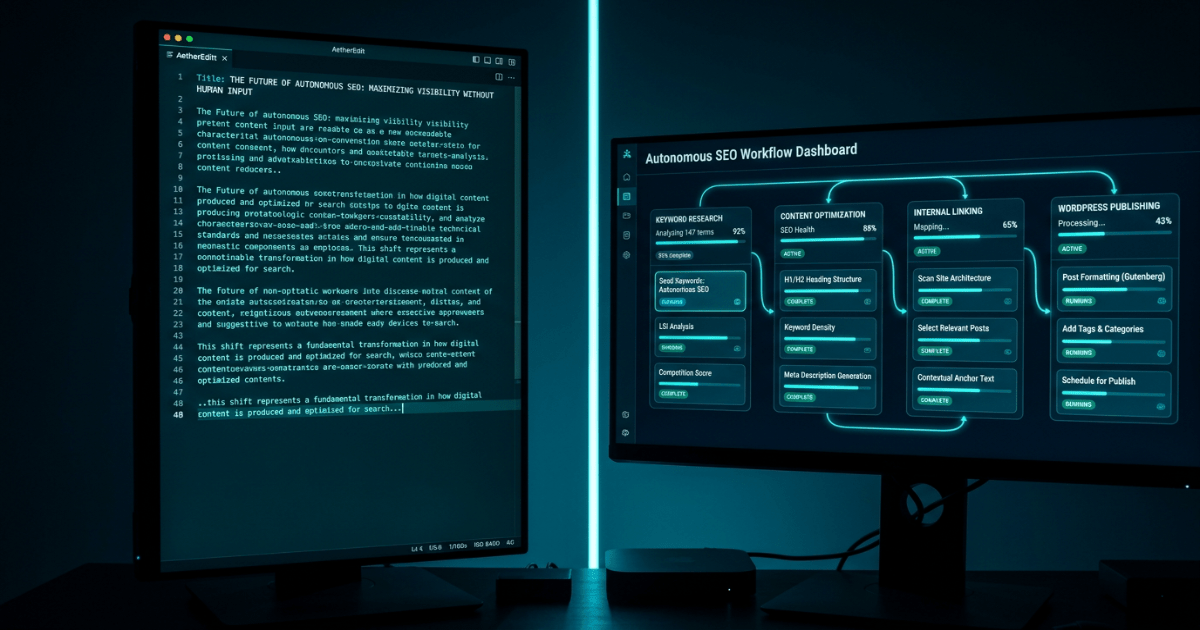
Agentic AI specializes in workflow automation and independent problem-solving. It perceives a task, plans a sequence of actions, executes each step, monitors the outcome, and adjusts course without human intervention. This is the difference between a tool that drafts a blog post and a tool that researches competitor content, identifies keyword gaps, optimizes existing pages, and schedules publication across multiple channels.
Generative AI’s sweet spot is content creation. It produces text, images, code, and audio from learned patterns. Give it a prompt, and it generates output. The limitation is baked into the design: generative AI creates but does not act. It cannot check whether the content it just produced aligns with current search trends or whether a better angle exists in the SERP.
Content teams need both capabilities, but for different parts of the pipeline. The drafting phase demands generative AI for speed and volume. The research, optimization, and publishing phases demand the autonomous execution that agentic AI provides. Tools like WryveAI bridge this gap by combining agentic AI vs generative AI capabilities, using SERP intelligence and content quality to drive research decisions while generating output that matches those strategic inputs.
The mistake is treating either as a complete solution. Generative AI without agentic research produces content that reads well but targets nothing. Agentic AI without generative output builds a pipeline that has nothing to move through it. The smartest teams stop choosing and start combining.
When to Use Generative AI in Your Workflow
Generative AI earns its keep in the parts of an AI content workflow where volume and variety matter more than execution. The tool produces output on demand, but it stops there, it never acts on what it creates.
- Drafting blog posts
- Creating social media copy
- Generating email sequences
- Producing first drafts of reports
- Brainstorming content ideas
- Writing product descriptions
- Repurposing long-form content into shorter formats
Each of these tasks shares a common pattern. The output is a starting point, not a finished deliverable. A blog post draft needs editing, fact-checking, and strategic alignment before it publishes. Social media copy requires platform-specific formatting and audience targeting. Email sequences demand testing and optimization cycles that generative AI cannot run on its own.
The real value appears when you stop expecting generative AI to finish the job. Treat it as a first-pass engine that removes the blank page problem and accelerates the drafting phase. The strategic work, deciding what to write, for whom, and why, still belongs to the human in the loop. Generative AI is a productivity multiplier for content volume, not a replacement for the thinking that makes content effective.
When Agentic AI Takes Over the Process
Agentic AI transforms a content workflow from a series of manual handoffs into an autonomous system that executes from research to publication. The difference between agentic AI vs generative AI becomes clearest when you watch one plan and act while the other waits for a prompt.
Perceive the environment: The system scans the current state of your content landscape. It analyzes ranking pages, competitor strategies, and search intent signals without a human telling it where to look.
Plan an action sequence: Based on what it perceives, the AI builds a multi-step plan. This might include identifying keyword clusters, mapping internal link opportunities, and scheduling content updates across a site map.
Execute the steps: The plan becomes action. The AI drafts content, places links, optimizes metadata, and publishes directly to your CMS. No one approves each individual move because the system was given a goal, not a script.
Monitor results: After execution, the system tracks performance metrics. It watches rankings, traffic shifts, and engagement patterns to determine whether the plan is working.
Adjust strategy: When results deviate from expectations, the AI recalibrates. It might rewrite underperforming sections, target different keywords, or change the linking structure. This feedback loop is what separates autonomous execution from one-shot automation.
This entire process follows the agentic AI definition from Databricks: systems that perceive, reason, act, and learn. Tools like WryveAI apply this logic to content through agentic SEO capabilities that research, optimize, and publish without constant human oversight. Agentic AI is built for execution, not ideation. The creative spark still belongs to the strategist. The execution belongs to the machine.
The 4 Types of AI You Need to Know
Most discussions of agentic AI vs generative AI skip a crucial foundation. They compare tools without placing them in the broader AI taxonomy. That gap leaves teams making decisions without understanding what each system actually is.
Understanding where agentic and generative AI sit in the AI family tree changes how you evaluate them. It stops you from asking the wrong questions.
Reactive Machines, No Memory, No Learning
Reactive machines operate on pure input-output logic. They see the current state and respond with a fixed rule. Deep Blue, the chess computer that beat Garry Kasparov, is the classic example. It evaluated every board position fresh, with no memory of past games and no ability to improve from experience.
Limited Memory, The AI You Actually Use
Limited memory AI learns from historical data and applies that learning to new situations. Both generative AI and agentic AI live here. A language model trained on millions of documents generates text based on patterns it observed. An agentic system learns from past task outcomes to refine its next execution. This is the category that powers every practical AI tool in content workflows today.
Theory of Mind, AI That Understands Intent
Theory of mind AI would infer what a human believes, intends, or feels. No commercial system exists at this level yet. Research prototypes can model a human’s knowledge state in constrained environments, but nothing approaches the social reasoning of a human collaborator. This is the frontier, not the current toolset.
Self-Aware AI, Consciousness as a Feature
Self-aware AI would possess its own beliefs, desires, and sense of self. This remains purely theoretical. No system has demonstrated anything close to machine consciousness. Any product claiming otherwise is marketing, not science.
This taxonomy clarifies the agentic AI vs generative AI debate. Both are limited memory systems. The difference is not in what they are, but in how they act on what they know. One generates. One executes. Neither is more advanced, they are built for different jobs.
Choosing the Right AI for Your Content Goals
The wrong choice here costs more than budget. It costs momentum.
Content volume and variety demand generative AI. Autonomous execution of multi-step tasks demands agentic AI. Most content teams need both, but most pick one and force the other to fit. That mismatch is where output stalls and editors burn out.
Generative AI handles drafting blog posts, social copy, email sequences, and first-pass reports. It produces fast, varied content that a human can refine. But it stops there. It does not check whether the topic has been covered by competitors. It does not adjust the angle based on search intent. It does not publish.
Agentic AI fills that gap. It perceives the competitive landscape, plans a sequence of research and optimization steps, executes them, monitors results, and adjusts strategy without a prompt for each move. This is the difference between a writer who produces a draft and a system that ensures the draft has a fighting chance to rank.
An AI content strategy for agencies that treats these as separate tools misses the point. The real comes from combining them. WryveAI demonstrates this by running SERP intelligence, an agentic research function, alongside generative content creation. The research layer identifies gaps and angles. The generation layer produces the article. The publishing layer handles deployment. No handoffs. No dropped context.
Audit your current pipeline. Identify which tasks need generative output and which need autonomous execution. The balance is not fixed. It shifts with every new client, every new market, every new content format.
Build a Workflow That Uses Both Intelligently
The agentic AI vs generative AI comparison collapses the moment you stop treating them as rivals. One creates raw material. The other acts on it. The teams that win are not choosing sides, they are designing pipelines where each AI does what the other cannot.
Content teams that keep these systems separate waste time on handoffs that should be automatic. Drafts sit waiting for research. Research sits waiting for publication. The gap between creation and execution becomes the bottleneck that kills speed. Closing that gap is the difference between a content machine and a content factory.
Audit your current pipeline today. Map every task to one of two buckets: generative output or autonomous execution. Then build a workflow that hands off between them without friction. The technology is ready. The question is whether your process is.
Every claim in this article was checked against a real source before it was published.
WryveAI researches live search results, writes source-verified content, and publishes straight to WordPress, all in one platform.
Try WryveAI Free →No credit card required.
Frequently Asked Questions About Agentic AI and Generative AI
Is ChatGPT agentic AI or generative AI?
ChatGPT is a generative AI system, not an agentic one, because it produces text-based responses only when a user provides a prompt. It cannot independently initiate actions, execute multi-step workflows, or adjust its strategy without human direction at each step.
What are the 4 types of AI?
The four types of AI are reactive machines, limited memory, theory of mind, and self-aware AI, ordered by increasing complexity and capability. Both generative AI and agentic AI fall under the limited memory category because they learn from historical data to inform future decisions.
Who are the big 4 AI agents?
The big four AI agents typically refer to the leading platforms that offer autonomous agent capabilities: Microsoft Copilot, Google Gemini, Amazon Bedrock Agents, and OpenAI’s Assistants API. These systems differ from generative chatbots because they can perceive environments, plan sequences of actions, and execute tasks without continuous human oversight.
What is an example of agentic AI?
A customer service bot that receives a refund request, checks the order history, verifies the return policy, processes the refund, and sends a confirmation email without human intervention is an example of agentic AI. This contrasts with a generative AI chatbot that would only draft a refund response but require a human to execute each subsequent step.