
Citations Are the New Backlinks: What Google’s 2026 Updates Actually Prove
ⓘ TL;DR
- Citations are the new backlinks. Google’s 2026 core updates introduced citation equity as a parallel authority signal running alongside the old link graph.
- A DA 70 site with zero citations gets ignored by AI answers. A DA 30 site cited across five AI responses gets the recommendation. Domain authority no longer predicts AI visibility.
- Backlinks tell Google a page is popular. Citations tell Google a page is authoritative enough for an AI to stake its answer on. These are not the same signal.
- Backlink tools measure the past. Citation trackers measure the present. Teams still relying on Ahrefs alone are optimizing for a signal that no longer drives AI visibility.
- Run a citation audit this week. The gap between your backlink profile and your citation profile is the only metric that tells you where your content strategy is actually failing.
You have been building links for years. Domain authority was the score that mattered. Then a client mentioned that ChatGPT recommended a competitor with a DA of 30 over your DA 70 site. That moment is not an anomaly. It is the signal that citations are the new backlinks.
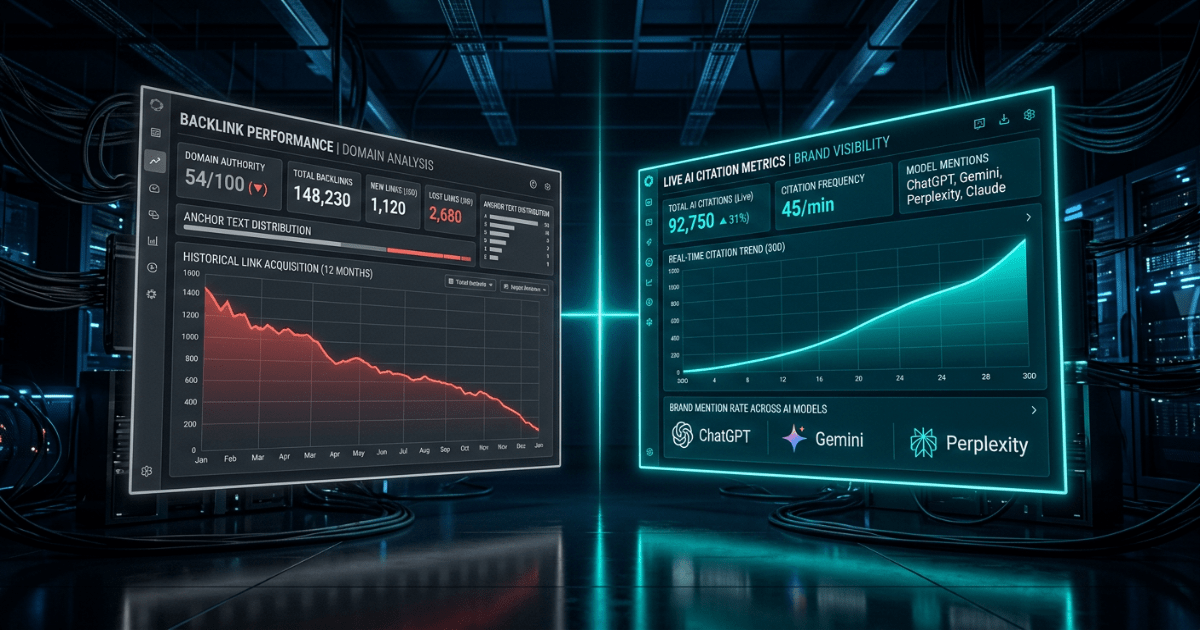
Most SEO teams still optimize for the old signal. They chase link equity when Google’s 2026 core updates have quietly shifted the authority infrastructure to citation equity. Backlinks tell Google a page is popular. Citations tell Google a page is authoritative enough for an AI to stake its answer on. These are not the same thing.
This article explains what changed, why citation equity now determines AI visibility, and how to audit your own standing in under an hour. By the end, you will know exactly where your brand appears in AI answers and what to do about it.
What Google’s 2026 Core Update Actually Changed
The 2026 core update did not kill backlinks. It made them secondary.
Google’s ranking systems now evaluate two distinct signals: link equity and citation equity. Backlinks tell Google a page is popular. Citations tell Google a page is authoritative enough for an AI to stake its answer on. The update introduced citation equity as a parallel authority signal running alongside the old link graph.
This changes how visibility works at the infrastructure level. A page with fifty high-quality backlinks can still rank in traditional search results. But when an AI model generates an answer, it does not consult the link graph. It consults its training data and the citation patterns embedded in that data. The sources that appear in AI answers are the ones the model has seen cited repeatedly across trusted contexts.
This is not a replacement of authority. It is a reframing. AI models lean toward sources that other trusted sites and publications already reference, and backlinks remain one proxy for that trust. The difference is that backlinks are now just one input among several. Citation frequency across authoritative contexts carries more weight than raw link count. Teams still optimizing for traditional link building alone are optimizing for a signal that no longer decides AI visibility.
The practical consequence is stark. A site with a DA of 70 and no citation footprint gets ignored by AI answers. A site with a DA of 30 that appears consistently in trusted discussions gets the recommendation. This is not a theory. This is what the update proved.
Most SEO teams still treat off-page SEO in 2026 as a backlink game. That gap is where the next wave of winners and losers will separate.
Why Domain Authority No Longer Predicts AI Visibility
Domain authority was never a Google metric. It was a third-party proxy that happened to correlate with rankings. That correlation has broken.
Google’s 2026 systems do not check your DA score. They check how often AI models cite your content when generating answers. The old proxy is gone.
Before: Teams spent months building backlink profiles to push DA from 50 to 70. The logic was simple: higher DA meant higher trust. A site with DA 70 ranked above a site with DA 30 in almost every case. SEO strategy became a link-building arms race.
After: Citation frequency now determines AI visibility. A competitor with DA 30 can outrank a DA 70 site in ChatGPT answers because AI models cite the lower-DA source more often. The metric that matters is no longer how many links point to you. It is how many AI-generated answers reference your content. AI citation trackers now reveal which sources models actually cite. The DA 70 site with zero citations is invisible. The DA 30 site cited in five AI answers gets the recommendation.
This is the gap most SEO teams still miss. They optimize for a proxy that no longer predicts the outcome. The teams that adapt to AI SEO content will own the next search landscape.
How Citation Equity Replaces Link Equity
Citation equity is the accumulated trust a source earns when AI models repeatedly reference it across authoritative contexts. It is not a score in a third-party tool. It is a behavioral signal: how often does an AI like Gemini choose this source over every other option when generating an answer.
Most SEO teams still treat link equity as the only game in town. They chase backlinks from high-DA domains, assuming that trust flows through hyperlinks. That assumption is now incomplete. AI tools like Gemini are directly choosing which sources to include in their answers. The link graph is one input. The citation graph is another. Optimizing for only one leaves visibility on the table.
This changes how visibility works. A page with ten high-quality backlinks but zero AI citations will not appear in a Gemini answer. A page with three backlinks and twenty citations across community threads, niche publications, and structured data feeds will. The old model rewarded popularity. The new model rewards reliability, the kind that makes an AI stake its answer on your content.
The implication for practitioners is straightforward. Stop treating link building as the sole authority strategy. Build citation equity by making your content referenceable in the contexts where AI models look for answers. That means structured data, clear claims, and cross-platform presence. The teams that understand this shift are already moving toward agentic SEO strategies that prioritize citation readiness over link volume alone.
The Sites AI Trusts Most (Hint: Not the Ones You Think)
High domain authority no longer guarantees a seat at the AI table. The sites models like ChatGPT and Gemini cite most frequently share a different set of traits entirely.
These platforms earn trust through repeated, verifiable mentions across the web. They are not always the biggest names in a category.
- Community platforms (Reddit, Stack Overflow)
- Niche industry publications
- Structured data-rich pages
- Brand mentions across cross-platform memory
- Long-form technical documentation
- Academic and government domains
- Verified expert Q&A archives
The pattern is clear. AI models favor sources that appear consistently across multiple contexts, not just those with the most backlinks. A single mention on a high-DA site matters less than the same concept being referenced on Reddit, a niche blog, and a structured knowledge base simultaneously.
This is where AI internal linking and cross-platform memory become decisive. Citations are strengthened by cross-platform memory. Mention your concepts and URLs on community platforms, niche publications, and structured data pages. The result is higher visibility in ChatGPT default mode, Gemini answers, and Perplexity Pro with no paid distribution. Start mapping where your brand already appears and fill the gaps where competitors are cited but you are not.
What Citation Tracking Reveals That Backlink Tools Miss
Backlink tools measure the past. Citation trackers measure the present.
Ahrefs and Majestic tell you who linked to your page last month. That data is useful for link building campaigns. It tells you nothing about whether an AI model will reference your content in a live answer today. The gap between these two signals is where visibility is being lost.
Traditional tools count links. Citation trackers count mentions in AI-generated responses. The difference is structural, not semantic.
Backlink Tools vs Citation Trackers: What Each Actually Measures
| What It Measures | Backlink Tools (Ahrefs, Majestic) | Citation Trackers (OtterlyAI, Profound) |
|---|---|---|
| Signal type | Historical link equity | Real-time AI trust |
| Data source | Crawled web links | AI model outputs |
| What it misses | AI answer inclusion, mention rate | Link authority, domain age |
| Primary use case | Outreach and link building | Content gap analysis, citation equity |
| Update frequency | Weekly or monthly | Near real-time |
Citation tracking monitors which URLs AI engines cite when generating answers. The data correlates with mention rate, share of voice, and early referral traffic signals. Backlink tools cannot see any of this.
OtterlyAI is the most agency-ready option in 2026. It surfaces which third-party URLs appear in ChatGPT, Gemini, and Perplexity answers. Profound offers similar coverage with a stronger focus on competitive analysis. Both reveal what AI citation tracking exposes that backlink profiles hide.
Run both tools for a month. The gap between your backlink profile and your citation profile will tell you exactly where your content strategy is failing. That gap is the only metric that matters now.
Teams still relying on Ahrefs alone are optimizing for a signal that no longer drives AI visibility. Adding citation tracking to the workflow is not optional. It is the minimum viable investment for anyone serious about SEO writing AI tools adoption in 2026.
Building Citation-Ready Content vs. Link-Worthy Content
The entire content playbook flips when the goal shifts from earning backlinks to earning citations. Link-worthy content optimizes for shares, viral hooks, and anchor text distribution. Citation-ready content optimizes for structured data, verifiable claims, and cross-platform mention density. These are not the same thing.
Link-worthy content asks one question: will someone link to this? Citation-ready content asks a harder one: will an AI model stake its answer on this? The difference shows up in the format. A listicle with 50 shallow tips gets links. A single page with a well-sourced methodology, a clear data schema, and a definitive claim gets cited. The second format is harder to produce. It also lasts longer.
Community platforms reveal this gap most clearly. When a brand gets mentioned in a ‘best tools for X’ Reddit thread, that citation reaches high-intent users and signals to search engines that the brand is relevant for that specific need. That is a different signal than a backlink from the same thread. The backlink says someone found the page useful. The citation says someone found the brand authoritative enough to recommend. The second signal carries more weight in an AI-generated answer.
Building citation-ready content means treating every page as a potential source for an AI model. That means adding FAQ schema, publishing author bylines with credentials, linking to primary research, and writing claims that can be verified against a single source of truth. It also means distributing the content across platforms where AI models train, Reddit, Medium, industry forums, and structured directories. A link on a DA 90 site helps. A citation on three community platforms helps more.
This is where the SEO content strategy for SaaS model breaks from the old playbook. The old playbook said build one great page and wait for links. The new playbook says build one great page, then place its core claims on every platform your audience uses. The page earns the citation. The citation earns the AI visibility. The link becomes a secondary outcome, not the primary goal.
The uncomfortable truth: most content teams are still writing for the link economy. They are producing content that earns shares but not citations. That gap is where visibility disappears when an AI model chooses which source to cite. Writing for the citation economy means accepting that a page with zero backlinks can still be the most authoritative source in an AI answer, if it is built and distributed correctly.
How to Audit Your Citation Equity in 30 Minutes
Most teams skip the first step entirely. They jump to content optimization without knowing where they stand. A citation equity audit reveals the gap between what AI models trust and what your site currently offers.
Step 1. Run a citation audit using OtterlyAI or Profound. These tools scan AI-generated answers across ChatGPT, Gemini, and Perplexity to show which sources get cited for your target queries. Without this step, you are guessing which signals matter.
Step 2. Identify your top-cited competitors. Export the list of domains that appear most frequently in AI answers for your keywords. The names on that list will surprise you. A niche blog with structured data often beats a media giant with high domain authority.
Step 3. Map citation gaps to your existing content. Compare what AI models cite against what your site covers. Every query where a competitor appears and you do not is a gap. Prioritize the gaps that overlap with your highest-value conversion pages.
Step 4. Optimize existing pages for structured data and cross-platform mentions. Add FAQ schema, how-to schema, and review markup to every page in your gap list. Then distribute those pages across Reddit, industry forums, and LinkedIn with context-rich posts that link back naturally.
Step 5. Set a monthly re-audit cadence. Citation equity shifts faster than link equity. A source cited today can disappear from AI answers next week. Teams that treat this as a one-time task lose the signal before they can act on it.
Completing this process gives you a live map of your AI visibility. The output is not a report, it is a ranked list of exactly which pages to fix and which platforms to target. For enterprise SEO teams, this replaces the quarterly backlink audit as the primary health check.
The New Authority Infrastructure Is Already Running
Backlinks are not dead, but citation equity is now the primary trust signal. That is the structural reality Google’s 2026 updates have already locked in.
Teams that run a citation audit this week will see the gap between their current visibility and their real potential. Teams that wait will watch competitors with lower domain authority capture every AI-generated recommendation in their category.
Run the audit. Find the gap. Build the citation presence your domain authority never earned. The infrastructure is already running. The only question is whether you are on it.
Every claim in this article was checked against a real source before it was published.
WryveAI researches live search results, writes source-verified content, and publishes straight to WordPress, all in one platform.
Try WryveAI Free →No credit card required.
Common Questions About Citations and Backlinks in 2026
Are citations and backlinks the same thing?
No, citations and backlinks are not the same thing, though both signal trust to search engines. A backlink is a link from one site to another, while a citation is any mention of a brand, source, or URL across the web, including in AI-generated answers, social posts, and community threads, that Google’s systems now evaluate as an authority signal.
Are backlinks still relevant in 2026?
Yes, backlinks remain relevant in 2026, but they are no longer the primary trust signal for AI-driven search results. Google’s 2026 core updates introduced citation equity as a parallel authority metric, meaning a page with fewer backlinks but frequent citations across trusted platforms can now outrank a page with a stronger link profile.
Are citations good for SEO?
Citations are now essential for SEO because they directly influence which sources AI models choose to reference in generated answers. A brand mentioned consistently across Reddit, industry publications, and structured data-rich pages earns visibility in ChatGPT, Gemini, and Perplexity outputs without needing a high domain authority score.
How do I start tracking AI citations?
Start tracking AI citations by running a citation audit using a dedicated tool like OtterlyAI or Profound, which monitor which URLs AI engines cite when generating answers. The audit reveals your current citation frequency, top-cited competitors, and the specific gaps between your content and the sources AI models already trust.


