
SEO Brand Marketing: The Strategy That Wins When Search and Brand Collide

ⓘ TL;DR
- Ranking first on Google used to be the finish line. It is now just the starting gun. The searcher now chooses based on brand trust, not position.
- Zero-click searches and AI overviews have changed the metric that matters. The question is no longer did they click. It is did they remember the brand after they got their answer.
- The brand SEO flywheel replaces the funnel. Visibility creates recall. Recall creates branded search. Branded search signals authority. Authority boosts rankings. The wheel keeps turning.
- Branded search volume is the most underused KPI in SEO. It is the only metric that cannot be gamed. It only grows when real people choose to search for a brand by name.
- The 3 3 3 rule forces nine decisions: three authority topics, three purchase-intent queries per topic, three trust-building content formats per query. Vague content plans do not survive it.
This article will not give you another checklist for keyword research or a lecture on brand voice. It will show you how to stop treating search and brand as separate departments and start using each to amplify the other.
The standard approach pits SEO teams against brand teams. One optimizes for algorithms. The other optimizes for perception. Neither sees the full picture. The result is content that ranks but does not convert, or content that builds trust but never gets found.
Here you will find a framework called SEO brand marketing. It is the strategic integration of search data into brand messaging and brand equity into search performance. By the end, you will know how to build a flywheel where visibility and trust feed each other, not a funnel where they compete.
Why SEO Alone No Longer Wins the Click
Ranking first on Google used to be the finish line. It is now just the starting gun.
Zero-click searches now dominate the results page. AI overviews pull answers directly into the snippet, stealing the click before the searcher ever scrolls. Branded search intent, the moment someone types your company name, is where real trust is measured. A top ranking without brand recognition is a top ranking that converts no one.
This is where SEO brand marketing enters. It forces the question: does the result build trust or just occupy space? The AMA makes the stakes clear, organizations that disregard search engine marketing do so at their own peril. SEO is not just for big corporations. Any business or individual with an online presence can benefit from ranking higher in search results.
But ranking higher is no longer enough. The searcher now chooses based on brand trust, not position. A result from an unknown brand gets skipped. A result from a trusted brand gets clicked, even if it sits below the fold.
The old game was about beating the algorithm. The new game is about earning the click after the algorithm delivers you.
The Brand SEO Flywheel: How Visibility Builds Trust
The brand SEO flywheel is a self-reinforcing loop where search visibility generates brand impressions, those impressions increase branded search volume, and that volume signals relevance to search engines, which then boost rankings further. It replaces the old linear funnel, awareness at the top, conversion at the bottom, with a circular system where every output feeds the next input. SEO brand marketing operates inside this loop, not outside it.
The old model treated search and brand as separate stages. A team built awareness through ads, then hoped searchers would find the site later. That approach leaks momentum. Every impression that does not lead to a branded search is a turn of the wheel that never happened. The flywheel captures that energy instead.
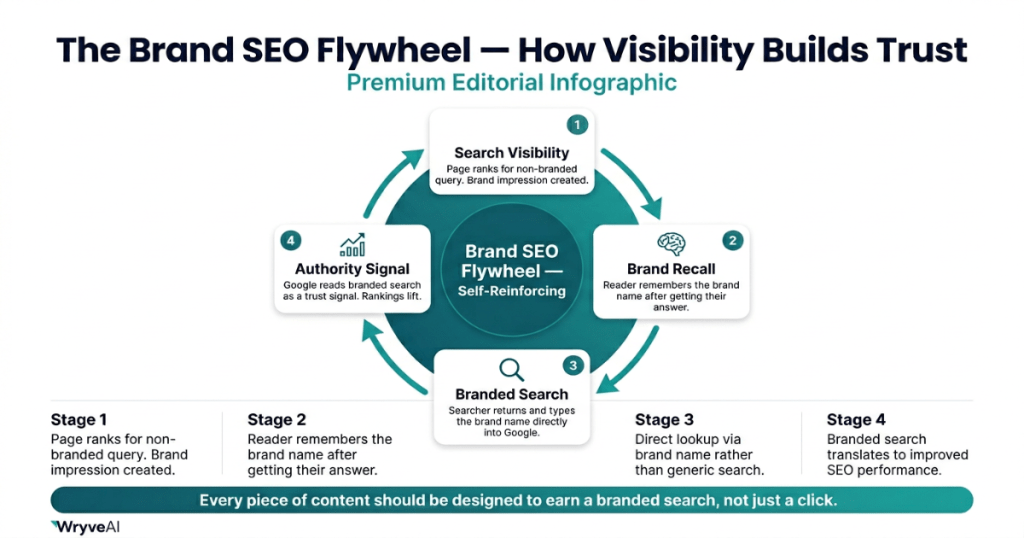
Consider how a single high-ranking article works inside this system. A searcher finds it for a non-branded query. They read it, remember the company name, and later search for it directly. Google sees that branded search as a relevance signal. The next time someone searches the same non-branded query, the article ranks higher. The wheel turned once. It will turn again.
This is not theoretical. Brand SEO research confirms that branded search volume correlates with organic ranking strength. The implication is direct: every piece of content should be designed to earn a branded search, not just a click. That is the difference between a digital marketing playbook built for the flywheel and one built for the funnel.
The old funnel asked how many people entered at the top. The flywheel asks how many people leave wanting to come back through the front door.
Audit Your Brand Visibility Across Search Surfaces
Most brand audits stop at the homepage. They check the logo, the tagline, the color palette. They never check what happens when someone actually searches for the brand. That is where SEO brand marketing lives or dies. The gap between what a brand says it is and what search results say it is determines whether the flywheel spins or stalls.
- Branded SERP features: knowledge panel, sitelinks, top stories
- Non-branded topic rankings for core authority subjects
- Review site presence: G2, Trustpilot, Capterra, Google Business Profile
- Social search results on LinkedIn, Reddit, and YouTube
- AI overview citations for branded and non-branded queries
- Image pack inclusion for branded visual searches
- News tab presence for brand-related current events
The list reveals something uncomfortable. A brand does not control its own story on search engine results pages. The knowledge panel pulls from Wikipedia. The review sites pull from customers. The AI overviews pull from whoever published first. Each surface is a reputation vector that operates independently.
Run this audit once per quarter. Pick one surface that is underperforming and fix it before touching the others. A missing knowledge panel matters more than a missing social result. Prioritize by what a new prospect would see first.
Align Brand Messaging with Search Intent Signals
The standard content workflow treats keywords and brand messaging as separate assembly lines. A writer gets a keyword list, produces a page that ranks, and then a brand team slaps a logo on it. The result is a page that technically wins the click but loses the trust the moment the reader arrives. The messaging does not match what the searcher actually needs, and the page converts poorly because it feels like a generic answer, not a brand with a point of view.
Before: A SaaS company targets the keyword “project management software.” The page ranks well. It lists features, pricing tiers, and a comparison table. But the searcher is not looking for a feature list. They are a team lead drowning in Slack notifications and missed deadlines. They need to know if this tool will reduce their personal chaos. The generic page does not answer that question. They bounce.
After: The same company uses search intent data to shape the brand messaging itself. The page opens with a scenario the team lead recognizes: “You have 14 tabs open and three overdue deliverables.” The language matches the emotional state of the searcher. The page ranks because it still covers the keyword. But it converts because the messaging signals understanding before the reader scrolls. The trust is earned in the first paragraph.
This is the core of SEO brand marketing. The search data does not just tell you what words to use. It tells you what the reader is afraid of, what they are hoping for, and what they need to hear to believe you can help. The truth about SEO services is that most of them stop at the keyword. The ones that go further build brands that searchers actually choose.
The 3 3 3 Rule for SEO Brand Marketing
Most frameworks for SEO brand marketing fail because they ask for too much at once. The 3 3 3 rule solves that by compressing the strategy into nine focused actions. Each number forces a decision, not a suggestion.
Define three brand topics that establish your authority: These are not product categories or service lines. They are the subjects your company can credibly own in a way competitors cannot. A cybersecurity firm might choose attack surface management, zero-trust architecture, and incident response playbooks. Each topic must be narrow enough to dominate and broad enough to generate sustained search interest.
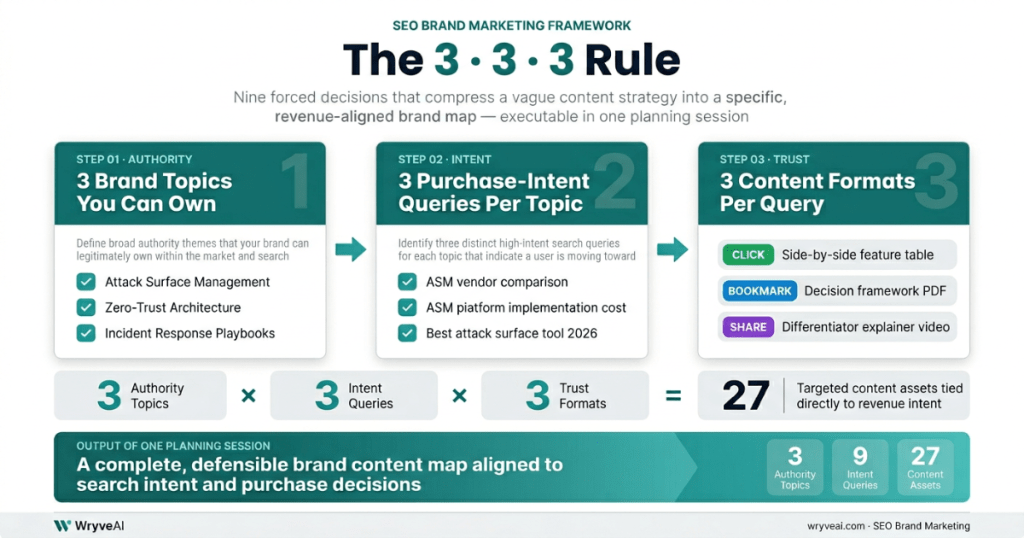
Find three search queries per topic that signal purchase intent: The queries must reveal a searcher who is evaluating options, not just browsing. For the attack surface management topic, queries like “attack surface management vendor comparison” or “ASM platform implementation cost” indicate someone close to a decision. These queries become the targets for brand messaging, not just keyword placement.
Create three content formats per query that build brand trust: One format earns the click. One format earns the bookmark. One format earns the share. For the vendor comparison query, the click format is a side-by-side feature table, the bookmark format is a decision framework PDF, and the share format is a short video explaining the key differentiators. Each format serves a distinct trust-building function.
Completing the 3 3 3 rule produces a content map that is specific, defensible, and directly tied to revenue intent. It turns a vague digital marketing strategy framework into a repeatable process any team can execute in a single planning session.
Measure What Matters: Brand Search Volume as a KPI
Most SEO teams track impressions, clicks, and domain authority as if those numbers alone prove their work is working. They do not. Impressions measure how often a brand appears, not whether anyone remembers it. Domain authority measures a site’s technical standing, not its trust with real people. The metric that connects search performance to actual brand strength is branded search volume, the number of people who type a company’s name into a search bar because they already know it exists and want to find it.
Branded search volume is the single most underused KPI in SEO brand marketing. It correlates directly with brand awareness, more people searching for a brand by name means more people remember it. It also correlates with search relevance, because Google treats branded search queries as a strong signal that a brand is a trusted answer for related topics. A rising branded search curve means the flywheel is turning: visibility creates recall, and recall creates more visibility.
Tracking it is straightforward. Google Search Console shows branded query volume under the performance report. Google Trends shows directional movement over time. The goal is a steady upward slope, not a spike from a campaign, but a consistent climb that reflects growing recognition. A healthy curve looks like a slow, compounding rise, not a jagged line of peaks and valleys.
This metric beats vanity metrics because it cannot be gamed. Impressions can be inflated by ranking for irrelevant terms. Domain authority can be manipulated with link schemes. Branded search volume only grows when real people choose to search for a brand by name. That choice is the purest signal of trust available. The benefits of digital marketing become visible in this number, not in a dashboard of hollow counts, but in the actual behavior of people who remember a brand well enough to seek it out.
The question every team should ask is not whether branded search volume is growing, but whether it is growing faster than the competition. That comparison reveals the real state of brand equity. Without it, the dashboard shows activity, not progress.
Is SEO Dead or Evolving in 2026?
The question itself reveals a misunderstanding of what search has become. SEO is not dying. The version of SEO that chased rankings as the terminal goal is the one fading. SEO brand marketing is what replaces it, a strategy that treats every search result as a brand impression first and a click opportunity second.
AI overviews and zero-click searches have changed the game. A user can get their answer without ever leaving the search results page. That sounds like a disaster for traffic. It is not a disaster for brand recall. When a user sees a brand’s name in an AI-generated answer, that impression plants a seed. The next time they search, they search for the brand by name. That is the flywheel turning.
The teams that panic are the ones still measuring success by sessions. The teams that adapt are the ones asking a different question: did the searcher remember us after they got their answer? Brand recall is the new conversion. It cannot be gamed. It cannot be bought. It has to be earned through consistent, trustworthy visibility across every search surface.
This shift exposes common marketing mistakes. The biggest one is treating SEO and brand as separate budgets. When they operate in silos, the SEO team optimizes for a click that never comes, and the brand team builds awareness that never shows up in search. The integration is the only path forward.
The evolution is not optional. Search engines are getting better at answering questions without sending traffic. The only way to survive that shift is to make sure the brand is the answer. SEO brand marketing is not a tactic for 2026. It is the only strategy that works when the click is no longer guaranteed.
Build the Flywheel, Not the Funnel
SEO brand marketing is not a tactic you bolt onto an existing strategy. It is the strategic integration that forces search data and brand equity to work as a single system.
The reader who acts on this now changes how every piece of content earns its budget. Every page either turns the flywheel or it does not get published. That is a cleaner standard than most teams have ever used.
Audit one branded search query this week. Type it into a private browser window. Look at what appears. Ask whether the result builds trust or just occupies a position. The answer tells you whether the flywheel is turning or stuck.
Every claim in this article was checked against a real source before it was published.
WryveAI researches live search results, writes source-verified content, and publishes straight to WordPress, all in one platform.
Try WryveAI Free →No credit card required.
Frequently Asked Questions About SEO Brand Marketing
Is SEO dead or evolving in 2026?
SEO is evolving, not dead, and the shift is from a technical ranking game to a brand trust game where recall matters more than clicks. AI overviews and zero-click searches mean the goal is no longer driving traffic but ensuring a searcher remembers the brand after getting their answer.
What is the 3 3 3 rule in marketing?
The 3 3 3 rule in marketing is a framework that compresses strategy into nine forced decisions across three brand topics, three purchase-intent queries per topic, and three trust-building content formats per query. It replaces vague content plans with a specific, defensible map that aligns brand messaging directly with what searchers actually need.
What is the 80/20 rule for SEO?
The 80/20 rule for SEO states that roughly 20% of content drives 80% of search results, meaning a small fraction of pages drive the majority of organic visibility. This principle reinforces why SEO brand marketing must focus on building deep authority on a few core topics rather than spreading efforts thin across hundreds of shallow pages.


