
Schema Markup for AI Citations vs. FAQ Pages: Which Wins?
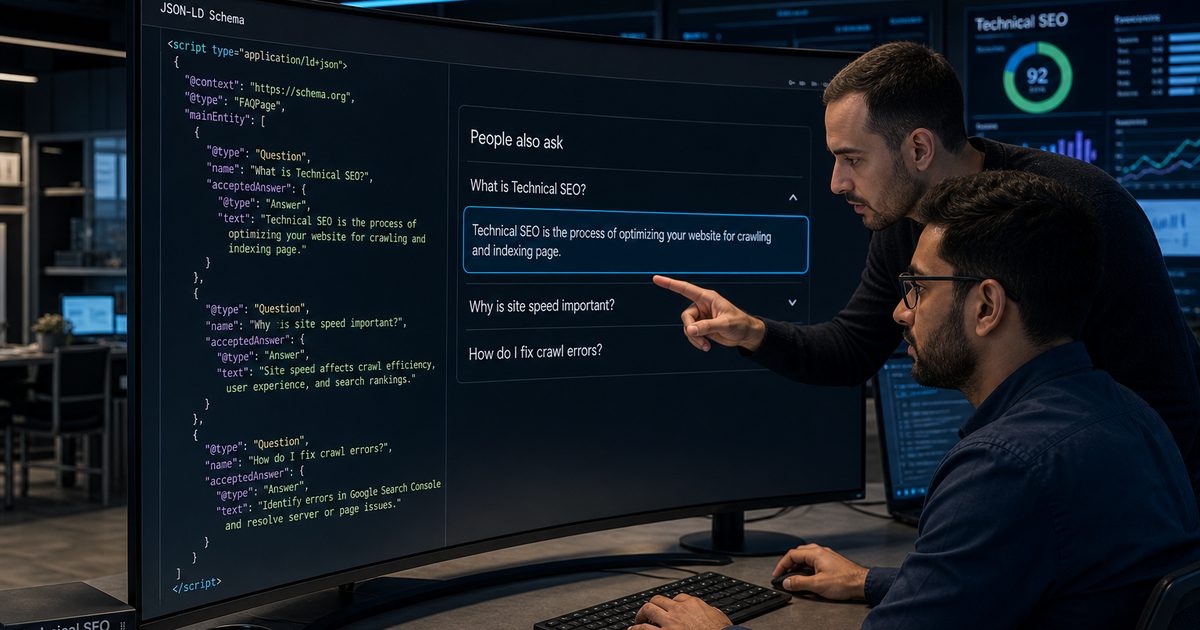
You check the AI Overview for your target query and a competitor is quoted. Not summarized. Quoted, with their sentence sitting in the answer box while your page sits below it.
The instinct is to reach for one fix: schema markup for AI citations, or a rewritten FAQ page. That framing is the problem. Schema is a machine-readable wrapper. An FAQ block is extractable content. They work at different layers, and picking one over the other is a category error.
This article gives you a decision framework, a head-to-head comparison, and a clear recommendation keyed to what your pages already contain. By the end, you’ll know which signal your site is missing and why adding the other one won’t fix it.
The Two Signals Teams Keep Confusing
Schema markup is machine-readable code that describes what a page is, who published it, and how its entities relate. It adds no visible content. An FAQ page answers discrete questions in short, extractable blocks a reader can scan and a machine can lift. Teams treat these as rival tactics for winning AI citations. One is a wrapper. The other is the payload.
An engine reading a product page with clean structured data knows it is looking at a product, from a named seller, at a stated price. It still has nothing to quote if the page never answers a question directly. Flip it: a plain page with a crisp FAQ block gets lifted into an answer while the markup on a competitor’s page goes unread.
Structured data earns trust. Extractable answers earn the quote. Skip either and the citation goes elsewhere.
Google’s own documentation on how structured data works frames markup as a way to describe page content, not to add new claims. Markup that overstates what the page says gets ignored or penalized.
The evaluation criteria for the rest of this article follow from that split. Does a signal establish identity and verifiability, or does it supply a passage worth quoting? Answer that for your own pages before choosing a side. Then use it to track AI search visibility against what you actually changed.
What Actually Decides an AI Citation
Citation selection is a retrieval problem before it is a markup problem. An answer engine pulls candidate passages, scores each for relevance and extractability, then attributes the answer to a source it can verify. Extractability is a content property. Verifiability is a structural property. That split is why neither signal wins on its own.
Answer engines lean heavily on the opening of a page, so the first answer block carries much of the weight. A page that buries its answer under three paragraphs of setup loses the passage before markup ever enters the equation.
Answer engines favor passages that stand on their own. A sentence that reads cleanly with no surrounding context is a sentence an engine can lift. Write a paragraph that only makes sense after the heading above it, and the extractor skips it.
This is where well-marked-up pages quietly fail. Structured data may support clearer grounding but does not guarantee visibility or grounding traffic, per Bing’s webmaster guidelines. A page with immaculate JSON-LD and no quotable answer still loses to a plain page with a crisp one.
The reverse failure is just as common. A tight FAQ block on an anonymous page gives the engine a passage but no reason to trust the source. Engines want the formats answer engines favor: self-contained, direct, and attributable to an entity they can resolve. Schema supplies the attribution. Treat these as two separate scoring gates. You can pass one and fail the other, and the citation goes to whoever passes both.
Where Schema Markup for AI Citations Wins
Structured data earns its keep when the problem is ambiguity about who you are, not what you said. An engine that can’t resolve your brand, your authors, or your product lines will hedge or skip you.
- Entity identity across authors. A brand name and a byline mean little to a retrieval system until declared as connected entities. Consistent
PersonandOrganizationmarkup lets an engine trace a claim back to a named, verifiable source. - Disambiguating products and services. Generic names collide across markets. Stable identifiers such as
skuorgtintell an engine which product you mean, so it stops confusing your offering with a competitor’s. - Connecting entities with @id. Linking brand, author, and page through
@idproperties lets an engine resolve one graph instead of guessing at relationships. That graph is what entity-rich content optimization is built on. - Declaring the page type. An engine reading an
Articletreats it differently from aProductor aFAQPage. Getting the type right tells it whether to quote you as a guide or a listing. - Matching supported features. The gallery of supported markup types shows which formats engines actually parse. Chasing unsupported types wastes engineering time.
Every item establishes trust; none supplies a quotable answer. Schema is infrastructure, not a content tactic. It pays off most on pages that already answer clearly, and only while the markup still matches the page. WryveAI rebuilds each article’s FAQ schema from its visible FAQ before it ships, so the two never drift apart.
Where FAQ Pages Beat Structured Data
Markup can describe a page down to the last property and still hand an engine nothing worth quoting. That gap is where FAQ blocks win when you optimize for AI Overviews.
An FAQ page puts a complete answer on the page in a block an engine can lift. Conversational queries reward this hardest: the engine wants a short, self-contained passage it can quote without stitching context together.
Markup fails here because it’s a description, not a payload. A page can carry flawless JSON-LD and still read as a wall of positioning copy with no discrete answer anywhere.
The trap sits inside the FAQ block itself. Written as marketing copy, an FAQ buries the answer under three sentences of preamble and gets skipped. Written as a direct answer, it gets pulled almost verbatim. Lead with the answer, then qualify it. The reverse order kills extraction.
Structure formalizes what the visible block already does. A FAQPage is a WebPage type that tells an engine the question-and-answer pattern is intentional. The 69-page report on strategic FAQ design packs 94 guidelines into the same lesson: answers first, context second.
FAQ content wins when the query is conversational, the answer is short, and the engine needs a passage it can lift. Markup wins on identity and trust.
Head-to-Head: Schema vs. FAQ Pages
The comparison below is a decision aid, not a scoreboard. Each row isolates one dimension where the two signals diverge, so you can see which gap your own pages carry.
| Dimension | Schema Markup | FAQ Pages | Both Together |
|---|---|---|---|
| What it does | Declares page type, publisher, and entity links | Supplies short, self-contained answers | Verifies the source and arms it with quotable text |
| Page types it suits | Product, brand, author, and service pages | Support hubs, guides, and comparison pages | Pillar pages that answer and establish authority |
| Effort to implement | Developer time for JSON-LD and entity graphs | Writer time to rewrite answers as direct responses | Both, sequenced so markup follows the rewrite |
| Failure mode | Perfect markup on a page with nothing to quote | Answers buried under marketing preamble | Markup describing content that no longer matches |
| Citation scenario it wins | Engine needs to confirm who published the claim | Engine needs a passage it can lift verbatim | Engine needs both a trustworthy source and a clean answer |
Schema wins on identity and verification. FAQ blocks win on extractability and conversational match. The combination wins on pages that need both, which is most pages chasing content for Google AI Overviews.
Read the table as a gap finder. If your rows cluster in the schema column, you’ve built trust without a payload. If they cluster in the FAQ column, you’ve built a payload nobody can attribute. The signal you’re missing is the one worth building next.
The Implementation Order That Saves Rework
Sequence matters more than effort. Teams that write markup before answers rebuild both within a quarter. Running these steps in order means the schema markup for AI citations you ship describes content that already earns quotes.
Step 1. Audit pages for extractable answers. Sort every URL into two piles: pages with a passage an engine could lift verbatim, and pages that only assert things about themselves. That split tells you where markup will pay off.
Step 2. Rewrite answer blocks before touching code. A page with no quotable passage gains nothing from a perfect JSON-LD block. Fix the content first, because you cannot mark up an answer that does not exist.
Step 3. Add JSON-LD server-side, describing visible content only. Marking up content users cannot see violates guidelines and risks penalties, so keep the graph tied to what renders. Bing’s structured data guidance treats markup as a description of the page, not an addition.
Step 4. Connect entities with @id properties. Brand, author, and page should resolve as one graph rather than three disconnected claims. An engine that can follow those links stops guessing which publisher it is reading.
Step 5. Validate after every deployment and log citation gains. Untested markup fails silently. Track which pages earn citations after each change so you learn what your site responds to.
For teams shipping dozens of pages a month, WryveAI publishes each finished article to WordPress in one click, with its FAQ schema already matched to the visible answers. That is how the platform works. Finish the sequence and every structured claim points at a real answer.
Which One Your Site Should Prioritize
The recommendation below keys off what your pages already contain, not off which signal gets more press. Diagnose the gap first, then invest in the layer that’s missing.
- Clear answers, no citations. Prioritize schema and entity work so engines can verify who published the passage they already want to quote.
- Marked up, never quoted. Rewrite answer blocks as FAQ content, because perfect markup on a page with no extractable passage changes nothing.
- Starting from nothing. Build answer blocks first, then layer markup on top of content that actually deserves citing.
- Multiple brands or markets. Standardize one valid template per page type before scaling, or your entity graph fragments across properties.
- Auditing before investing. Check whether your existing markup describes visible content, since marking up hidden text violates guidelines.
- Measuring after the change. Log which pages gain citations so you know which signal moved the needle for your query set.
The list exposes something the bullets hide: teams rarely fail both gates at once. They usually have one working and one broken, which is why broad schema rollouts underdeliver.
Run this diagnostic on a handful of pages before committing budget, then use what you find to build an AI discoverability strategy on evidence rather than assumption.
Pick the Signal Your Pages Are Missing
The decision collapses once you stop asking which tactic wins and start asking which gate your pages fail. Schema markup for AI citations fixes trust. FAQ blocks fix quotability. Your pages are almost certainly short on one of them.
Act on the gap now and the payoff compounds. Every answer block you rewrite becomes a passage an engine can lift, and every entity you connect makes the next page easier to verify. Skip the audit and you keep publishing pages that describe themselves beautifully and say nothing worth quoting.
Start with five pages. Read each one and ask whether a stranger could quote a single sentence as an answer. Then open the source and check that the markup describes what a visitor actually sees. Track citations after the change instead of assuming the fix landed.
FAQ
Questions Teams Ask About Schema and FAQ Pages
Does schema markup help AI?
Yes, mainly with trust. Schema markup gives answer engines a clear description of who published a page and how its entities connect, which helps them attribute a claim to you. It does not give them anything to quote, so it helps most on pages that already answer the question directly.
How to increase AI citations?
Find which gate your pages fail, extractability or verifiability, and fix that one first. Then close the other, because engines cite pages that pass both: a passage they can lift and a source they can trust.
Are AI-generated citations accurate?
Not always. AI engines sometimes cite a page that does not fully support the claim, or attribute a point to the wrong source, so it is worth opening the cited page before relying on it. Pages that state their answers plainly and declare who published them give engines less room to misattribute a claim.
Do FAQ pages still work if the answers are not marked up?
Unmarked FAQ blocks still get extracted, because answer engines lift visible text whether or not it carries structured data. Adding the FAQPage type formalizes what the block already does, which helps engines classify it as a question set rather than body copy.
Every claim in this article was checked against a real source before it was published.
WryveAI researches live search results, writes source-verified content, and publishes straight to WordPress, all in one platform.
Try WryveAI Free →No credit card required.


